Many people in Nagpur find out they have gallstones by accident: an ultrasound done for acidity, a health check-up, or a scan during pregnancy shows “cholelithiasis” in the report. Others learn about them the hard way, with sudden, severe pain under the right ribs after a heavy dinner.
Either way, the questions are the same. Do all gallstones need an operation? Can medicines or home remedies dissolve them? What should I eat? This guide from the gastroenterology and GI surgery team at LGI Hospitals answers these questions in plain language.
Quick answer
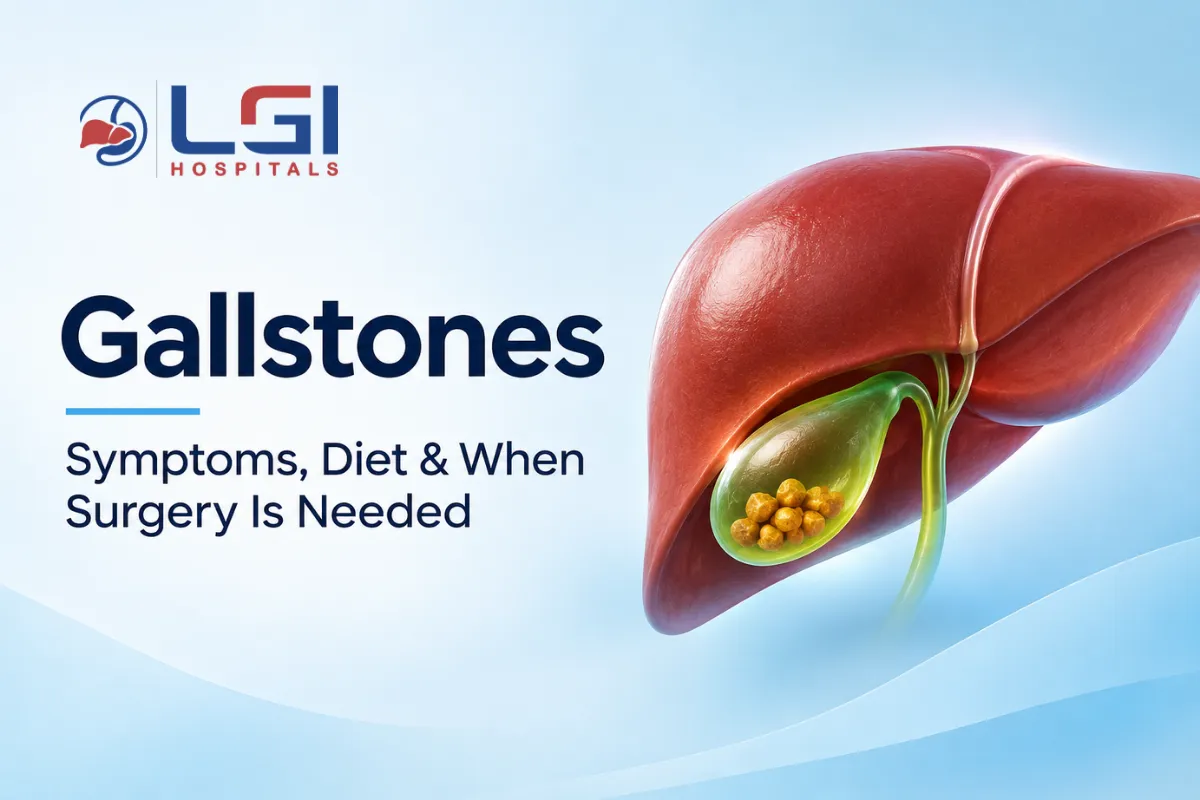
- Gallstones are hard deposits that form inside the gallbladder, a small pouch under the liver that stores bile.
- The classic symptom is pain in the upper right or upper middle abdomen, often after a fatty meal or at night, lasting from 30 minutes to a few hours.
- Most gallstones cause no symptoms and usually do not need surgery unless specific risk factors are present.
- Gallstones that cause pain or complications are usually treated with laparoscopic (keyhole) gallbladder removal.
- Diet cannot dissolve stones, but it can reduce attacks while you plan treatment.
What are gallstones?
The gallbladder stores bile, a digestive juice made by the liver. When you eat, especially fatty food, the gallbladder squeezes bile into the intestine to help digest fat.
If the bile contains too much cholesterol or bilirubin, or if the gallbladder does not empty well, the bile can harden into stones. Stones can be as small as a grain of sand or as large as a golf ball, and a person may have one stone or hundreds.
Types of gallstones
- Cholesterol stones: the most common type, linked to obesity, diabetes and diet.
- Pigment stones: made of bilirubin, more common in people with blood disorders, liver cirrhosis or bile infections.
- Mixed stones: a combination of both, commonly seen in Indian patients.
Who is more likely to get gallstones?
- Women, especially during or after pregnancy or while on hormone therapy
- People over 40
- People who are overweight, especially with fat around the abdomen
- People with diabetes or high triglycerides
- People who lose weight very fast (crash diets, long fasting, or after bariatric surgery)
- People with a family history of gallstones
- People with liver cirrhosis or blood disorders such as sickle cell disease or thalassaemia
Gallstone symptoms: what does gallbladder pain feel like?
When a stone temporarily blocks the outlet of the gallbladder, it causes biliary colic. Typical features:
- Steady, severe pain in the upper right abdomen or the centre of the upper abdomen, just below the breastbone
- Pain that may spread to the right shoulder blade or back
- Pain that starts after a heavy or oily meal, or wakes you up at night
- Pain that lasts from about 30 minutes to a few hours, then settles
- Nausea or vomiting during the attack
- Bloating, belching and indigestion (these are common and not specific to gallstones)
Many people mistake gallbladder pain for gas, acidity or even a heart problem. If the pain is new, severe or comes with breathlessness or sweating, get checked immediately.
Silent gallstones: do they need surgery?
Most people with gallstones never have symptoms. These are called silent (asymptomatic) gallstones. Studies that followed such patients for years found that only about 15–25% develop pain over 10 years, and serious complications occur in less than 1% per year.
International guidelines, including the World Gastroenterology Organisation and the American Academy of Family Physicians, therefore do not routinely recommend surgery for silent gallstones. Instead, your doctor will usually advise watchful waiting and seeing a doctor if symptoms start.
However, your surgeon may advise removing the gallbladder even without symptoms if you have:
- A very large stone (more than 3 cm)
- A gallbladder polyp larger than 1 cm
- A calcified (“porcelain”) gallbladder or gallbladder wall thickening that needs evaluation
- Stones in the bile duct (common bile duct stones)
- Sickle cell disease or certain other blood disorders
- A long distance from emergency care, or a planned major surgery or transplant
Long-standing gallstones are a known risk factor for gallbladder cancer, which is more common in some parts of India. This is one reason a specialist, not just a scan report, should decide whether your stones need removal.
How are gallstones diagnosed?
| Test | What it shows |
| Abdominal ultrasound | The first and most reliable test for gallbladder stones. Quick, painless and radiation-free. |
| Liver function test (LFT) | Raised bilirubin or liver enzymes can suggest a stone blocking the bile duct. |
| Blood count and amylase/lipase | Signs of infection (cholecystitis) or gallstone pancreatitis. |
| MRCP | A special MRI that shows stones in the bile duct without any procedure. |
| EUS (Endoscopic Ultrasound) | Detects very small bile duct stones that other scans can miss. |
| ERCP | Mainly a treatment: removes stones from the bile duct through an endoscope. |
Gallbladder stone treatment
1. Laparoscopic cholecystectomy (keyhole gallbladder removal)
For gallstones that cause pain or complications, removing the gallbladder is the standard and permanent treatment. Removing only the stones is not done, because new stones usually form again in the same gallbladder.
At LGI Hospitals, the operation is done laparoscopically, through 3-4 small cuts, under general anaesthesia. Most patients:
- Walk the same day and start a light diet soon after surgery
- Go home within about 1–2 days
- Return to desk work in about 1–2 weeks (heavy lifting takes longer)
2. ERCP for bile duct stones
If a stone has slipped into the bile duct, it can cause jaundice, infection or pancreatitis. These stones are usually removed by ERCP, an endoscopic procedure, before or around the time of gallbladder surgery.
3. Medicines to dissolve stones
A medicine called ursodeoxycholic acid (UDCA) can slowly dissolve small cholesterol stones in a few carefully selected patients. It takes many months, works only for certain stones, and stones often come back once the medicine is stopped. It is not a substitute for surgery in most people with symptoms. Take it only under a doctor’s advice.
What about home remedies and “gallbladder flushes”?
Apple cider vinegar, olive oil with lemon juice, and similar “flushes” have no scientific evidence of removing gallstones. The green lumps some people pass after a flush are usually clumps of oil and juice, not stones. Delaying treatment for these remedies can lead to complications such as infection or pancreatitis.
When gallstones become an emergency
Go to an emergency department or call LGI Hospitals right away if you have:
- Abdominal pain lasting more than 5–6 hours, or pain that keeps getting worse
- Fever with chills along with abdominal pain (possible gallbladder or bile duct infection)
- Yellow eyes or skin, dark urine or pale stools (possible bile duct blockage)
- Severe upper abdominal pain spreading to the back with repeated vomiting (possible gallstone pancreatitis)
Gallstone diet: what to eat and what to avoid
Food cannot dissolve gallstones. But the right eating pattern can reduce painful attacks while you wait for treatment, and help prevent new stones.
| Eat more of | Limit or avoid |
| Vegetables, fruits, salads | Deep-fried snacks: samosa, kachori, pakoda, vada |
| Whole grains: jowar, bajra, brown rice, whole-wheat roti, oats | Heavy gravies with lots of oil, butter, ghee or cream |
| Dal, sprouts, low-fat curd, paneer in small amounts | Full-fat dairy, malai, rich sweets |
| Grilled, steamed or boiled fish and chicken | Red meat, processed meat, fast food |
| Small amounts of healthy oil (groundnut, mustard, rice bran) | Large heavy meals late at night |
| Enough water through the day | Crash diets and long fasting |
Practical tips:
- Eat regular, moderate meals. Skipping meals and then eating a large meal is a common trigger for an attack.
- Lose extra weight slowly, about 0.5–1 kg a week. Rapid weight loss can actually cause new stones.
- Note which foods trigger your pain and avoid them until treatment.
- Wedding season and festivals bring heavy, oily meals. If you know you have gallstones, eat smaller portions and avoid fried food late at night.
Life after gallbladder removal
You can live a completely normal life without a gallbladder. The liver keeps making bile; it simply flows directly into the intestine instead of being stored.
Some people have loose stools or bloating after fatty meals for a few weeks. This usually improves as the body adjusts. A low-fat diet in the first few weeks, then a gradual return to normal food, works for most patients.
FAQs
Rarely. Very small stones may pass into the intestine, but this can also cause a blockage on the way. Most stones stay in the gallbladder for life.
Size alone does not decide surgery. Any stone that causes symptoms usually needs treatment. In people without symptoms, stones larger than 3 cm are one of the reasons doctors may advise removal.
Laparoscopic cholecystectomy is one of the most commonly performed abdominal operations and is very safe when done by an experienced team. Planned surgery is safer than emergency surgery after complications develop.
Silent stones are usually just monitored. Medicines can dissolve a few small cholesterol stones, but stones often return. For stones that cause pain, surgery is the reliable treatment.
Small amounts are usually fine for most people. What matters more is the total amount of fat in a meal. If a particular food triggers pain, avoid it until treatment.
Yes. Pregnancy hormones slow gallbladder emptying. Most pregnant women with stones are managed with diet and monitoring, and surgery, if needed, is planned carefully with the obstetrician.
A gastroenterologist or surgical gastroenterologist (GI surgeon). At LGI Hospitals, both specialists work together, so your scan, tests, ERCP (if needed) and surgery are handled under one roof.
Gallstone treatment at LGI Hospitals, Nagpur
LGI Hospitals is a dedicated digestive and liver hospital in Nagpur. Our gastroenterologists and surgical gastroenterologists evaluate gallstones with ultrasound, MRCP and EUS, treat bile duct stones with ERCP, and perform laparoscopic gallbladder removal, so you do not need to visit different centres for each step.
If your ultrasound report shows gallstones, or you have pain after meals, book a consultation with our team to know whether you need surgery or just monitoring.
Disclaimer: This article is for general information and does not replace a consultation with a qualified doctor.
References
- National Institute for Health and Care Excellence (NICE). Gallstone disease: diagnosis and management (CG188).
- World Gastroenterology Organisation. Practice Guideline: Asymptomatic Gallstone Disease.
- American Academy of Family Physicians. When is surgery indicated in patients with asymptomatic cholelithiasis? Am Fam Physician. 2014;89(6):468–470.
- National Institute of Diabetes and Digestive and Kidney Diseases (NIDDK). Gallstones: Symptoms, Causes, Diagnosis and Treatment.
- Tokyo Guidelines 2018: diagnostic criteria and management of acute cholecystitis and cholangitis.