
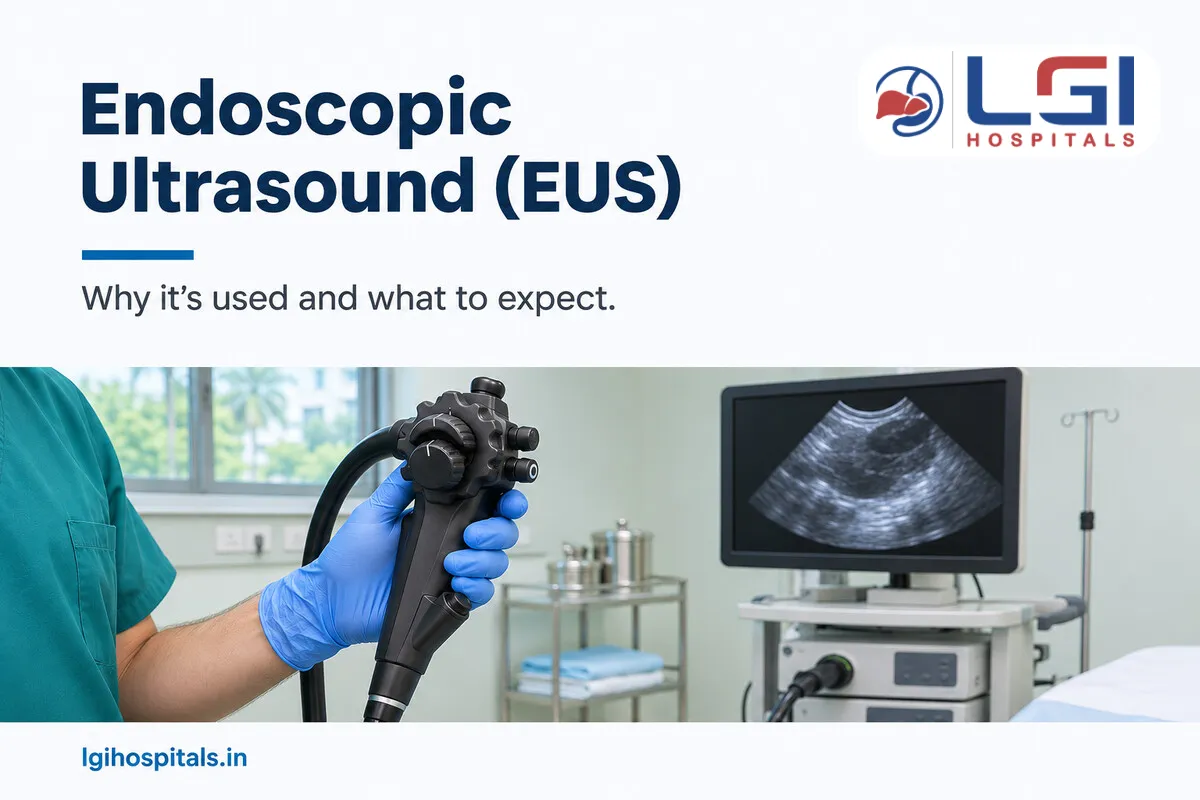
EUS, or Endoscopic Ultrasound, is a medical procedure that combines endoscopy and ultrasound imaging to examine the digestive tract and nearby organs.
It helps doctors obtain detailed images of structures such as the pancreas, bile ducts, gallbladder and gastrointestinal tract. In selected cases, it can also guide tissue sampling through a technique called EUS-guided biopsy.
Endoscopic Ultrasound is included among the advanced gastroenterology services listed by LGI Hospitals, Nagpur.
But what is an EUS test, how is it performed, and when might a doctor recommend it? This guide explains the procedure in simple terms.
What Is the Full Form of EUS?
EUS stands for Endoscopic Ultrasound, also known as Endoscopic Ultrasonography.
It combines two technologies:
- Endoscopy: A flexible tube with a camera is used to examine the digestive tract.
- Ultrasound: High-frequency sound waves create images of internal organs and surrounding structures.
A small ultrasound probe is attached to the end of a specialised endoscope. This allows doctors to examine the digestive tract walls and nearby organs from inside the body.
Unlike conventional abdominal ultrasound, which uses an external probe, EUS places the ultrasound probe inside the digestive tract to obtain closer images of selected structures.
What Is EUS Used For?
EUS may be recommended when doctors need detailed information about digestive organs or abnormalities identified during earlier investigations.
1. Evaluating Pancreatic Conditions
EUS can provide detailed images of the pancreas and help evaluate:
- Pancreatic cysts.
- Pancreatic masses.
- Certain pancreatic tumours.
- Changes associated with chronic pancreatitis.
- Pancreatic duct abnormalities.
For more information about pancreatic inflammation, read LGI’s guide to pancreatitis treatment and evaluation.
2. Examining Bile Duct Abnormalities
EUS may help investigate suspected bile duct stones, narrowing and other abnormalities involving the biliary system.
The findings help doctors decide whether further treatment is needed. For example, if EUS confirms a bile duct stone, it is usually removed with ERCP, a treatment-focused procedure explained later in this guide.
3. Evaluating Gastrointestinal Abnormalities
EUS can help examine certain abnormalities involving the oesophagus, stomach and rectum.
It may provide information about the depth of a lesion and nearby lymph nodes, depending on the location and clinical requirement.
4. Assessing Pancreatic Cysts
Pancreatic cysts are fluid-filled structures that may be identified through imaging.
EUS can help examine their internal features. In selected cases, fluid sampling may be performed to support further evaluation.
Not all pancreatic cysts require treatment. Their management depends on individual clinical findings.
What Is an EUS-Guided Biopsy?
EUS-guided biopsy is a technique in which ultrasound images help guide a fine needle towards a selected abnormal area.
The needle passes through the endoscope to collect tissue or fluid for laboratory examination.
It may be considered for selected:
- Pancreatic masses.
- Pancreatic cystic lesions.
- Gastrointestinal wall abnormalities.
- Enlarged or suspicious lymph nodes.
- Other lesions near the digestive tract.
Two commonly used sampling techniques are:
- FNA: Fine-Needle Aspiration.
- FNB: Fine-Needle Biopsy.
A biopsy is not necessary for every EUS examination. The doctor decides whether tissue sampling is appropriate.
How Does an EUS Procedure Work?
An EUS examination generally involves the following steps:
- Preparation: The patient follows fasting and medication instructions.
- Sedation: Sedation is commonly used for upper gastrointestinal EUS.
- Endoscope insertion: The doctor gently passes the specialised endoscope through the mouth.
- Ultrasound examination: The probe generates images of the digestive tract and nearby organs.
- Additional sampling: A biopsy may be performed if clinically required.
For selected lower gastrointestinal examinations, the endoscope may be introduced through the rectum.
The duration depends on the examination and whether additional procedures are performed.
How to Prepare for an EUS Test
Preparation depends on the type of EUS and whether a biopsy or therapeutic procedure is planned.
Patients may be instructed to:
- Avoid food and drinks for a specified period before the examination.
- Inform the doctor about all current medicines.
- Discuss blood-thinning medications and diabetes medicines.
- Report previous reactions to sedation or anaesthesia.
- Share information about allergies and existing medical conditions.
- Arrange for a responsible adult to accompany you to the hospital and take you home if sedation is planned.
Do not stop or adjust prescribed medication without medical instructions.
The treating team will provide the exact preparation requirements.
What Happens After EUS? Recovery and Aftercare
After the examination, patients are monitored in a recovery area until the effects of sedation have worn off sufficiently. The doctor or nurse will give written discharge instructions before you leave.
Common, temporary effects: A mild sore throat, bloating or a feeling of fullness from the air used during the procedure, and drowsiness are common. These usually settle within a few hours to a day or two.
Going home safely after sedation
Sedation can affect judgement, reaction time and memory for the rest of the day, even if you feel alert. For this reason:
- A responsible adult must accompany you home. You should not leave alone or travel by yourself by taxi, auto-rickshaw or public transport. Ideally, someone should stay with you for the rest of the day and night.
- Do not drive for 24 hours. This includes cars, two-wheelers and bicycles. Your doctor may advise a longer period depending on the medicines used.
- Avoid risky or important tasks for 24 hours. Do not operate machinery, drink alcohol, sign legal or financial documents, make important decisions or care for young children or dependants on your own.
- Rest for the remainder of the day. Most people can return to normal activities the next day unless advised otherwise.
Eating, drinking and medicines
- If a numbing throat spray was used, wait until normal sensation returns before eating or drinking, as instructed by the team.
- Most patients can return to their usual diet the same day unless the doctor gives specific instructions.
- Restart blood thinners, diabetes medicines and other regular medicines only as your doctor advises, especially if a biopsy or other procedure was performed.
Results and follow-up
If a biopsy has been performed, the sample is sent for laboratory examination. The results may take additional time.
The doctor explains the findings and recommends further investigation or follow-up when necessary.
Patients should follow all post-procedure instructions provided by the healthcare team.
Warning Symptoms After EUS: When to Seek Medical Help
Serious complications after EUS are uncommon. Contact your doctor immediately, or go to the nearest emergency department, if you develop any of the following:
- Severe or worsening abdominal pain.
- Severe pain in the neck, chest or back.
- Fever or chills.
- Vomiting, especially vomiting blood or material that looks like coffee grounds.
- Black, tarry stools or blood in the stool.
- Difficulty breathing or swallowing.
- Dizziness, fainting or unusual weakness.
These symptoms may indicate bleeding, infection, pancreatitis or, rarely, a perforation. The risk is higher after a biopsy, cyst drainage or other EUS-guided treatment. Keep your discharge summary and the hospital contact number easily available for the first few days.
What Are the Benefits and Limitations of EUS?
Potential benefits
- Provides detailed images of the digestive tract and nearby organs.
- Helps examine the pancreas and bile ducts.
- Can evaluate selected cysts, masses and lesions.
- Allows guided tissue sampling when required.
- Supports certain specialised endoscopic interventions.
Limitations
- Requires specialised equipment and trained professionals.
- May involve sedation and procedural preparation.
- Does not provide a definitive diagnosis in every case.
- Some findings require additional imaging or laboratory testing.
- May not be suitable for every patient.
EUS results should always be interpreted alongside the patient’s medical history and other investigation findings.
What Are the Possible Risks of EUS?
EUS is an established medical procedure, but certain complications are possible.
These may include:
Bleeding: May occur, particularly when tissue sampling or therapeutic intervention is performed.
Infection: Possible with certain interventional procedures, including selected cyst-drainage procedures.
Pancreatitis: Inflammation of the pancreas can occur after certain pancreatic interventions.
Sedation-related complications: Some patients may experience reactions to sedative medications or breathing and circulation-related complications.
Perforation: A tear in the digestive tract wall is rare but potentially serious.
The risks depend on the type of examination, any additional intervention and the patient’s health condition.
For signs that need urgent attention after the procedure, see the warning symptoms section above.
EUS vs Traditional Endoscopy: What Is the Difference?
Both procedures use an endoscope, but their primary purposes are different.
| Feature | Traditional Endoscopy | EUS |
| Main technology | Camera and light | Camera and ultrasound probe |
| Main purpose | Visual examination of the digestive tract lining | Examination of digestive tract walls and nearby organs |
| Pancreas assessment | Limited direct visual access | Detailed ultrasound assessment |
| Tissue sampling | Possible in accessible areas | Can guide sampling of selected deeper lesions |
| Additional applications | Certain diagnostic and therapeutic procedures | Selected diagnostic and therapeutic interventions |
EUS is not a replacement for every conventional endoscopic examination. The choice depends on the clinical question.
EUS vs ERCP: What Is the Difference?
EUS and ERCP are both specialised endoscopic procedures used for the pancreas and bile ducts, but their main roles are different.
EUS (Endoscopic Ultrasound) is mainly used for diagnosis. It combines endoscopy with ultrasound imaging to examine the pancreas, bile ducts and surrounding structures, and it can guide biopsies. In selected cases, it is also used for certain treatments, such as draining fluid collections.
ERCP (Endoscopic Retrograde Cholangiopancreatography) combines endoscopy with X-ray imaging and is primarily used for treatment. It is used to treat problems of the bile and pancreatic ducts, such as removing bile duct stones, opening narrowed or blocked ducts and placing stents.
Because ERCP carries a higher risk of complications, such as pancreatitis, it is not usually the first test used only to diagnose a problem. For diagnosis alone, doctors generally prefer less invasive tests such as MRCP (a type of MRI scan) or EUS. ERCP is usually performed when treatment is likely to be needed during the same procedure.
In practice, the two procedures often work together. For example, EUS may confirm a suspected bile duct stone, and ERCP may then be used to remove it.
| Feature | EUS | ERCP |
| Imaging used | Ultrasound | X-ray with contrast dye |
| Primary role | Mainly diagnosis, with selected treatments | Mainly treatment |
| Typical uses | Assessing the pancreas, bile ducts, cysts and masses; guiding biopsies | Removing bile duct stones, placing stents, opening narrowed ducts |
| Risk profile | Diagnostic EUS generally carries a low risk | Higher risk; pancreatitis is the most common complication |
Explore ERCP services at LGI Hospitals to understand the procedure further.
You can also read the hospital’s educational guide: What Is ERCP? Meaning, Procedure, Uses and Recovery.
Frequently Asked Questions
1. What is the full form of EUS in medical terminology?
EUS stands for Endoscopic Ultrasound. It combines endoscopy and ultrasound imaging to examine the digestive tract and nearby organs.
2. Is EUS the same as a regular ultrasound?
No. A regular ultrasound uses an external probe, while EUS uses an ultrasound probe attached to an endoscope introduced into the digestive tract.
3. Can EUS detect pancreatic cancer?
EUS can help identify suspicious pancreatic abnormalities and guide tissue sampling. A definitive diagnosis requires appropriate clinical and pathological evaluation.
4. Is an EUS biopsy always required?
No. Some EUS examinations are performed for imaging alone. A biopsy is considered when additional tissue or fluid analysis is clinically required.
5. Does EUS require anaesthesia?
Many upper gastrointestinal EUS examinations are performed using intravenous sedation. The approach depends on the examination and the patient’s medical condition.
6. How long does an EUS procedure take?
The duration varies according to the examination and whether additional interventions are performed.
7. Is EUS used for pancreatitis?
EUS may help evaluate selected pancreatic abnormalities and changes associated with chronic pancreatitis. The decision depends on the clinical findings.
8. Can I drive after EUS?
No. If you received sedation, do not drive a car, two-wheeler or bicycle for 24 hours, or for longer if your doctor advises. A responsible adult should accompany you home.
9. When should I contact a doctor after EUS?
Seek medical help immediately for severe or worsening abdominal, chest or neck pain, fever, vomiting (especially blood), black or bloody stools, or difficulty breathing or swallowing.
10. Is ERCP the same as EUS?
No. EUS is mainly a diagnostic test that uses ultrasound, while ERCP uses X-ray imaging and is primarily used to treat bile and pancreatic duct problems, such as removing stones or placing stents.
Endoscopic Ultrasound at LGI Hospitals, Nagpur
Endoscopic Ultrasound is included in the advanced gastroenterology services listed by LGI Hospitals, Nagpur.
The hospital’s published service information also includes EUS-guided FNAC and biopsy, as well as selected EUS-guided therapeutic procedures.
Patients who have been advised to undergo EUS can discuss their medical history, previous imaging reports and procedure-related questions with a qualified gastroenterologist.
Explore Gastroenterology services at LGI Hospitals for further information.
References
1. American Society for Gastrointestinal Endoscopy (ASGE). Understanding EUS (Endoscopic Ultrasonography). asge.org
2. Forbes N, Coelho-Prabhu N, Al-Haddad MA, et al. Adverse events associated with EUS and EUS-guided procedures. ASGE Standards of Practice Committee. Gastrointestinal Endoscopy. 2022. asge.org
3. National Institute of Diabetes and Digestive and Kidney Diseases (NIDDK). Endoscopic Retrograde Cholangiopancreatography (ERCP). niddk.nih.gov
4. Mayo Clinic. Endoscopic ultrasound. mayoclinic.org
5. MedlinePlus, U.S. National Library of Medicine. Endoscopic ultrasound. medlineplus.govMedical Disclaimer: This article is intended for general educational and informational purposes only. It does not replace professional medical advice, diagnosis or treatment. The need for EUS, its suitability and associated risks depend on individual clinical assessment. Consult a qualified medical practitioner for advice regarding your health concerns.