
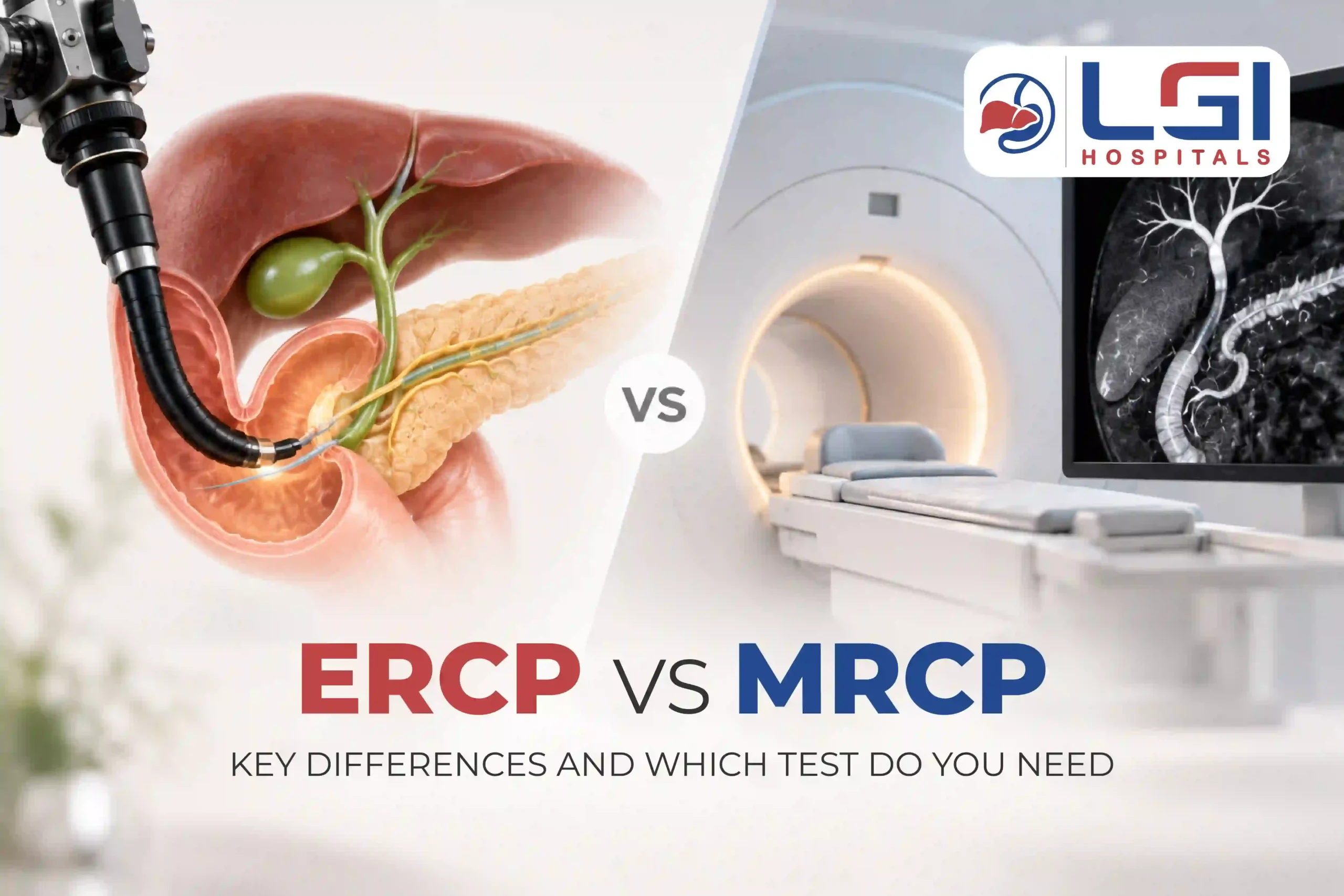
When doctors suspect a problem involving the bile ducts or pancreatic ducts, they may recommend MRCP or ERCP. Although these tests have similar names, they serve different purposes.
MRCP is a non-invasive MRI scan used to examine the bile and pancreatic ducts, while ERCP is an endoscopic procedure primarily used to treat problems affecting these ducts. MRCP helps doctors investigate conditions such as suspected bile duct stones or narrowing. ERCP can allow a specialist to remove certain stones, place stents and treat selected obstructions.
The choice between ERCP and MRCP depends on the patient’s symptoms, test results and whether treatment is likely to be needed.
ERCP vs MRCP: Key Differences at a Glance
| Feature | MRCP | ERCP |
| Full form | Magnetic Resonance Cholangiopancreatography | Endoscopic Retrograde Cholangiopancreatography |
| Type | MRI scan | Endoscopic procedure using X-ray guidance |
| Main purpose | Investigate and diagnose duct abnormalities | Primarily treat selected duct problems |
| Instruments passed through the mouth | No | Yes |
| Sedation | Usually not required for a routine scan | Generally required |
| Ionising radiation | No | Yes |
| Can remove bile duct stones? | No | Yes, when appropriate |
| Can place a stent? | No | Yes |
| Recovery | Usually minimal | Depends on the procedure and recovery |
| Main consideration | Cannot provide treatment | Invasive and associated with procedural complications |
In simple terms, MRCP helps doctors understand what may be happening inside the ducts, while ERCP allows them to treat certain problems when an intervention is needed.
What Is MRCP?
MRCP stands for Magnetic Resonance Cholangiopancreatography. It is a specialised MRI examination that produces detailed images of the biliary system and pancreatic ducts. Doctors may recommend an MRCP scan when blood tests or an ultrasound suggest a problem but do not provide enough information to establish the diagnosis.
What Can an MRCP Scan Detect?
MRCP can help investigate:
- Bile duct stones: Stones lodged in the common bile duct.
- Biliary strictures: Narrowing that may interfere with the flow of bile.
- Duct obstruction: A suspected blockage that may be associated with jaundice or abnormal liver tests.
- Pancreatic duct abnormalities: Changes affecting the ducts that carry pancreatic secretions.
- Structural abnormalities: Selected cysts and variations in the anatomy of the biliary or pancreatic system.
How Is MRCP Performed?
During an MRCP scan, the patient lies on a table that moves into an MRI scanner.
The machine uses a magnetic field and radio waves to create images of internal structures.
The scan is non-invasive and does not use ionising radiation. Many MRCP examinations can be performed without injected contrast, although the protocol depends on the clinical question.
Patients should follow the imaging centre’s preparation instructions and inform the team about implanted devices, metal fragments, previous surgeries and possible pregnancy.
What Are the Limitations of MRCP?
MRCP provides images but cannot remove a stone, open a narrowed duct or place a stent.
It may also miss some very small stones or biliary sludge. If the scan is negative or inconclusive but the doctor still suspects a problem, further evaluation may be needed.
This could include endoscopic ultrasound (EUS) or ERCP, depending on the clinical findings.
What Is ERCP?
ERCP stands for Endoscopic Retrograde Cholangiopancreatography. It combines endoscopy with X-ray imaging to access the bile and pancreatic ducts.
Unlike MRCP, ERCP allows the doctor to perform certain treatments during the procedure. It is primarily used when the clinical findings suggest that an intervention may be necessary.
What Can ERCP Treat?
Depending on the diagnosis, a gastroenterologist may use ERCP to:
- Remove stones from the common bile duct.
- Place stents to help bile or pancreatic fluid drain through narrowed or obstructed ducts.
- Perform a sphincterotomy to facilitate access or treatment at a duct opening.
- Obtain selected tissue samples when indicated.
- Manage certain bile leaks and duct obstructions.
How Is an ERCP Procedure Performed?
ERCP is generally performed in a hospital or specialised endoscopy unit under sedation or anaesthesia.
The doctor passes a flexible endoscope through the mouth into the first part of the small intestine. A thin catheter is then used to access the opening of the bile or pancreatic duct. Contrast dye and fluoroscopy, a type of X-ray imaging, help the doctor examine the ducts.
If treatment is needed, specialised instruments can be used to remove stones, perform a sphincterotomy or place a stent.
The procedure’s duration and recovery depend on its complexity. Some patients return home the same day, while others require a longer observation period or hospital admission.
Learn more about the ERCP procedure at LGI Hospitals.
MRCP vs ERCP for Bile Duct Stones
Bile duct stones are known medically as choledocholithiasis. They occur when stones become lodged in the common bile duct, potentially obstructing the flow of bile.
These stones can cause abdominal pain, jaundice and other complications. An obstruction may also lead to infection or pancreatitis.
When Is MRCP Recommended?
MRCP may be appropriate when:
- Ultrasound or blood tests suggest a bile duct problem, but the diagnosis is uncertain.
- The doctor needs more detailed images of the biliary system.
- Further investigation is needed before deciding whether an invasive procedure is justified.
For patients with an intermediate likelihood of common bile duct stones, the American Society for Gastrointestinal Endoscopy (ASGE) supports MRCP or EUS as diagnostic options, depending on the clinical circumstances.
When Is ERCP Recommended?
ERCP may be recommended when the available evidence strongly indicates a duct problem that needs treatment.
ASGE guidance identifies certain findings that can support proceeding directly to ERCP for suspected common bile duct stones, including a stone seen on imaging, ascending cholangitis, or a combination of elevated bilirubin and bile duct dilation that meets the guideline’s criteria.
The treating team must interpret these findings in the context of the patient’s condition. MRCP is not compulsory before every ERCP.
If a patient has jaundice with fever, severe abdominal pain or other signs of a potentially serious obstruction or infection, prompt medical assessment is important. The appropriate investigation and treatment depend on the clinical situation.
What If MRCP Does Not Detect a Stone?
A negative MRCP does not always exclude every possible duct abnormality, particularly when very small stones are suspected.
If symptoms or blood test results continue to suggest a problem, the gastroenterologist may recommend EUS or further investigation. ERCP may be considered if the findings support a therapeutic procedure.
MRCP vs CT Scan: What Is the Difference?
CT and MRCP have different strengths.
A CT scan provides cross-sectional images of the abdomen and may help investigate a broad range of abdominal conditions and certain complications. MRCP is specifically designed to provide detailed images of the bile and pancreatic ducts.
MRCP does not use ionising radiation, while CT uses X-rays. However, neither examination is universally better than the other. The appropriate test depends on the suspected condition, the information needed and the patient’s circumstances.
Preparation, Recovery and Safety
Preparing for MRCP
Follow the imaging centre’s instructions regarding eating, drinking and medicines. Tell the team about implanted medical devices, metal fragments and possible pregnancy. MRI safety depends on the specific device and scanning conditions, so the imaging team must verify eligibility.
Preparing for ERCP
Before ERCP, the medical team will review the patient’s medical history, medicines, allergies and test results. Inform the doctor about blood-thinning medicines, diabetes medicines and previous reactions to sedation or anaesthesia.
Fasting is generally required. Do not stop prescribed medicines unless instructed by the treating team.
What Should Patients Know About ERCP Safety?
ERCP can be effective, but possible complications include pancreatitis, bleeding, infection and perforation. Sedation or anaesthesia also carries risks.
The ASGE guideline reports adverse events in approximately 6% to 15% of ERCP procedures in the context discussed in its guidance on common bile duct stones. Individual risk varies depending on the patient and the intervention.
After ERCP, patients are monitored during recovery. Seek urgent medical attention if severe or worsening abdominal pain, fever, persistent vomiting, bleeding or other concerning symptoms develop.
What Is the Cost of ERCP and MRCP in India?
The cost of MRCP and ERCP varies between hospitals and depends on the procedure required.
MRCP costs may depend on the imaging facility and examination protocol. ERCP costs may include the procedure, sedation or anaesthesia, hospital observation, specialised instruments, stents and other treatment-related expenses.
A straightforward ERCP and a complex therapeutic procedure can have very different costs. Contact the hospital for an estimate and confirm which services and consumables are included.
The choice between MRCP and ERCP should be based on the clinical indication and the treating gastroenterologist’s recommendation, not cost alone.
Gastroenterology Services at LGI Hospitals, Nagpur
Choosing between MRCP and ERCP requires an assessment of symptoms, blood test results, existing imaging and the likelihood that treatment will be needed.
LGI Hospitals, Nagpur, provides gastroenterology services for patients being evaluated for digestive, biliary and pancreatic conditions. The appropriate investigation and treatment plan should be determined by the treating specialist.
Patients can learn more about ERCP and cholangiopancreatoscopy services at LGI Hospitals and discuss their symptoms and reports with a qualified gastroenterologist.
If you are experiencing jaundice or have been advised to investigate a possible bile duct problem, seek medical advice to understand the cause and appropriate next steps. You can book an appointment at LGI Hospitals for an individual assessment.
FAQs
No. MRCP is not required before every ERCP. If existing imaging and clinical findings strongly indicate a duct problem requiring treatment, the gastroenterologist may recommend ERCP directly. MRCP or EUS may help when the diagnosis is uncertain.
ERCP can remove stones from the common bile duct, but it does not usually remove stones inside the gallbladder itself. Gallbladder stones may require a separate treatment plan, often involving surgery.
Neither test is universally better. MRCP is a non-invasive scan used to investigate the ducts, while ERCP is primarily used when treatment is needed. The appropriate choice depends on the clinical findings.
Yes. Some very small stones or biliary sludge may not be detected. If clinical suspicion remains despite a negative scan, the doctor may recommend EUS or further evaluation.
No. MRCP uses MRI technology and does not use ionising radiation. ERCP uses fluoroscopy, which involves X-rays.
MRCP ek non-invasive MRI scan hai jo bile ducts aur pancreatic ducts ki images banata hai. ERCP ek endoscopic procedure hai jisme doctor zaroorat ke hisaab se bile duct stone nikal sakte hain ya stent laga sakte hain. Kaunsa test karna chahiye, yeh symptoms, reports aur gastroenterologist ki salah par depend karta hai.
The Bottom Line
MRCP and ERCP serve different purposes in evaluating bile duct and pancreatic duct problems. While MRCP helps doctors examine these structures non-invasively, ERCP enables them to treat certain conditions during an endoscopic procedure.
MRCP may be appropriate when more diagnostic information is needed. ERCP may be recommended when the available evidence indicates that treatment is necessary. Neither test is right for every patient, and MRCP is not always required before ERCP.
If your symptoms or reports suggest a bile duct problem, consult a gastroenterologist to understand which investigation or treatment is appropriate for your situation.
Book an Appointment at LGI Hospitals, Nagpur
Medical Disclaimer: This article is intended for general educational purposes and does not replace professional medical advice, diagnosis or treatment. The choice between MRCP, ERCP and other investigations must be made by a qualified healthcare professional based on the patient’s clinical condition.