December in Nagpur means weddings, office parties and New Year celebrations, and for many people, more drinks than usual. Most people assume their liver is fine because they “only drink socially” or “only on weekends”. But alcohol-related liver damage usually builds up silently for years before it causes any symptoms.
In this guide, the liver specialists at LGI Hospitals explain how alcohol harms the liver, the warning signs to watch for, the three stages of alcoholic liver disease, and how much your liver can recover if you stop.
Quick answer
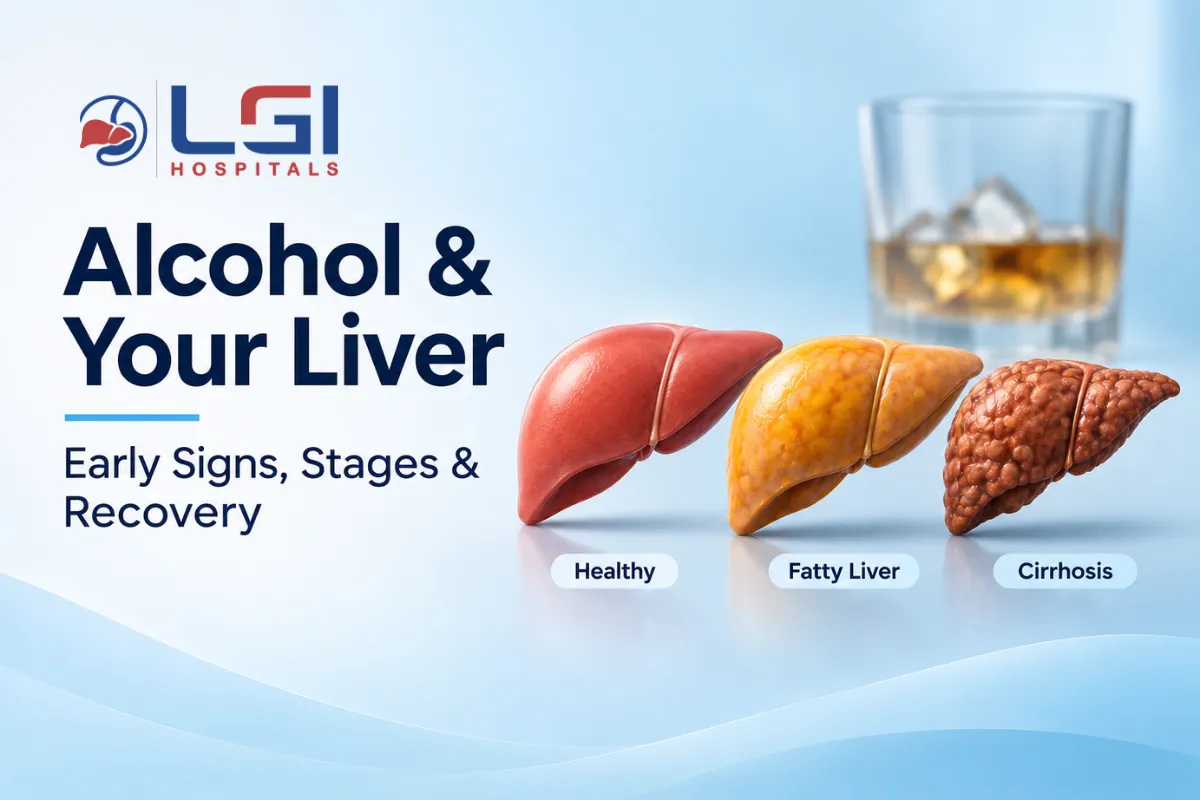
- Alcohol damages the liver in three stages: fatty liver → alcoholic hepatitis → cirrhosis.
- The first stage is usually reversible if you stop drinking. Cirrhosis is permanent, but stopping alcohol still slows damage and improves survival.
- Early liver damage often has no symptoms. Blood tests and a Fibroscan can detect it before you feel unwell.
- According to the World Health Organization, there is no completely safe level of alcohol for health.
- Yellow eyes, swelling of the abdomen or legs, vomiting blood, black stools or confusion need urgent medical care.
How does alcohol damage the liver?
The liver breaks down almost all the alcohol you drink. During this process, it produces a toxic chemical called acetaldehyde, which damages liver cells and triggers inflammation. Alcohol also makes the liver store fat.
With every heavy drinking session, the liver repairs itself. But when drinking continues for months and years, repeated injury leads to scarring (fibrosis). Over time, the scars replace healthy tissue and the liver can no longer work properly. This end stage is cirrhosis.
Doctors now often call this condition alcohol-associated liver disease (ALD).
How much alcohol is too much?
In January 2023, the World Health Organization stated that no level of alcohol consumption is safe for health. Alcohol is classified as a Group 1 carcinogen, and the risk of harm rises with the amount you drink.
For the liver specifically, risk depends on how much, how often and for how many years you drink. To understand your own intake, it helps to count in standard drinks. One standard drink contains about 10 grams of pure alcohol. Common Indian drinks:
| Drink | Approximate alcohol content | Standard drinks |
| 1 peg (30 ml) whisky, rum, vodka (42.8%) | ≈ 10 g | 1 |
| 1 “large” (60 ml) peg | ≈ 20 g | 2 |
| 1 bottle (650 ml) regular beer (5%) | ≈ 26 g | 2.5 |
| 1 bottle (650 ml) strong beer (8%) | ≈ 41 g | 4 |
| 1 glass (150 ml) wine (12%) | ≈ 14 g | 1.4 |
| 1 quarter bottle (180 ml) spirit | ≈ 61 g | 6 |
A person who drinks three large pegs every evening is taking in about 6 standard drinks a day, or around 40+ a week. Drinking at this level for years puts the liver at serious risk.
Factors that increase your risk
- Binge drinking: a lot of alcohol on one occasion, even if only on weekends
- Being a woman: women develop liver damage at lower amounts of alcohol
- Overweight, diabetes or fatty liver: alcohol and metabolic fatty liver together damage the liver faster
- Hepatitis B or C infection
- Smoking and family history of liver disease
- Drinking on an empty stomach or poor nutrition
The 3 stages of alcoholic liver disease
| Stage | What happens | Can it reverse? |
| 1. Alcohol-associated fatty liver | Fat builds up in liver cells. Usually no symptoms. Seen as “fatty liver” on ultrasound. | Yes. Often returns to normal within a few weeks of stopping alcohol. |
| 2. Alcoholic hepatitis | Inflammation of the liver. Can be mild, or severe and life-threatening, with jaundice and fever. | Mild cases can improve with complete, permanent abstinence. Severe cases need hospital care. |
| 3. Alcoholic cirrhosis | Permanent scarring. The liver shrinks and hardens and can fail. | No, but stopping alcohol slows further damage, reduces complications and improves survival. |
These stages often overlap, and not everyone goes through them in order. Some people develop cirrhosis without ever having an attack of hepatitis.
Early signs of alcohol liver damage
In the early stages, most people feel completely normal. When symptoms appear, they are often vague:
- Tiredness and low energy
- Loss of appetite, nausea
- Dull discomfort or heaviness in the upper right abdomen
- Unexplained weight loss or loss of muscle
- Frequent acidity, bloating or loose stools after drinking
This is why routine tests matter for anyone who drinks regularly, even if they feel fine.
Warning signs of advanced liver disease (see a doctor urgently)
- Yellow eyes or skin (jaundice), dark urine
- Swelling of the abdomen (ascites) or legs
- Vomiting blood or passing black, tar-like stools
- Confusion, excessive sleepiness or change in behaviour (hepatic encephalopathy)
- Easy bruising or bleeding from gums or nose
- Red, spider-like blood vessels on the chest and shoulders; reddish palms
- Severe itching
Vomiting blood, black stools or confusion are medical emergencies. Go to the nearest emergency department immediately.
Tests to check liver damage from alcohol
| Test | Why it is done |
| Liver function test (LFT) | In alcohol-related damage, SGOT (AST) is often about twice the SGPT (ALT). GGT is also commonly raised. |
| Complete blood count | Large red blood cells (high MCV) and low platelets can point to alcohol use and advanced liver disease. |
| PT/INR and albumin | Show how well the liver is making proteins, a measure of liver function. |
| Ultrasound abdomen | Shows fatty liver, liver size and shape, signs of cirrhosis and fluid in the abdomen. |
| Fibroscan | Measures liver stiffness (scarring) and fat (CAP score) without a needle. |
| Hepatitis B and C tests | Rule out viral infections that add to liver damage. |
| Endoscopy | In cirrhosis, checks for swollen veins in the food pipe (varices) that can bleed. |
Important: a normal LFT does not always mean a healthy liver. Some people with significant scarring or even cirrhosis have near-normal LFT results. A Fibroscan gives a clearer picture.
Can the liver recover after quitting alcohol?
The liver has a remarkable ability to heal, but how much it recovers depends on the stage:
- Fatty liver: usually reverses within a few weeks to two months of stopping alcohol completely.
- Mild alcoholic hepatitis: liver tests often improve over weeks to months with complete abstinence.
- Fibrosis: early scarring can partly improve over months to years without alcohol.
- Cirrhosis: scarring does not go away, but people who stop drinking have fewer complications and live significantly longer than those who continue.
A safety warning before you stop
If you have been drinking heavily every day, do not stop suddenly on your own. Alcohol withdrawal can cause shaking, sweating, hallucinations, seizures and a dangerous condition called delirium tremens. Speak to a doctor first. Withdrawal can be managed safely with medical supervision.
Treatment for alcoholic liver disease
- Stopping alcohol completely: the single most important treatment at every stage. Counselling, support groups and medicines that reduce cravings can help. Your doctor will choose medicines that are safe for your liver.
- Nutrition: many people with alcohol-related liver disease are undernourished. Adequate protein, regular meals, and a small bedtime snack (in cirrhosis) help the liver and muscles.
- Treating alcoholic hepatitis: severe cases need hospital admission, and some patients benefit from specific medicines such as steroids under specialist care.
- Managing cirrhosis complications: medicines for fluid build-up, endoscopic banding of varices, and treatment of confusion and infections.
- Vaccination: hepatitis A and B vaccines protect an already weak liver.
- Liver transplant: for advanced liver failure, in people who have stopped drinking and meet medical criteria.
Common myths about alcohol and the liver
| Myth | Fact |
| “Beer and wine are safe; only hard liquor damages the liver.” | It is the amount of pure alcohol that matters, not the type of drink. |
| “I only drink on weekends, so my liver is fine.” | Binge drinking on weekends can be as harmful as daily drinking. |
| “Liver detox drinks and supplements will clean my liver.” | No drink or supplement cancels the effect of alcohol. Some herbal products can themselves harm the liver. |
| “My LFT is normal, so there is no damage.” | LFT can be normal even with scarring. A Fibroscan may be needed. |
| “Eating well while drinking protects the liver.” | Food slows absorption but does not prevent liver damage. |
Tips for the party and wedding season
- The safest choice for your liver is not to drink. If you do drink, set a limit before you start and stick to it.
- Alternate every drink with water or a non-alcoholic drink.
- Avoid “bottoms up” rounds and drinking games that encourage binge drinking.
- Do not drink on an empty stomach, and avoid oily, fried snacks with drinks.
- Do not combine alcohol with painkillers like paracetamol in high doses, or with other medicines, without asking your doctor.
- If you have fatty liver, diabetes, hepatitis B or C, or a previous liver problem, avoid alcohol completely.
FAQs
Fatty liver can develop after just days to weeks of heavy drinking. Cirrhosis usually develops after many years of regular heavy drinking, but the timeline varies widely from person to person.
A single heavy session can cause temporary fat build-up in the liver. Repeated binges are what lead to lasting damage.
Alcohol can raise SGPT, but in alcohol-related damage SGOT is usually higher than SGPT. Other causes such as fatty liver, hepatitis or medicines should also be checked.
In early-stage damage, liver tests often start improving within a few weeks. Your doctor may repeat tests after 4–8 weeks of complete abstinence.
Cirrhosis cannot be reversed, but it can be managed. Stopping alcohol, good nutrition and regular follow-up can keep many people stable for years. In advanced cases, a liver transplant may be an option.
A gastroenterologist or hepatologist (liver specialist). At LGI Hospitals, our liver team can assess your liver with blood tests, Fibroscan and endoscopy, and plan treatment.
Liver care at LGI Hospitals, Nagpur
LGI Hospitals is a dedicated liver and digestive care hospital in Nagpur. Our gastroenterologists and hepatologists diagnose and treat alcohol-related liver disease at every stage, from fatty liver to cirrhosis and its complications, with in-house Fibroscan, endoscopy and intensive care.
If you drink regularly and have not had your liver checked, or if you have any warning signs, book a liver check-up with our team. Early detection gives your liver the best chance to recover.
Disclaimer: This article is for general information and does not replace a consultation with a qualified doctor. If you are struggling to stop drinking, please speak to a doctor or counsellor.
References
- World Health Organization (Regional Office for Europe). No level of alcohol consumption is safe for our health. News release, 4 January 2023.
- NHS inform (Scotland). Alcohol-related liver disease.
- Cleveland Clinic. Alcohol-associated liver disease.
- Patel R, Mueller M. Alcoholic Liver Disease. StatPearls. NCBI Bookshelf (NBK546632).
- Crabb DW, et al. Diagnosis and Treatment of Alcohol-Associated Liver Diseases: 2019 Practice Guidance from the American Association for the Study of Liver Diseases (AASLD). Hepatology. 2020.