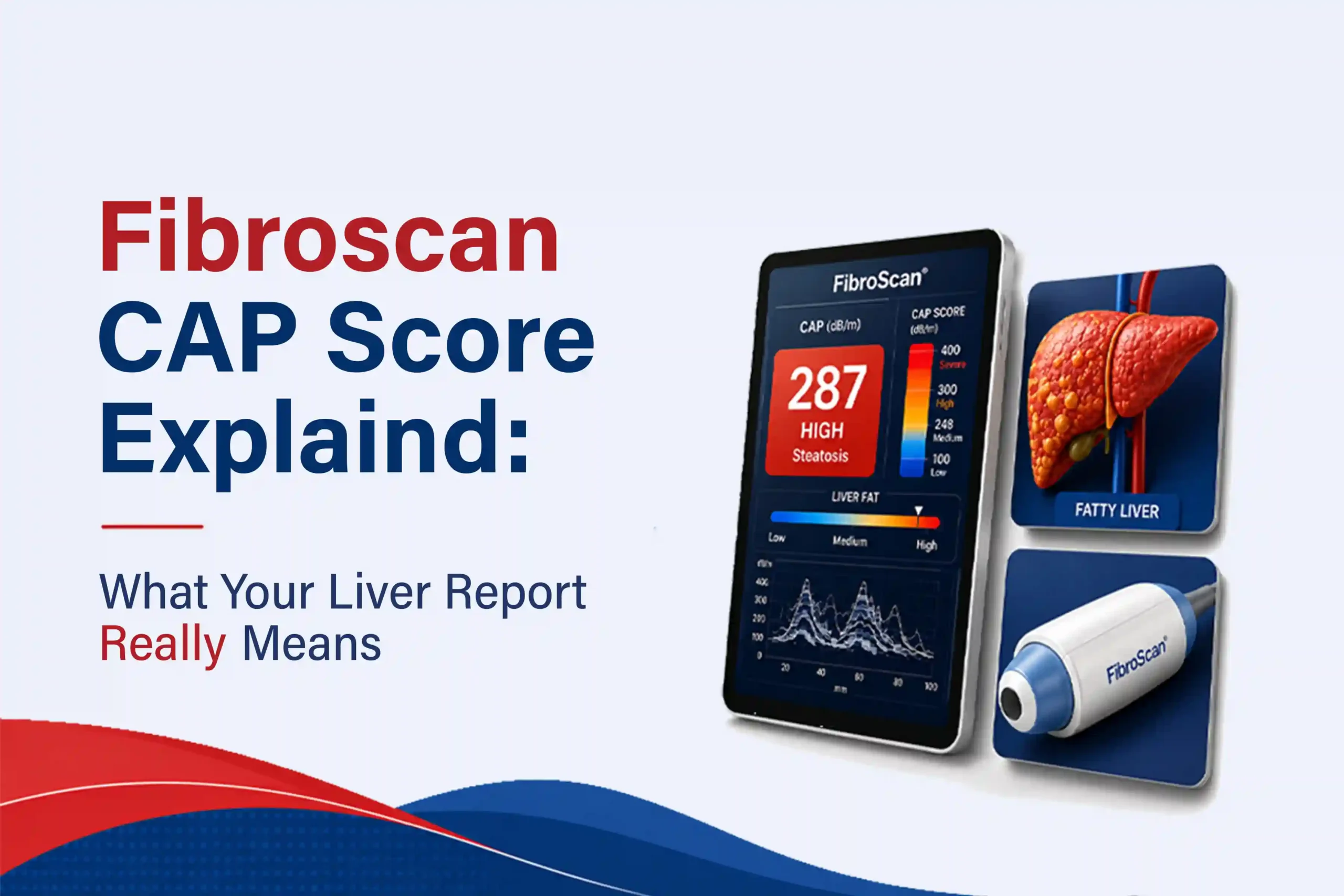
You just walked out of the diagnostic centre holding a printed Fibroscan report. Somewhere on that page is a number labelled CAP Score, another labelled kPa, and a few abbreviations that mean nothing to you yet. If you searched for “Fibroscan Cap Score” hoping for a simple explanation, you are not alone. Every week, patients and family members bring these reports into a gastroenterologist’s clinic with the same worried question: what do these numbers actually mean, and should I be concerned? The good news is that a Fibroscan report looks far more intimidating than it actually is. Once each value is explained on its own, the full picture becomes easy to follow.
What Is a Fibroscan?
Fibroscan is a specialised, non-invasive ultrasound-based test that assesses two things at once: the amount of fat in the liver and the degree of stiffness or scarring in liver tissue. It works using a technology called vibration-controlled transient elastography, which sends a gentle, painless vibration through the liver and measures how fast it travels. Fat slows and scatters the sound wave differently than stiff, scarred tissue does, which is how the machine calculates two separate readings from a single scan.
Doctors commonly recommend a Fibroscan for people with fatty liver disease, unexplained abnormal liver function tests, obesity, type 2 diabetes, long-standing alcohol use, or chronic viral hepatitis. It is also used to track how liver health changes over time, since the test is quick, painless, and can be repeated without any radiation exposure.
Quick Answer
The Fibroscan CAP Score measures how much fat has built up in your liver, expressed in decibels per metre (dB/m). Liver stiffness, measured separately in kilopascals (kPa), reflects how much scarring or fibrosis may be present. Doctors never look at these numbers in isolation. They interpret CAP Score and kPa together, alongside your symptoms, blood tests, and medical history, before drawing any conclusion about your liver health.
What Is a Fibroscan CAP Score?
CAP stands for Controlled Attenuation Parameter. It is the value on your report that estimates the amount of fat present in the liver, a condition known as hepatic steatosis or fatty liver.
CAP Score is measured in decibels per metre (dB/m), and in general, a higher number suggests a greater degree of fat accumulation. It is important to understand that CAP Score reflects fat content only. It says nothing about scarring, inflammation, or long-term liver damage on its own, which is why it must always be read alongside the second Fibroscan value: Liver Stiffness.
What Is Liver Stiffness (kPa)?
Liver Stiffness is the second core reading on a Fibroscan report, measured in kilopascals (kPa). While CAP Score looks at fat, Liver Stiffness looks at scarring, a process doctors call fibrosis.
Fibrosis develops when the liver repeatedly repairs itself after inflammation or fat-related stress, gradually replacing healthy tissue with firmer, less flexible scar tissue. Left unaddressed over many years, advanced fibrosis can progress to cirrhosis, a more serious stage where scarring is extensive and liver function becomes affected. This is exactly why doctors measure stiffness in kPa: a stiffer liver on the scan generally corresponds to a greater degree of underlying fibrosis.
Difference Between Fibroscan CAP Score and kPa
| Parameter | CAP Score | Liver Stiffness (kPa) |
| Purpose | Estimates fat content in the liver | Estimates scarring or fibrosis |
| Unit | Decibels per metre (dB/m) | Kilopascals (kPa) |
| What it measures | Hepatic steatosis (fatty liver) | Degree of liver fibrosis |
| Indicates | Fat accumulation severity | Structural stiffness from scar tissue |
| Clinical use | Screening and monitoring fatty liver | Staging fibrosis and monitoring progression |
How Doctors Read a Fibroscan Cap Score Report
A Fibroscan cap score report is one piece of a larger clinical picture, not a standalone diagnosis. Before reaching any conclusion, a gastroenterologist typically reviews the report step by step, in the context of the person sitting in front of them:Presenting symptoms and general health history
Existing medical conditions such as diabetes or obesity
Liver Function Tests (LFTs) and other relevant blood work
Abdominal ultrasound findings
Fibroscan CAP Score and Liver Stiffness values
History of alcohol consumption
Screening for viral hepatitis where relevant
No single number from this list is used in isolation. A gastroenterologist correlates all of these findings together, which is why two patients with a similar CAP Score can sometimes receive very different advice depending on their overall clinical picture.
How to Understand Your Fibroscan Report
To make this practical, consider a sample report most patients might recognise:
CAP Score: 285 dB/m
Liver Stiffness: 7.2 kPa
A CAP Score in this range may point toward a mild to moderate degree of fat in the liver, and a stiffness reading in this range may suggest early-stage changes worth monitoring. These figures are shared here purely as an example of how the two values appear together on a report. They are not meant to be compared against your own results or used to self-diagnose. Reference ranges can vary between machines, labs, and patient profiles, which is exactly why the same report can mean different things for different people. The only reliable way to understand what your specific numbers mean is a proper clinical evaluation.
Understanding Fibroscan IQR
Alongside Fibroscan CAP Score and kPa, most reports also list an IQR value, which stands for Interquartile Range. IQR reflects how consistent the ten individual measurements taken during your scan were with one another.
A lower IQR generally indicates a more reliable, technically sound reading, while a higher IQR can mean the measurements varied more than expected, sometimes due to factors like body build or how the scan was positioned. Before interpreting CAP Score or kPa values at all, doctors first check the IQR to judge whether the scan quality is trustworthy. A report with a high IQR may need to be repeated before any conclusions are drawn from it.
What Are Bad Fibroscan Results?
There is no single number that universally qualifies as a bad Fibroscan result. What matters is the overall pattern and how it fits with everything else known about the patient.
An elevated CAP Score generally points toward a higher degree of fat accumulation in the liver
Increased Liver Stiffness generally points toward a greater degree of fibrosis
Both values must be interpreted alongside blood tests, ultrasound, and clinical history, not by themselves
Two reports that look identical on paper can lead to different conclusions once a gastroenterologist factors in the patient’s full history. This is why searching for what a specific number “means” online rarely gives an accurate answer for an individual case.
Can CAP Score Improve?
For many people, particularly those with fatty liver related to lifestyle factors, CAP Score can improve over time with sustained changes. Commonly recommended approaches include:
• Gradual, sustainable weight management
• Regular physical activity
• A balanced, home-style diet lower in refined sugar and processed food
• Better control of blood sugar levels in those with diabetes
• Reducing or avoiding alcohol consumption
Work with your doctor to plan these changes gradually, since the right approach depends on your overall health, existing conditions, and current Fibroscan findings.
When Should You See a Gastroenterologist?
Consider booking a consultation with a gastroenterologist if any of the following apply to you:
- A higher-than-expected CAP Score on your report
- A higher-than-expected Liver Stiffness (kPa) reading
- Fatty liver identified on an ultrasound
- Abnormal Liver Function Test (LFT) results
- A diagnosis of diabetes
- Obesity or a rapidly increasing weight trend
- Persistent symptoms such as fatigue or discomfort in the upper right abdomen
- A family history of liver disease
At LGI Hospitals, our gastroenterology team evaluates each Fibroscan report in the context of your complete health profile, so you receive guidance that is specific to you rather than a generic interpretation of a single number.
Myth vs Fact
Myth: A high CAP Score means you already have cirrhosis.
Fact: CAP Score measures fat, not scarring. Cirrhosis is assessed through Liver Stiffness and other clinical findings, not CAP Score alone.
Myth: A normal Liver Stiffness reading rules out fatty liver completely.
Fact: You can have a normal kPa value alongside a raised CAP Score, since fat and fibrosis are measured separately.
Myth: Fibroscan replaces the need for blood tests.
Fact: Fibroscan is one part of the assessment. Liver Function Tests and other blood work remain essential for a complete picture.
Myth: Only people who drink alcohol need to worry about their Fibroscan results.
Fact: Non-alcoholic fatty liver disease is common in people with diabetes, obesity, or sedentary lifestyles, regardless of alcohol use.
Myth: A high IQR means your liver condition is severe.
Fact: IQR reflects the reliability of the scan itself, not the severity of liver disease.
Myth: Fibroscan results cannot improve once they are abnormal.
Fact: CAP Score in particular can improve with sustained lifestyle changes, especially when addressed early.
Common Mistakes to Avoid
- Googling your exact numbers and self-diagnosing without clinical context
- Ignoring an abnormal report because you feel fine
- Assuming CAP Score alone confirms or rules out a diagnosis
- Starting any medication or supplement without medical advice
- Delaying a consultation while trying to interpret the report yourself
Decision Table: What Your Report May Suggest
| If your report shows | Possible meaning | What doctors usually do next |
| Normal CAP Score, normal kPa | Low likelihood of significant fat or fibrosis at this time | Routine monitoring and lifestyle advice |
| Raised CAP Score, normal kPa | Fat accumulation present, fibrosis not yet significant | Lifestyle guidance and periodic follow-up |
| Raised CAP Score, raised kPa | Fat accumulation along with possible early fibrosis | Further evaluation with blood tests and closer monitoring |
| High kPa regardless of CAP Score | Possible advanced fibrosis needing detailed assessment | Additional investigations and specialist consultation |
| High IQR on any reading | Scan reliability may be affected | Repeat scan before interpreting results |
When to Seek Emergency Care
Review your Fibroscan report during a routine outpatient visit, but seek urgent medical attention immediately if you experience symptoms related to liver disease. Seek emergency care immediately if you experience:
• Vomiting blood
• Black or tarry stools
• Severe or rapidly worsening jaundice (yellowing of the skin or eyes)
• Confusion or unusual drowsiness
• Severe abdominal swelling
These symptoms should never wait for a scheduled appointment. Head to the nearest emergency department without delay.
FAQs
You can often lower your CAP score gradually by maintaining a healthy weight, exercising regularly, eating a balanced diet, controlling your blood sugar, and reducing alcohol intake. Your doctor will monitor your progress with follow-up Fibroscan scans over the coming months.
A CAP Score around 280 dB/m generally falls in a range that may suggest mild to moderate fat accumulation in the liver, though exact reference ranges can vary. Your doctor should interpret this figure alongside your Liver Stiffness reading and overall health profile, rather than viewing it in isolation.
Doctors generally associate cirrhosis with markedly elevated Liver Stiffness readings, but they determine the exact threshold based on the underlying liver condition and the equipment used. A gastroenterologist confirms this through Liver Stiffness values combined with blood tests, imaging, and clinical assessment, never through a single number alone.
Doctors generally associate higher kPa readings with more advanced fibrosis stages, including Stage 3, but they determine the precise cutoff based on clinical guidelines and individual patient factors. Staging fibrosis accurately requires a doctor’s interpretation rather than comparing your kPa value against a number found online.
FInal Thoughts
Once your doctor explains your CAP Score, Liver Stiffness, and IQR individually, you can understand your Fibroscan report much more easily. CAP Score reflects fat, kPa reflects scarring, and IQR reflects how reliable the scan itself was. Your doctor should interpret all of these values together, and you should not try to diagnose yourself based on search results.
If your Fibroscan report has left you with more questions than answers, consulting a gastroenterologist can help you understand what the numbers mean in the context of your overall liver health. At LGI Hospitals, specialists evaluate Fibroscan results alongside your symptoms, medical history, blood tests, and imaging to recommend the most appropriate next steps. Book an appointment for a personalised liver health assessment.
Medical Disclaimer
This article provides general educational information only and should not replace professional medical advice, diagnosis, or treatment. Your gastroenterologist will interpret your Fibroscan results, including CAP Score, Liver Stiffness, and IQR, together with your clinical examination, medical history, and other relevant investigations to provide an accurate diagnosis and treatment plan. Please consult a doctor before making any decisions regarding your liver health.