
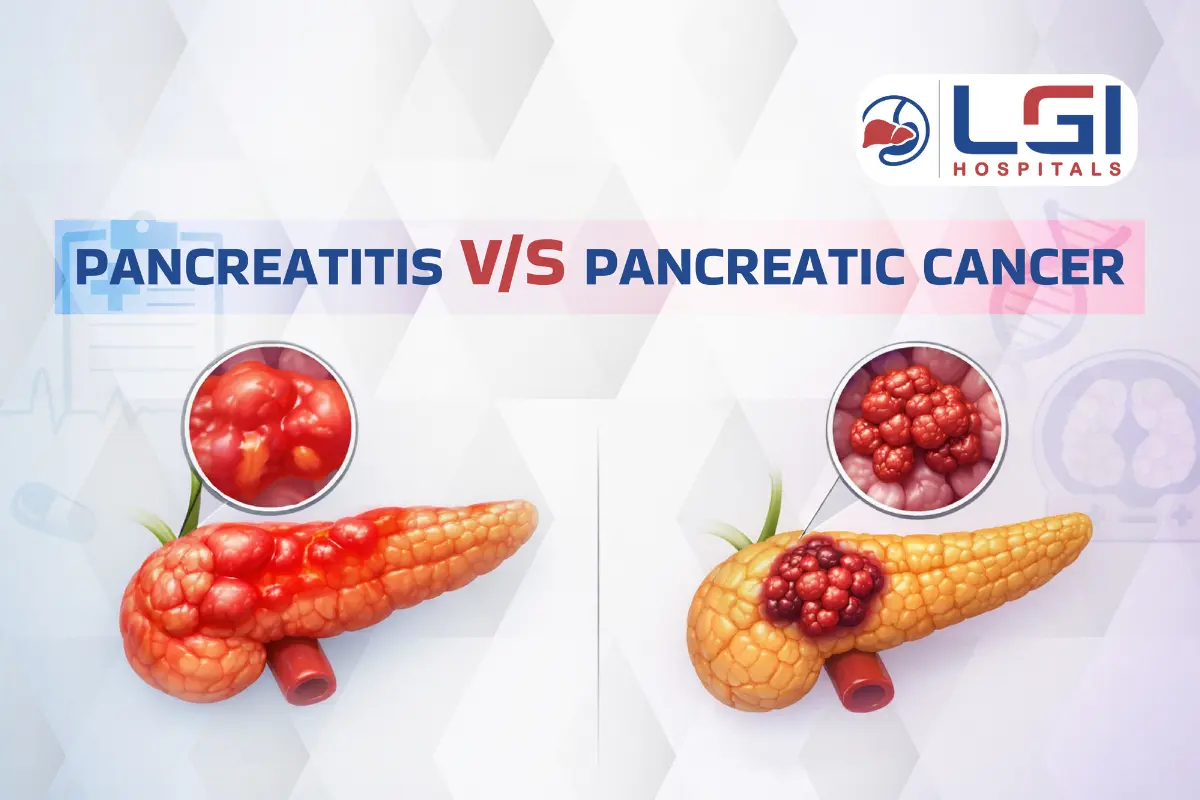
Pancreatitis and pancreatic cancer can present with surprisingly similar symptoms in their early stages. Both can cause upper abdominal pain, weight loss, and digestive changes. This overlap leads to one of the most dangerous delays in oncology: patients with pancreatic cancer initially being managed as pancreatitis, with the true diagnosis emerging only when the disease has progressed to an advanced stage. Understanding the differences between these two conditions is not a matter of academic interest. It is a matter of clinical urgency.
This blog clearly explains what pancreatitis and pancreatic cancer are, how their symptoms compare, what specific features distinguish one from the other, and which red flags should trigger immediate specialist evaluation rather than watchful waiting.
The distinction between these two conditions requires imaging, blood work, and specialist assessment. This guide is designed to help patients understand what to ask, what to watch for, and when to escalate their concern.
Quick Overview
- Pancreatitis: Inflammation of the pancreas, which can be acute (sudden) or chronic (long-term), caused most commonly by gallstones or alcohol
- Pancreatic cancer: Malignant tumor in the pancreas, most commonly pancreatic ductal adenocarcinoma, typically presenting late with poor prognosis if not caught early
- Shared symptoms: Upper abdominal pain, weight loss, nausea, jaundice
- Key difference: Pancreatitis tends to present acutely with elevated enzyme levels; pancreatic cancer tends to present with painless jaundice, progressive weight loss, and normal or mildly elevated enzymes
- Critical point: Chronic pancreatitis itself increases the risk of developing pancreatic cancer over time
What is Pancreatitis?
Pancreatitis is inflammation of the pancreas. It occurs in two forms:
Acute Pancreatitis
Sudden inflammation where digestive enzymes are activated within the pancreas before they reach the intestine, causing the organ to self-digest. Most cases are caused by gallstones or alcohol. Acute pancreatitis can range from mild, resolving in a few days with supportive treatment, to severe with life-threatening complications including organ failure and infected necrosis.
Chronic Pancreatitis
Long-term inflammation that progressively scars and destroys pancreatic tissue. It leads to permanent loss of both digestive enzyme production and insulin secretion over time. Chronic pancreatitis is most commonly caused by prolonged alcohol use, though genetic and autoimmune causes also exist.
Visit for understanding and treating Pancreatitis
What is Pancreatic Cancer?
Pancreatic cancer is a malignant tumor arising from pancreatic tissue. Over 85 percent of cases are pancreatic ductal adenocarcinoma (PDAC), arising from the cells lining the pancreatic ducts. It is the 12th most common cancer globally but one of the deadliest due to late-stage diagnosis in most cases. The five-year survival rate for all stages combined remains below 12 percent, but rises significantly for stage 1 diagnosis.
Risk factors include age over 60, smoking, chronic pancreatitis, obesity, family history, and BRCA gene mutations.
Know about: Gastrointestinal Cancers including Pancreatic Cancer
Symptom Comparison: Pancreatitis vs Pancreatic Cancer
| Symptom | Acute Pancreatitis | Chronic Pancreatitis | Pancreatic Cancer |
| Abdominal pain | Sudden, severe, upper abdomen | Chronic, recurring, upper abdomen | Gradual, dull, upper abdomen or back |
| Pain radiation to back | Yes, common | Yes, common | Yes, particularly mid-back |
| Jaundice | Uncommon unless bile duct blocked | Possible in late stages | Common, often painless |
| Weight loss | Moderate, due to not eating | Progressive, due to malabsorption | Significant, unexplained |
| Nausea and vomiting | Prominent | Intermittent | Mild to moderate |
| Oily stools | Uncommon acutely | Common in advanced disease | Common if exocrine function affected |
| New-onset diabetes | Uncommon acutely | Common over time | Can be an early or presenting sign |
| Fever | Common in acute cases | Uncommon | Uncommon unless duct is obstructed |
| Blood enzyme elevation | Marked (amylase and lipase) | Mild or absent in burnt-out disease | Often absent or mildly elevated |
Key Distinguishing Features
The Nature of Pain
Pancreatitis pain is typically acute in onset, severe, and associated with nausea and vomiting. Patients often describe it as the worst abdominal pain they have experienced. It is usually constant, worsened by eating, and may be relieved somewhat by leaning forward.
Pancreatic cancer pain tends to develop gradually, is often described as a dull ache in the upper abdomen or back, and may not be severe in early stages. Many patients with early pancreatic cancer have minimal or no pain at all.
Jaundice
Painless jaundice, where the skin and eyes turn yellow without associated severe abdominal pain or fever, is a classic presentation of pancreatic cancer involving the head of the pancreas compressing the bile duct. This specific presentation should be investigated urgently for malignancy.
Jaundice in pancreatitis, when it occurs, is typically accompanied by significant abdominal pain and fever, and is caused by a gallstone blocking the bile duct rather than a tumor.
Enzyme Levels
In acute pancreatitis, serum amylase and lipase are markedly elevated, often 3 times the upper limit of normal or higher. In pancreatic cancer, enzyme levels are frequently normal or only mildly elevated because the tumor does not typically cause the same degree of pancreatic self-digestion.
Weight Loss Pattern
Both conditions cause weight loss but through different mechanisms. In pancreatitis, weight loss is primarily due to pain-related reduced oral intake and digestive insufficiency. In pancreatic cancer, weight loss is often more profound, occurs even when appetite seems adequate, and is a direct metabolic consequence of the malignancy.
Red Flags That Suggest Cancer Rather Than Pancreatitis
These specific features should prompt urgent investigation for malignancy rather than a working diagnosis of pancreatitis:
- Painless jaundice in a patient over 50 with no prior gallstone history
- Profound unexplained weight loss exceeding 5 to 8 kg over a few weeks
- New-onset diabetes in a non-obese adult over 50 with no family history
- Upper abdominal mass felt on physical examination
- Normal or near-normal enzyme levels with CT findings showing a pancreatic mass
- Chronic pancreatitis that suddenly worsens or changes character after years of stability
- Persistent bile duct dilation on imaging without an obvious benign cause
Discover: 7 warning symptoms of pancreas problems you should never ignore
Diagnostic Tests and What They Show
| Test | Pancreatitis Findings | Pancreatic Cancer Findings |
| Serum amylase and lipase | Markedly elevated | Usually normal or mildly elevated |
| CT scan abdomen | Pancreatic swelling, peripancreatic fat stranding, necrosis | Mass lesion, ductal dilation, vascular involvement |
| MRI / MRCP | Ductal anatomy, necrosis characterization | Mass lesion, bile duct obstruction |
| Endoscopic Ultrasound | Pancreatic texture changes, pseudocysts | Mass lesion, biopsy capability |
| CA 19-9 tumor marker | May be mildly elevated | Often significantly elevated in cancer |
| Biopsy (EUS-guided) | Not typically needed | Required for definitive cancer diagnosis |
The Important Link: Chronic Pancreatitis as a Cancer Risk Factor
Chronic pancreatitis is recognized as an independent risk factor for pancreatic cancer. The cumulative risk of pancreatic cancer in patients with chronic pancreatitis is significantly higher than in the general population, increasing over time with disease duration. This means that patients with a longstanding chronic pancreatitis diagnosis should have periodic surveillance imaging to monitor for the development of a superimposed malignancy.
Key Takeaways
Pancreatitis and pancreatic cancer are distinct conditions but their symptomatic overlap creates real diagnostic challenges. The most important thing a patient can do is not attribute persistent, changing, or worsening symptoms to a known condition without updated imaging and specialist evaluation.
To summarize:
- Acute pancreatitis presents suddenly with severe pain and markedly elevated enzymes; pancreatic cancer tends to present gradually with painless jaundice and normal enzyme levels
- Painless jaundice, profound weight loss, and new-onset diabetes in older adults are red flags for cancer, not pancreatitis
- Chronic pancreatitis increases the long-term risk of pancreatic cancer and requires periodic surveillance
- Diagnosis requires imaging, specialist evaluation, and in the case of cancer, tissue biopsy
- Early detection of pancreatic cancer significantly improves outcomes
If you are managing chronic pancreatitis or have developed new symptoms on a background of existing pancreatic disease, a gastroenterology review at LGI Hospitals, Dhantoli, Nagpur with updated imaging is worth discussing with your treating doctor.
Medical Disclaimer: This article discusses two serious pancreatic conditions, one inflammatory and one malignant. It is written for general informational purposes only and must not be used to self-diagnose or differentiate between pancreatitis and cancer. Pancreatic cancer is a life-threatening condition where early diagnosis significantly affects survival outcomes. If you are experiencing jaundice, unexplained weight loss, persistent abdominal or back pain, or any sudden change in symptoms, seek immediate medical evaluation. Only a qualified gastroenterologist using appropriate imaging and laboratory investigations can make an accurate diagnosis. Do not delay specialist assessment based on reassuring symptom overlap with less serious conditions.
FAQ
Q1. Can pancreatitis turn into pancreatic cancer? Pancreatitis itself does not directly transform into pancreatic cancer. However, chronic pancreatitis is a recognized risk factor for pancreatic cancer, meaning people with long-standing chronic pancreatitis have a statistically higher lifetime risk of developing pancreatic cancer compared to the general population.
Q2. How do doctors tell apart pancreatitis and pancreatic cancer? The key tools are imaging (CT scan or MRI), blood tests including enzyme levels and CA 19-9 tumor marker, and endoscopic ultrasound which can also guide biopsy. Clinical features including the nature of jaundice, weight loss pattern, and enzyme levels help direct the investigation toward the more likely diagnosis.
Q3. Is pancreatic cancer always painful? No. Early pancreatic cancer is frequently painless or causes only mild, vague discomfort. This is one reason it is so often diagnosed late. Significant pain tends to develop when the tumor is large enough to involve surrounding nerves or cause bile duct obstruction.
Q4. What is the CA 19-9 test and is it reliable for pancreatic cancer? CA 19-9 is a blood tumor marker that is elevated in many cases of pancreatic cancer. However, it is not a screening test. It can be elevated in benign conditions including pancreatitis and biliary disease, and it may be normal in early pancreatic cancer. It is used alongside imaging and clinical findings rather than as a standalone diagnostic tool.
Q5. What is painless jaundice and why is it serious? Painless jaundice is yellowing of the skin and eyes without associated severe abdominal pain. It typically occurs when a tumor in the head of the pancreas compresses the bile duct, causing bilirubin to back up into the bloodstream. Because it often indicates an obstructing mass rather than inflammation, painless jaundice in a middle-aged or older adult is considered a red flag for pancreatic cancer until proven otherwise.Q6. How often should someone with chronic pancreatitis be screened for cancer? There is no universal consensus on the exact screening interval, but most gastroenterology guidelines recommend periodic imaging every 1 to 2 years for patients with long-standing chronic pancreatitis, particularly those with additional risk factors like smoking, family history, or hereditary pancreatitis. This should be discussed and individualized with a treating gastroenterologist.