
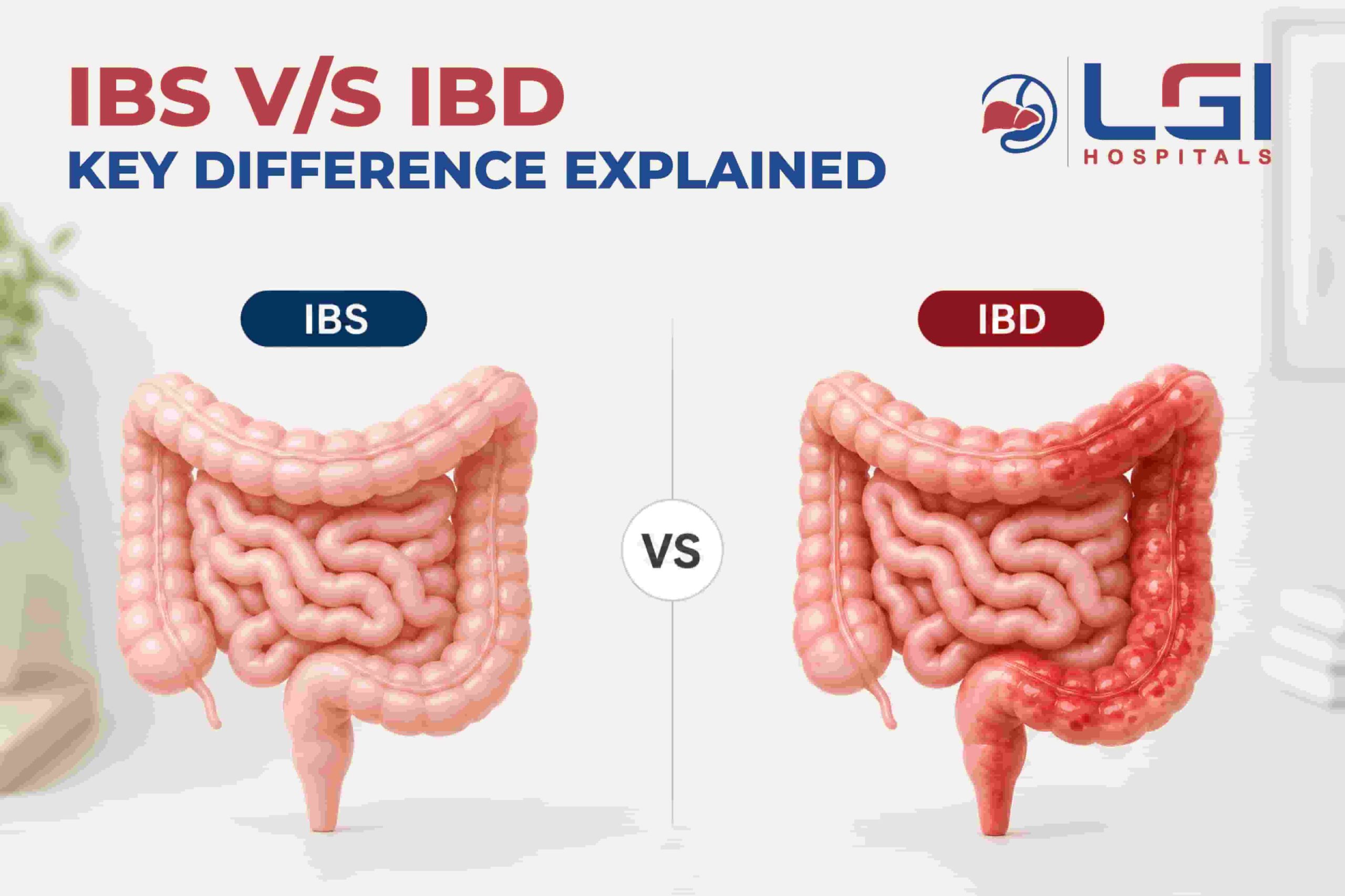
Quick Answer: IBS (Irritable Bowel Syndrome) is a functional disorder with no visible tissue damage, while IBD (Inflammatory Bowel Disease, including Crohn’s disease and ulcerative colitis) involves actual chronic inflammation and damage to the intestinal lining. They share overlapping symptoms but differ significantly in diagnosis, long-term risk, and treatment approach. Only a gastroenterologist can confirm which one you have.
What is IBS?
IBS is a functional gut disorder affecting how the intestines move and communicate with the nervous system, without visible structural damage on standard diagnostic tests. It causes real, sometimes significant discomfort, but does not damage the intestinal tissue itself. For a detailed breakdown of IBS symptoms and whether the condition is curable, read our complete guide on IBS symptoms in men and women.
What is IBD?
IBD is an umbrella term for two main conditions:
- Crohn’s Disease: Can affect any part of the digestive tract, from mouth to anus, often in patches, and can involve the full thickness of the intestinal wall.
- Ulcerative Colitis: Affects only the colon and rectum, typically involving continuous inflammation of the innermost lining.
Both involve genuine chronic inflammation, visible on colonoscopy and biopsy, and can lead to complications like strictures, fistulas, or increased colorectal cancer risk over time if not properly managed.
Overlapping Symptoms That Cause Confusion
Both conditions can cause abdominal pain, bloating, and altered bowel habits. This is exactly why the distinction matters and should never be assumed without proper testing. At LGI Hospitals, we frequently see patients who have self-diagnosed IBS based on online symptom checkers, only to find on evaluation that they actually have early-stage IBD that needs very different treatment.
Key Differences Between IBS and IBD
| Feature | IBS | IBD |
| Tissue damage | None visible on tests | Visible inflammation and damage |
| Diagnosis method | Symptom pattern, ruling out other causes | Colonoscopy, biopsy, imaging confirm it directly |
| Blood in stool | Uncommon | Common |
| Weight loss | Uncommon | Common, especially during flares |
| Fever | Uncommon | Can occur during active flares |
| Night symptoms | Rarely wakes you up | Often wakes you from sleep |
| Long-term cancer risk | Not increased | Increased with certain types and duration |
| Primary treatment | Diet, lifestyle, symptom-targeted medication | Anti-inflammatory and immune-modulating medication, sometimes surgery |
Doctor’s Tip: If you are experiencing blood in your stool, unexplained weight loss, or symptoms that wake you from sleep, do not assume it is IBS. These are classic IBD red flags that require prompt evaluation by a gastroenterologist.
Warning Signs That Suggest IBD, Not IBS
The following red flags point toward IBD and warrant prompt evaluation rather than assuming symptoms are just IBS:
- Blood in stool
- Unexplained weight loss
- Persistent fever alongside digestive symptoms
- Waking up at night specifically due to digestive symptoms
- Symptoms starting for the first time after age 50
- A family history of IBD
If you are experiencing any of these warning signs, the specialists at LGI Hospitals, Nagpur recommend booking an evaluation as soon as possible rather than trying to manage symptoms on your own.
Can You Have Both IBS and IBD?
Yes, this is actually fairly common. Some patients with IBD continue experiencing IBS-like symptoms even when inflammation is well-controlled on treatment. This can make ongoing symptom management more complex and requires distinguishing between active disease symptoms and functional overlay symptoms.
A gastroenterologist with experience in both IBS and IBD can help differentiate the two and tailor treatment accordingly. Dietary strategies like the IBS diet chart may still play a role in managing the functional overlay, but only alongside proper IBD treatment.
Why Getting the Right Diagnosis Matters
Because IBD involves real tissue damage with long-term complications, treating it as if it were IBS with diet and lifestyle changes alone can allow inflammation to progress unchecked. Conversely, over-testing or over-treating IBS as if it were IBD leads to unnecessary medication exposure.
A proper diagnostic workup, not guesswork based on symptoms alone, is what determines the right path. The gastroenterology team at LGI Hospitals uses a combination of detailed symptom assessment, blood tests, stool tests for inflammatory markers like fecal calprotectin, and colonoscopy when needed to arrive at the correct diagnosis.
FAQs
IBD is generally considered more serious due to its potential for tissue damage, complications, and increased long-term cancer risk. IBS, though genuinely disruptive to quality of life, does not cause structural harm.
Not typically on their own, but if IBS-like symptoms come with any of the warning signs listed above, further evaluation is warranted to rule out IBD.
There is not a single definitive blood test for either condition, but inflammatory markers like elevated CRP or fecal calprotectin can help point toward IBD and prompt further investigation like colonoscopy.
Yes, having a first-degree relative with IBD increases your risk, which is one reason family history is an important part of the diagnostic conversation.
IBS ek functional disorder hai jisme pet ki tissue damage nahi hoti, jabki IBD mein intestine mein asli inflammation aur damage hota hai. IBS ke liye diet aur lifestyle changes kaafi hote hain, lekin IBD ke liye special dawaiyan aur kabhi kabhi surgery ki zaroorat padti hai. Dono ke symptoms same lag sakte hain, isliye sahi diagnosis ke liye gastroenterologist se milna zaroori hai. (आईबीएस एक फंक्शनल डिसऑर्डर है जिसमें आंत की ऊतक क्षति नहीं होती, जबकि आईबीडी में आंत में वास्तविक सूजन और क्षति होती है।)
Key Takeaways
- IBS is a functional disorder with no visible tissue damage, while IBD involves real inflammation and damage.
- Both share overlapping symptoms like abdominal pain, bloating, and altered bowel habits, making self-diagnosis unreliable.
- Red flags like blood in stool, weight loss, fever, and night symptoms suggest IBD and need prompt evaluation.
- IBD treatment focuses on controlling inflammation, while IBS treatment focuses on diet, lifestyle, and symptom management.
- You can have both IBS and IBD at the same time, which requires expert management.
- Only a gastroenterologist can confirm which condition you have through proper diagnostic workup.
To Wrap it Up
IBS and IBD may sound similar and share some symptoms, but they are fundamentally different conditions with very different treatment paths and long-term implications. The most important step you can take is getting a proper diagnosis rather than guessing based on symptoms alone. If you are experiencing persistent digestive symptoms, the gastroenterology team at LGI Hospitals, Nagpur can help you understand exactly what is going on and develop the right treatment plan for your specific condition.
Book Your Consultation at LGI Hospitals →
Medical Disclaime: This article is intended for educational purposes only and does not constitute medical advice, diagnosis, or treatment. Always consult a qualified gastroenterologist for accurate diagnosis and appropriate care.