
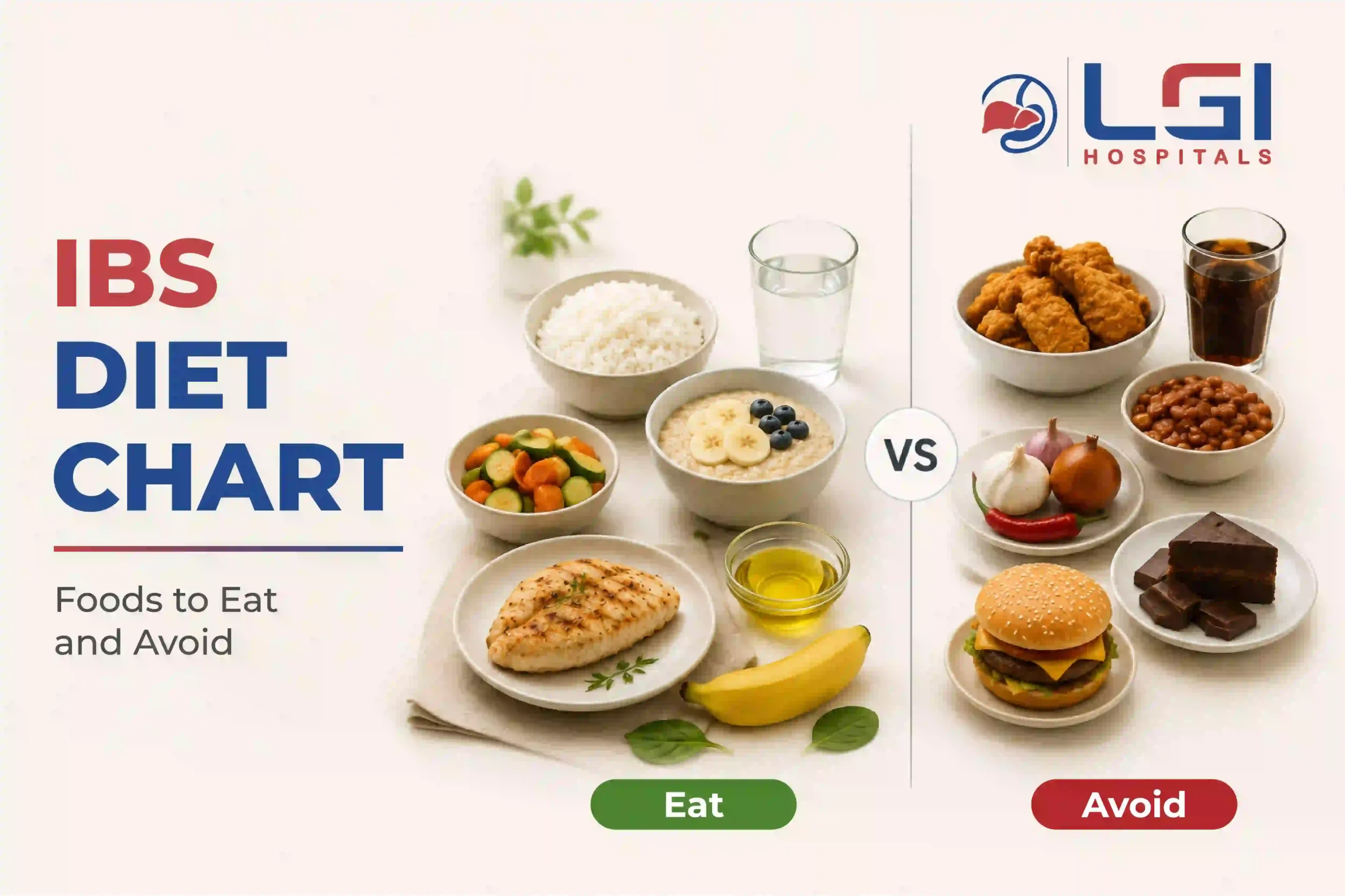
Quick Answer: IBS symptoms often improve with dietary changes, commonly by reducing high-FODMAP foods, caffeine, alcohol, and fatty foods, while increasing soluble fiber and staying well hydrated. However, triggers vary significantly by individual. Dietary changes should be personalized with guidance from a gastroenterologist or dietitian rather than followed as a rigid generic chart.
Understanding FODMAPs
FODMAP stands for Fermentable Oligosaccharides, Disaccharides, Monosaccharides, and Polyols. These are a group of short-chain carbohydrates that are poorly absorbed in the small intestine and can be fermented by gut bacteria, producing gas and drawing water into the intestine.
For many IBS patients, reducing high-FODMAP foods significantly reduces bloating, gas, and abdominal discomfort. At LGI Hospitals, we recommend that patients understand the basics of FODMAPs before making any major dietary changes, so the approach remains structured and effective rather than random restriction.
Foods That Commonly Trigger IBS Symptoms
The following foods are common triggers for many IBS patients. However, individual responses vary, and not every food on this list will affect every person.
| Food Category | Common Triggers | Why It Triggers Symptoms |
| High-FODMAP Foods | Certain beans and lentils, onions, garlic, wheat-based products, apples, pears, mangoes | Ferment in the gut, producing gas and bloating |
| Caffeine | Coffee, strong chai, energy drinks | Stimulates gut motility, worsens diarrhea-predominant IBS |
| Carbonated Drinks | Cola, soda, fizzy drinks | Add gas directly to the digestive tract |
| Alcohol | Beer, wine, spirits | Irritates gut lining and disrupts normal motility |
| Fried and Fatty Foods | Pakoras, samosas, heavy curries | Can speed up gut transit and worsen IBS-D |
| Artificial Sweeteners | Sorbitol and mannitol in sugar-free products | Polyols are poorly absorbed in the intestine |
| Dairy | Milk, paneer, ice cream (if lactose intolerant) | Lactose sensitivity is common alongside IBS |
Doctor’s Tip: Many Indian staples like onion and garlic are extremely high in FODMAPs. During an elimination phase, try using asafoetida (hing), ginger, and green parts of spring onions for flavor without triggering symptoms.
Foods That May Help Manage Symptoms
These foods are generally well-tolerated by most IBS patients and can form the foundation of your meals while you identify your specific triggers.
| Food Category | Safe Options | Benefits |
| Soluble Fiber | Oats, bananas, carrots, psyllium husk (isabgol) | Regulates bowel movements gently, without harsh effects |
| Low-FODMAP Vegetables | Spinach, cucumber, lauki, tori, carrot, potato | Easy to digest, nutrient-rich |
| Low-FODMAP Fruits | Grapes, strawberries, orange, papaya, banana | Gentle on the gut |
| Lean Proteins | Chicken, fish, eggs | Generally well tolerated |
| Adequate Water | 8 to 10 glasses daily | Supports digestion and prevents constipation |
| Smaller, Frequent Meals | 4 to 5 small meals instead of 3 large ones | Prevents overwhelming the digestive system |
A Sample Weekly Approach (General Guidance, Not a Prescription)
Rather than a rigid daily meal plan, most gastroenterologists at LGI Hospitals recommend an elimination-and-reintroduction approach:
- Elimination Phase (2 to 6 weeks): Remove common high-FODMAP triggers from your diet completely. Focus on low-FODMAP foods and track your symptoms.
- Reintroduction Phase (6 to 8 weeks): Slowly reintroduce eliminated foods one at a time, every 3 to 4 days, and monitor your reaction.
- Personalization Phase: Based on your responses, create a long-term diet that avoids only your specific triggers.
This structured approach is far more effective long-term than permanently avoiding broad food categories without knowing which specific foods are actually problematic for you.
Why a Personalized Approach Matters More Than a Generic Chart
IBS triggers vary significantly between individuals. A food that worsens symptoms for one person may be completely fine for another. Here is why a personalized approach is essential:
- Keeping a food-and-symptom diary for a few weeks helps identify patterns between what you eat and how you feel.
- Working with a gastroenterologist or dietitian to interpret the pattern prevents unnecessary restriction.
- Following generic “avoid these 20 foods” lists indefinitely can lead to nutritional deficiencies without actually improving symptoms.
- Your specific IBS subtype (IBS-C, IBS-D, or IBS-M) influences which dietary strategies will be most effective.
The specialists at LGI Hospitals guide patients through this personalization process, ensuring your diet remains balanced, nutritious, and tailored to your unique triggers.
When Diet Alone Is Not Enough
For some patients, dietary changes significantly reduce symptoms. For others, medical treatment is also needed alongside diet, particularly for more severe pain, persistent diarrhea, or constipation that does not respond to fiber and hydration alone.
Getting a professional evaluation for your IBS treatment plan ensures dietary changes are paired with the right medical management rather than used as a standalone fix when more is needed. The gastroenterology team at LGI Hospitals, Nagpur can prescribe targeted medications, recommend probiotics, and guide you through a structured dietary protocol safely.
FAQs
Not necessarily. It is a structured approach that patients typically use short-term under guidance to identify individual triggers, rather than following it as a lifelong default diet.
For many patients, diet plays a major role in symptom control, but some also need medical treatment alongside dietary changes for full relief.
This is typically done under professional guidance, often over several weeks, since the goal is to identify genuine triggers rather than restrict foods unnecessarily long-term.
Not automatically. Gluten sensitivity and IBS are different, though some IBS patients do find wheat-based products, which are also high-FODMAP, trigger symptoms. This should be evaluated individually rather than assumed.
IBS ke liye diet chart har vyakti ke liye alag hota hai. Generally, high-FODMAP foods jaise rajma, chole, onion, garlic, aur wheat products ko kam karna chahiye, aur soluble fiber jaise oats, banana, aur lauki ko badhana chahiye. Ek proper food diary rakhna sabse zaroori hai. (आईबीएस के लिए डाइट चार्ट हर व्यक्ति के लिए अलग होता है। उच्च-एफओडीएमएप फूड्स को कम करें और घुलनशील फाइबर बढ़ाएं। एक उचित फूड डायरी रखना सबसे जरूरी है।)
Key Takeaways
- FODMAPs are short-chain carbohydrates that trigger gas and bloating in many IBS patients.
- Common triggers include onions, garlic, wheat products, certain fruits, and high-fat foods.
- Safe foods include low-FODMAP vegetables, fruits, oats, and lean proteins.
- An elimination-and-reintroduction approach is far more effective than rigid, long-term restriction.
- Personalization through a food diary and professional guidance is essential.
- Diet often needs to be paired with medical treatment for full symptom control.
Conclusion
Managing IBS through diet is not about following a rigid chart or cutting out entire food groups forever. It is about understanding your body, identifying your specific triggers, and building a sustainable eating pattern that keeps your symptoms in check. The gastroenterology team at LGI Hospitals, Nagpur can guide you through this process safely and effectively, ensuring you get the right balance of nutrition and symptom relief.
Medical Disclaimer : This article is intended for educational purposes only and does not constitute medical advice, diagnosis, or treatment. Always consult a qualified gastroenterologist or registered dietitian for personalized dietary guidance.