
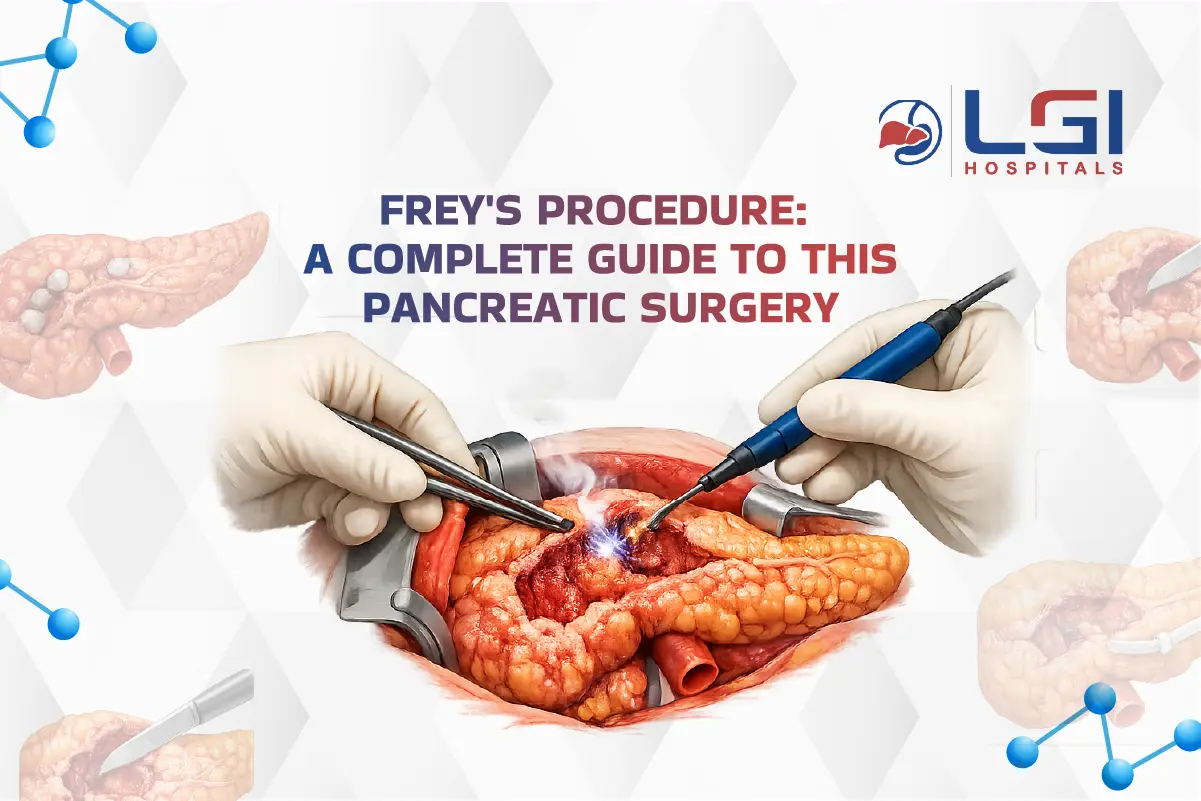
Frey’s procedure is one of the most important surgical options available for patients with chronic pancreatitis who have failed medical management. It combines drainage of the blocked pancreatic duct with targeted removal of diseased tissue from the pancreatic head — addressing the two core problems of the disease in a single operation.
Despite its clinical significance, awareness of Frey’s procedure remains low among patients in India. This guide explains what the surgery involves, who needs it, what the steps look like, how recovery unfolds, and how it compares to alternative procedures — so that patients and families can make informed decisions in consultation with their surgical team.
What Is the Frey Procedure?
Frey’s procedure — formally called local resection of the pancreatic head with longitudinal pancreaticojejunostomy — is a surgical technique developed by Dr. Charles F. Frey in 1987. It is designed specifically for patients with chronic pancreatitis where the pancreatic head is enlarged and fibrotic, and the main pancreatic duct is dilated and obstructed.
The procedure has two components performed together:
- Local resection (coring) — The fibrotic, inflamed core of the pancreatic head is surgically removed, reducing the mass effect and relieving ductal pressure.
- Longitudinal pancreaticojejunostomy — The main pancreatic duct is opened along its length and connected to a loop of small intestine (jejunum), creating a new drainage pathway for pancreatic enzymes.
This combined approach distinguishes Frey’s procedure from simpler drainage operations. Understanding the role of the pancreas in digestion and hormone regulation helps explain why restoring normal enzyme flow has such a significant impact on symptoms and quality of life.
For patients with pancreatic duct stones alongside their pancreatitis, Frey’s procedure also allows simultaneous stone removal from the duct. Read our detailed guide on pancreatic stones to understand how the two conditions are connected.
In Simple Terms: Frey’s procedure removes the diseased core of the pancreatic head and creates a new drainage route for pancreatic enzymes — relieving pain, improving digestion, and slowing disease progression in chronic pancreatitis.
Why Is the Frey Procedure Done?
Frey’s procedure is recommended when chronic pancreatitis has progressed to the point where medical management no longer controls symptoms, and where the anatomy of the pancreas makes combined drainage and resection the most appropriate surgical strategy.
Primary Indications
- Chronic pancreatitis with enlarged pancreatic head — The inflammatory mass in the head compresses the main pancreatic duct and sometimes the bile duct, causing obstruction and pain.
- Dilated main pancreatic duct — A duct diameter of 5 mm or more (often much larger) makes the patient suitable for a drainage procedure.
- Pancreatic duct stones with obstruction — When stones cannot be cleared endoscopically and are causing persistent ductal blockage, Frey’s procedure addresses both the stones and the underlying duct disease.
- Failed endoscopic treatment — Patients in whom ERCP and/or ESWL have not provided adequate, sustained pain relief.
- Intractable pain significantly affecting quality of life — Despite optimal medical therapy, including pain management and enzyme replacement.
- Suspected malignancy requiring tissue sampling — The resected pancreatic head tissue is sent for histopathological examination to rule out cancer.
If you are currently being managed for pancreatitis and want to understand where you are in the treatment pathway, our article on pancreatitis treatment gives a comprehensive overview of the options at each stage. You may also find it useful to read do you need pancreas surgery? before your consultation.
Important: Not every chronic pancreatitis patient needs surgery. The decision depends on disease stage, ductal anatomy, response to prior treatment, and overall health. Frey’s procedure is a major abdominal operation and is recommended only when the expected benefit clearly outweighs the surgical risk for that individual patient.
Frey’s Procedure Steps
Frey’s procedure is performed under general anaesthesia and typically takes 3–5 hours. Here is a step-by-step overview of what the operation involves:
Anaesthesia and Patient Positioning
The patient is placed under general anaesthesia. An epidural catheter is usually inserted for post-operative pain control. A urinary catheter and nasogastric tube are placed.
Abdominal Incision (Laparotomy)
A midline or bilateral subcostal (rooftop) incision is made to access the abdominal cavity. The surgeon carefully exposes the pancreas by entering the lesser sac — the space behind the stomach.
Assessment of the Pancreas
The surgeon directly assesses the pancreas, confirming the extent of the inflammatory mass in the head and the degree of ductal dilation. Intraoperative ultrasound may be used to localise the duct and any stones within it.
Local Resection of the Pancreatic Head (Coring)
The fibrotic, hardened core of the pancreatic head is carefully excised (cored out) while preserving the duodenum, bile duct, and surrounding vessels. This is the defining step that distinguishes Frey’s from a simple drainage procedure. The resected tissue is sent for histopathological analysis.
Longitudinal Ductotomy (Opening the Pancreatic Duct)
The main pancreatic duct is opened longitudinally along the body and tail of the pancreas, from the cored head region towards the tail. Any stones or strictures within the duct are removed or addressed at this stage.
Roux-en-Y Jejunal Loop Preparation
A segment of the small intestine (jejunum) is divided and reconfigured into a Roux-en-Y loop — a Y-shaped intestinal configuration that allows drainage without reflux of intestinal contents back into the pancreas.
Pancreaticojejunostomy (Joining Pancreas to Intestine)
The opened pancreatic duct — including the cored head region — is sutured to the Roux limb of the jejunum, creating a wide, side-to-side anastomosis (connection). This new opening allows pancreatic enzymes to drain freely into the intestine.
Closure and Drain Placement
Surgical drains are placed near the anastomosis to monitor for any leak. The abdominal wall is closed in layers. The patient is transferred to recovery and then to the ward or high-dependency unit.
For more detail on what pancreatic surgery generally involves, see: pancreas surgery — risks and what to expect.
Frey Procedure vs Beger Procedure
Both Frey’s and Beger’s procedures are surgical options for chronic pancreatitis with an inflammatory pancreatic head mass. They are frequently compared because they target the same problem with different approaches.
| Feature | Frey’s Procedure | Beger’s Procedure |
|---|---|---|
| Full name | Local resection of pancreatic head + longitudinal pancreaticojejunostomy | Duodenum-preserving pancreatic head resection (DPPHR) |
| Extent of resection | Partial coring of pancreatic head (subtotal) | Near-complete resection of pancreatic head with preservation of duodenum |
| Pancreatic duct drainage | Yes — full longitudinal ductotomy from head to tail | Limited — drainage primarily at the level of the head |
| Pancreatic tissue bridge | Maintained (no division of pancreas) | Pancreas divided at the neck; bridge of tissue left over portal vein |
| Surgical complexity | Lower — technically simpler, shorter operative time | Higher — requires division of pancreas at neck |
| Blood loss | Generally lower | Generally higher due to pancreatic division |
| Pain relief outcomes | Equivalent — 80–90% at long-term follow-up | Equivalent — 80–90% at long-term follow-up |
| Endocrine function (diabetes risk) | Preserved in most patients | Preserved in most patients |
| Best suited for | Most chronic pancreatitis with dilated duct + head mass; when duct stones are present | Large head mass with significant biliary compression; complex anatomy |
In practice, Frey’s procedure has largely become the preferred option at many centres because it achieves equivalent outcomes with lower technical complexity. The choice between the two depends on individual anatomy, surgeon experience, and the extent of disease. Your surgical team will guide this decision after reviewing your imaging.
Both procedures are very different from the concerns raised in pancreatitis vs pancreatic cancer — understanding this distinction is important when discussing surgery with your doctor.
What to Expect Before the Frey Procedure
Preparation for Frey’s procedure is thorough because it is a major abdominal operation. Your surgical team will typically arrange the following:
Diagnostic Imaging
- CT scan of the abdomen — Assesses the size of the inflammatory head mass, degree of ductal dilation, presence of stones, vascular anatomy, and rules out malignancy. LGI Hospitals provides CT scan abdomen in Nagpur.
- MRCP (Magnetic Resonance Cholangiopancreatography) — Gives detailed visualisation of the ductal system without radiation.
- Endoscopic Ultrasound (EUS) — Used when malignancy needs to be excluded with greater precision, or for biopsy.
Blood Tests and Assessment
- Liver function tests, serum amylase/lipase, full blood count, coagulation profile
- Blood glucose and HbA1c (to assess baseline pancreatic endocrine function)
- Nutritional assessment — many chronic pancreatitis patients are malnourished pre-operatively
- Anaesthesia fitness assessment, including ECG and lung function if indicated
Pre-operative Preparation
- Complete alcohol cessation — mandatory and non-negotiable before elective surgery
- Smoking cessation — significantly reduces post-operative complication risk
- Nutritional optimisation — high-protein diet or enteral supplementation if malnourished
- Adjustment of any pancreatic enzyme replacement therapy (PERT)
- Standard fasting from midnight before surgery
Our pancreatitis diet guide is relevant both before surgery (optimising nutrition) and after (supporting recovery).
Recovery After Frey’s Procedure
In Hospital (Days 1–7)
- Most patients spend 5–7 days in hospital after Frey’s procedure.
- Oral fluids are started on day 1–2; a soft diet is usually introduced by day 3–4.
- Surgical drains are monitored for amylase-rich fluid (indicating pancreatic leak) and removed when output is low and clear, typically day 3–5.
- Pain is managed with epidural analgesia initially, transitioning to oral medications.
- Blood glucose is monitored closely in the immediate post-operative period.
At Home (Weeks 2–6)
- Most patients return to light daily activities within 2–3 weeks.
- A low-fat, easily digestible diet is followed for the first 4–6 weeks. Full dietary guidance is provided at discharge — also see our pancreatitis diet guide.
- Pancreatic enzyme replacement therapy (PERT) is usually continued and the dose adjusted based on stool consistency and nutritional recovery.
- Heavy lifting and strenuous activity should be avoided for 6 weeks.
- A follow-up appointment is scheduled at 2 weeks for wound review and drain site check.
Long-term Recovery (Months 2–6 and Beyond)
- Most patients experience significant pain reduction within the first 3 months after surgery.
- Weight and nutritional status typically improve as enzyme flow is restored.
- Regular follow-up with your gastroenterologist is important to monitor pancreatic function, adjust enzyme therapy, and screen for long-term complications.
- Complete alcohol abstinence must be maintained permanently. Resumption of alcohol is the single most common cause of disease progression after surgery.
For long-term guidance on protecting pancreatic function after surgery, read: how to keep your pancreas healthy.
Recovery Tip: Nutritional rehabilitation is as important as the surgery itself. Many patients with chronic pancreatitis have significant pre-existing malnutrition. Working with a dietitian in the weeks before and after surgery significantly improves recovery speed and long-term outcomes.
Risks and Complications of Frey’s Procedure
Frey’s procedure is a major operation and, like all major surgeries, carries risks. Your surgical team will discuss these with you in detail before you sign consent. The key risks include:
| Complication | Approximate Frequency | Notes |
|---|---|---|
| Pancreatic fistula (leak at anastomosis) | 5–15% | Most resolve with conservative management; rarely requires reoperation |
| Delayed gastric emptying | 10–20% | Temporary; managed with dietary modification and medication |
| Post-operative infection / wound complications | 5–10% | Treated with antibiotics; rarely serious |
| Bleeding (intraoperative or post-operative) | 2–5% | Blood transfusion may be required; reoperation rare |
| New-onset or worsening diabetes | 5–15% | Dependent on pre-existing pancreatic reserve; regular glucose monitoring required |
| Exocrine insufficiency (malabsorption) | Variable | Managed with pancreatic enzyme replacement therapy (PERT) |
| Mortality | <2% at specialist centres | Significantly lower at high-volume pancreatic surgery centres |
The complication rates above are lower at high-volume, specialist centres with dedicated post-operative care pathways. Choosing where you have this surgery matters.
For a broader overview of what pancreatic surgery involves and when it is the right choice, see: do you need pancreas surgery? and our guide to pancreas diseases.
Frey’s Procedure for Chronic Pancreatitis — Outcomes
Frey’s procedure has an extensive evidence base built over nearly four decades of use. The outcomes for appropriately selected patients are consistently favourable:
80–90%Long-term pain relief
85%+Improved quality of life at 5 years
<2%Mortality at specialist centres
70%+Return to normal diet within 6 months
Pain Relief
The primary goal of Frey’s procedure is pain relief, and the evidence supports it strongly. Studies consistently report 80–90% of patients experiencing significant or complete pain relief at long-term follow-up (5–10 years), provided they maintain complete alcohol abstinence after surgery.
Pancreatic Function
Because Frey’s procedure preserves the duodenum and avoids complete pancreatic head resection, it is associated with better preservation of endocrine (insulin) and exocrine (enzyme) function compared to more extensive resections. New-onset diabetes after Frey’s is significantly less common than after pancreaticoduodenectomy (Whipple’s procedure).
Quality of Life
Most patients report meaningful improvement in ability to eat, work, and engage in normal daily activities within 3–6 months of surgery. Weight gain and nutritional recovery are common findings at follow-up.
Disease Progression
Frey’s procedure does not cure chronic pancreatitis — the underlying condition remains. However, by relieving ductal obstruction and reducing the inflammatory mass, it significantly slows structural damage to the remaining pancreatic tissue.
Understanding the distinction between pancreatitis and more serious pancreatic pathology is important. Read our comparison of pancreatitis vs pancreatic cancer, and our overview of symptoms of pancreas problems to understand when to seek urgent evaluation.
Considering Frey’s Procedure? Talk to Our Pancreatic Surgery Team.
LGI Hospitals, Nagpur offers specialist evaluation and surgical management for chronic pancreatitis and complex pancreatic conditions. Get a clear, honest assessment of your options — without unnecessary delay. Book a Consultation Now
Is Frey’s Procedure Available in Nagpur?
Yes. LGI Hospitals, Nagpur has a dedicated pancreatic surgery programme with experience in complex pancreatic procedures including Frey’s procedure, lateral pancreaticojejunostomy, and pancreatic head resection for both benign and malignant disease.
Our team brings together medical gastroenterologists and surgical specialists who work together to evaluate each patient comprehensively before recommending surgery. We offer:
- Pre-operative workup including advanced imaging and nutritional assessment
- Surgical management of chronic pancreatitis, pancreatic stones, and pancreatic duct strictures
- Post-operative care with dedicated follow-up and enzyme management
- Coordination with diabetology if endocrine involvement is present
If you have been diagnosed with chronic pancreatitis, have been told you need surgery, or want a second opinion on your current management plan, our pancreatic surgery team in Nagpur is available for consultation.
You may also want to visit our pancreatitis treatment page to understand the full medical and surgical pathway available at LGI Hospitals.
For acute or emergency presentations of severe pancreatitis, our severe pancreatitis intensive care unit provides 24-hour specialist support.
Frequently Asked Questions
Q1. What is Frey’s procedure used for?
Frey’s procedure is used for chronic pancreatitis where the pancreatic head is enlarged and fibrotic, and the main pancreatic duct is dilated. It combines local resection of the diseased pancreatic head with longitudinal drainage of the entire duct into a loop of small intestine — relieving pain, improving enzyme flow, and slowing disease progression.
Q2. What are the steps of Frey’s procedure?
Frey’s procedure involves: (1) general anaesthesia and abdominal incision, (2) exposure of the pancreas, (3) coring (local resection) of the fibrotic pancreatic head, (4) longitudinal opening of the main pancreatic duct from head to tail, (5) removal of any duct stones, (6) preparation of a Roux-en-Y jejunal loop, (7) wide anastomosis between the opened duct and the jejunum, and (8) drain placement and closure. The operation typically takes 3–5 hours.
Q3. What is the difference between Frey’s and Beger’s procedure?
Both procedures address chronic pancreatitis with an enlarged pancreatic head. Frey’s procedure performs a subtotal coring of the head and opens the entire length of the pancreatic duct, without dividing the pancreas. Beger’s procedure performs a near-complete resection of the head and does divide the pancreas at the neck. Frey’s is technically simpler with similar long-term pain relief outcomes and is now the more widely used of the two.
Q4. How long is recovery after Frey’s procedure?
Most patients spend 5–7 days in hospital. Return to light activity is typically possible within 2–3 weeks. A soft, low-fat diet is followed for 4–6 weeks. Heavy activity should be avoided for 6 weeks. Significant pain relief is usually experienced within the first 3 months, with continued improvement over 6–12 months.
Q5. What are the risks of Frey’s procedure?
The main risks include pancreatic fistula (5–15%), delayed gastric emptying (10–20%), wound infection (5–10%), bleeding (2–5%), and new-onset or worsening diabetes (5–15%). Mortality is under 2% at specialist centres. Your surgical team will review all risks with you in detail before the operation.
Q6. How effective is Frey’s procedure for pain relief?
80–90% of appropriately selected patients achieve significant or complete pain relief at long-term follow-up (5–10 years). The key condition for sustained benefit is complete and permanent alcohol abstinence after surgery, as resuming alcohol consumption is the most common reason for pain recurrence.
Q7. Will I need enzyme tablets after Frey’s procedure?
Many chronic pancreatitis patients already use pancreatic enzyme replacement therapy (PERT) before surgery. After Frey’s procedure, enzyme requirements may decrease as drainage improves, but a significant proportion of patients continue to need PERT long-term. Your gastroenterologist will adjust the dose based on your symptoms and nutritional recovery.
Q8. Can Frey’s procedure be done in Nagpur?
Yes. LGI Hospitals, Nagpur provides specialist surgical management for chronic pancreatitis, including Frey’s procedure and other pancreatic drainage and resection operations. Patients can book a consultation directly with our gastroenterology and pancreatic surgery team.
Related Reading from LGI Hospitals
- Pancreatic Stones: Causes, Symptoms & Treatment
- Pancreatitis Treatment Options Explained
- Pancreatitis Diet Guide
- 7 Symptoms of Pancreas Problems
- Pancreas Surgery: Risks and What to Expect
- Do You Need Pancreas Surgery?
- Pancreatitis vs Pancreatic Cancer
- Pancreas Diseases: A Complete Guide
- Fatty Pancreas: What You Need to Know
- How to Keep Your Pancreas Healthy
- Role of the Pancreas in Digestion
- Function of Pancreatic Juice
Medical Disclaimer
The information provided in this article is intended for general educational and informational purposes only. It does not constitute medical advice, diagnosis, or a recommendation for any specific surgical procedure. Frey’s procedure is a major abdominal operation that requires thorough individual evaluation by a qualified surgical gastroenterologist.
Surgical indications, risks, and expected outcomes vary significantly between patients. The complication rates and outcome statistics cited in this article are drawn from published medical literature and represent population-level averages — individual results may differ substantially based on disease severity, overall health, nutritional status, and adherence to post-operative guidance.
Do not use this content to self-diagnose, self-treat, or to decide whether to proceed with or decline surgery. If you are experiencing severe abdominal pain, jaundice, or any other concerning symptoms, please seek immediate medical attention.
All clinical content on this page has been reviewed by the gastroenterology and surgical team at LGI Hospitals, Nagpur. Medical knowledge evolves — always consult your treating physician for advice specific to your condition.
LGI Hospitals | Nagpur, Maharashtra | lgihospitals.in