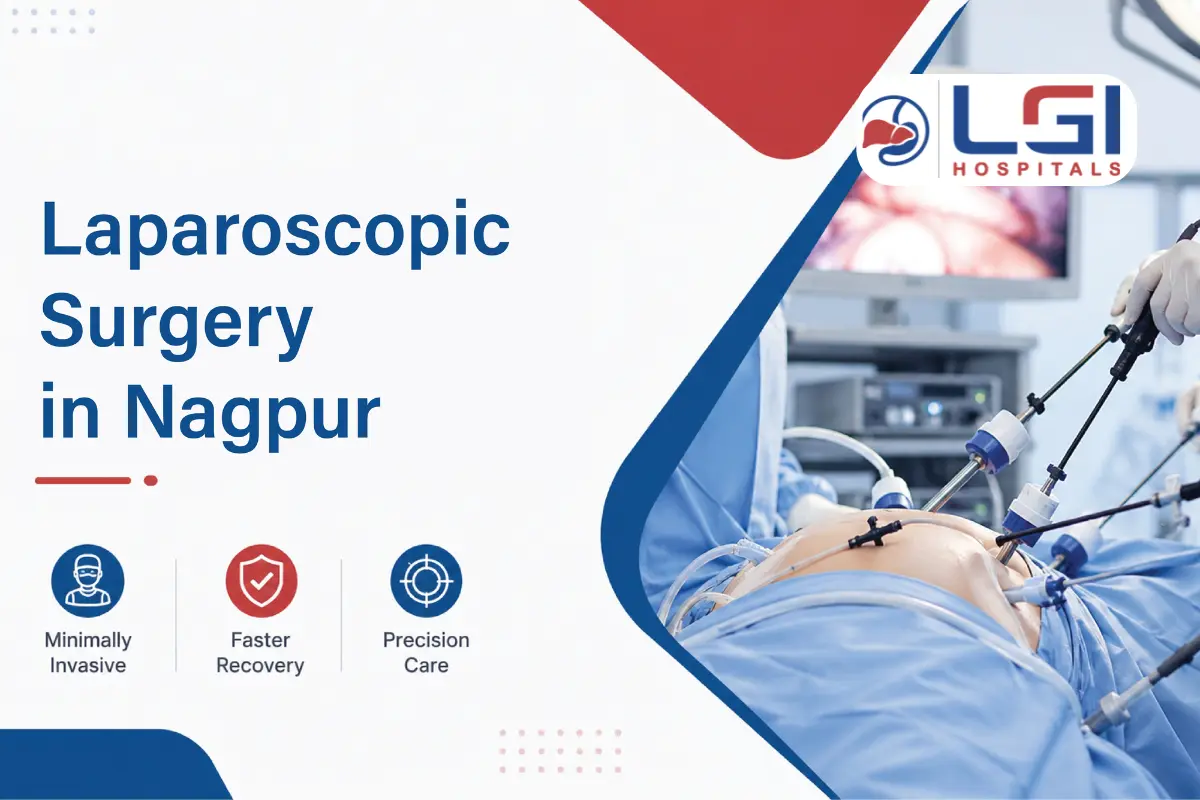
For patients in Nagpur and central India, laparoscopic surgery at LGI Hospitals represents one of the most significant advances in surgical care of recent decades. Also called keyhole surgery or minimally invasive surgery, laparoscopic procedures allow surgeons to operate through a few small incisions — typically less than a centimetre — rather than one large open cut.
The result for patients is less post-operative pain, reduced hospital stay, faster recovery, and a far lower risk of wound complications compared to conventional open surgery. This blog walks you through what laparoscopic surgery involves, which gastrointestinal (GI) conditions benefit most from it, and what you can realistically expect before and after your procedure.
What Is Laparoscopic Surgery?
Laparoscopic surgery uses a thin, camera-equipped tube called a laparoscope, inserted through a small incision in the abdomen. The camera sends a live, magnified image to a monitor in the operating theatre, guiding the surgeon’s instruments — introduced through one or two additional small ports — throughout the procedure.
At LGI Hospitals’ Department of Gastroenterology & GI Surgery, laparoscopic techniques are used routinely for a wide range of abdominal and GI conditions, offering patients in Nagpur a world-class standard of surgical care close to home.
Key Benefits of Laparoscopic Surgery
The advantages of minimally invasive surgery over open surgery are well documented in clinical literature. Here is what patients at LGI Hospitals typically experience:
- Smaller incisions and minimal scarring. Most patients have only two or three tiny cuts that heal with barely visible marks.
- Significantly less post-operative pain. Smaller wounds mean less tissue trauma and lower analgesic requirements after surgery.
- Shorter hospital stay. Many laparoscopic procedures allow discharge within one to two days, compared to five to seven days for open surgery.
- Faster return to normal activity. Most patients resume light daily activities within a week and return to work in two to three weeks.
- Lower risk of infection. Reduced exposure of internal organs to the external environment significantly lowers wound infection rates.
- Reduced blood loss. Precision instruments and high-definition camera guidance minimise intraoperative bleeding.
- Faster bowel recovery. The minimal tissue handling in laparoscopic surgery means the bowel resumes normal function sooner.
Common GI Conditions Treated with Laparoscopic Surgery at LGI Hospitals
Our surgical team performs the following minimally invasive procedures as part of our comprehensive GI care programme:
1. Laparoscopic Cholecystectomy (Gallbladder Removal)
The most commonly performed laparoscopic procedure worldwide. Indicated for gallstone disease and gallbladder inflammation, cholecystectomy is performed through three or four small ports. Most patients are discharged the next day and resume normal diet within a week.
2. Laparoscopic Appendectomy
The standard surgical treatment for appendicitis. Removing the appendix laparoscopically results in a faster recovery and lower complication rate compared to open appendectomy, even in cases of perforated appendicitis when performed promptly.
3. Laparoscopic Hernia Repair
Both inguinal (groin) and ventral (abdominal wall) hernias can be repaired laparoscopically at LGI Hospitals’ hernia surgery centre. The laparoscopic approach allows mesh to be placed behind the abdominal wall, offering a durable repair with minimal recurrence risk.
4. Laparoscopic Colorectal Surgery
Conditions including colorectal cancer, diverticular disease, and inflammatory bowel disease (Crohn’s disease, ulcerative colitis) may require bowel resection. Our colorectal surgery team performs laparoscopic colectomy and anterior resection, with outcomes comparable to open surgery for disease clearance and significantly superior for patient recovery.
5. Laparoscopic Anti-Reflux Surgery (Fundoplication)
Patients with chronic gastro-oesophageal reflux disease (GERD) who have not responded adequately to medication may be candidates for laparoscopic Nissen fundoplication, a procedure that reinforces the lower oesophageal sphincter to prevent acid reflux.
6. Laparoscopic Bariatric Surgery
For patients with morbid obesity, minimally invasive bariatric procedures including laparoscopic sleeve gastrectomy and gastric bypass are performed by our specialist team. These procedures aid sustainable weight loss and frequently resolve obesity-related conditions such as type 2 diabetes and hypertension.
Understanding the Risks: What Every Patient Should Know
Laparoscopic surgery is safe for the vast majority of patients, but like all surgical procedures it carries some degree of risk. Your surgeon will discuss these with you in detail before you consent to any operation. General risks include:
- Anaesthetic reactions or complications
- Bleeding or injury to surrounding structures during port insertion
- Infection at the incision sites
- Internal bleeding or bile leak (rare, more common in complex cases)
- Conversion to open surgery — if the laparoscopic approach cannot be completed safely, the surgeon will convert to an open procedure. This is not a complication but a clinical decision made in your interest.
- Deep vein thrombosis (DVT) — preventive measures including compression stockings and early mobilisation are routine at LGI Hospitals
If you have concerns about surgical risk, our gastroenterology and surgical team will assess your individual health status, existing conditions, and surgical history to advise whether laparoscopic surgery is appropriate for you.
Who Is a Good Candidate for Laparoscopic Surgery?
Most patients who need abdominal surgery are suitable candidates for the laparoscopic approach. Factors your surgeon will consider include:
- Age and overall fitness for general anaesthesia
- Body weight — while laparoscopic surgery is routinely performed in patients with obesity, extreme weight may affect visualisation
- History of previous abdominal surgeries (adhesions may influence technique)
- Complexity and urgency of the condition
- Presence of active infection or perforation
Book a surgical consultation at LGI Hospitals, Nagpur to receive a personalised evaluation from our minimally invasive surgery specialists.
What to Expect: Before and After Laparoscopic Surgery
Before Surgery
- Pre-operative investigations: blood tests, ECG, chest X-ray, abdominal ultrasound or CT as required
- Fasting from midnight the night before surgery (no food or drink)
- Medication review — certain blood thinners and diabetes medications may need to be paused
- Discussion with your anaesthetist and surgeon about the procedure, expected outcomes, and risks
After Surgery
- Recovery in a post-anaesthesia care unit (PACU) until you are alert and stable
- Pain managed through oral analgesics — most patients describe discomfort rather than severe pain
- Oral fluids typically resumed on the same day; light diet the following day
- Physiotherapy and early mobilisation — see our guidance on post-surgical recovery at LGI Hospitals
- Discharge instructions including wound care, activity restrictions, and follow-up appointment
Our Laparoscopic Surgery Team
LGI Hospitals’ minimally invasive surgery programme is led by experienced laparoscopic surgeons who have undergone advanced training in GI and general surgery. To learn more about our surgical team and to book a consultation.
Medical Disclaimer
The information provided in this article is intended for general educational purposes only and does not constitute medical advice, diagnosis, or a treatment recommendation. Surgical suitability is highly individual and depends on your clinical history, current health status, and the findings of your medical team. Always consult a qualified doctor or surgeon before making any decision about surgical treatment. If you are experiencing acute abdominal pain, fever, or other emergency symptoms, please seek immediate medical attention or visit our emergency services at LGI Hospitals, Nagpur.
FAQ
Duration depends on the procedure. A laparoscopic cholecystectomy typically takes 45 to 60 minutes, while more complex procedures such as colorectal resection may take two to four hours. Your surgeon will give you an estimated operative time at your pre-operative consultation.
Laparoscopic surgery involves significantly less post-operative pain than open surgery. You may experience mild shoulder pain caused by residual carbon dioxide gas used to inflate the abdomen during surgery; this typically resolves within 24 to 48 hours.
Most patients can tolerate sips of water within hours of surgery and a light diet the following day. Full dietary recovery is gradual and depends on the nature of the procedure. Your surgical team will provide specific dietary guidance before discharge.
Laparoscopic surgery may not be suitable in cases of severe intra-abdominal infection or abscess at initial presentation, dense adhesions from multiple prior surgeries, or when the anatomy cannot be adequately visualised laparoscopically. Your surgeon will discuss the most appropriate approach for your specific condition.
Most patients can return to driving within one to two weeks of straightforward laparoscopic surgery, provided they are no longer taking narcotic analgesics and feel confident in their reaction times. Always confirm with your surgeon before driving.
You will have two to four small scars — typically five to ten millimetres in size — at the port insertion sites. These generally fade significantly over six to twelve months and are far less conspicuous than open surgery scars.