
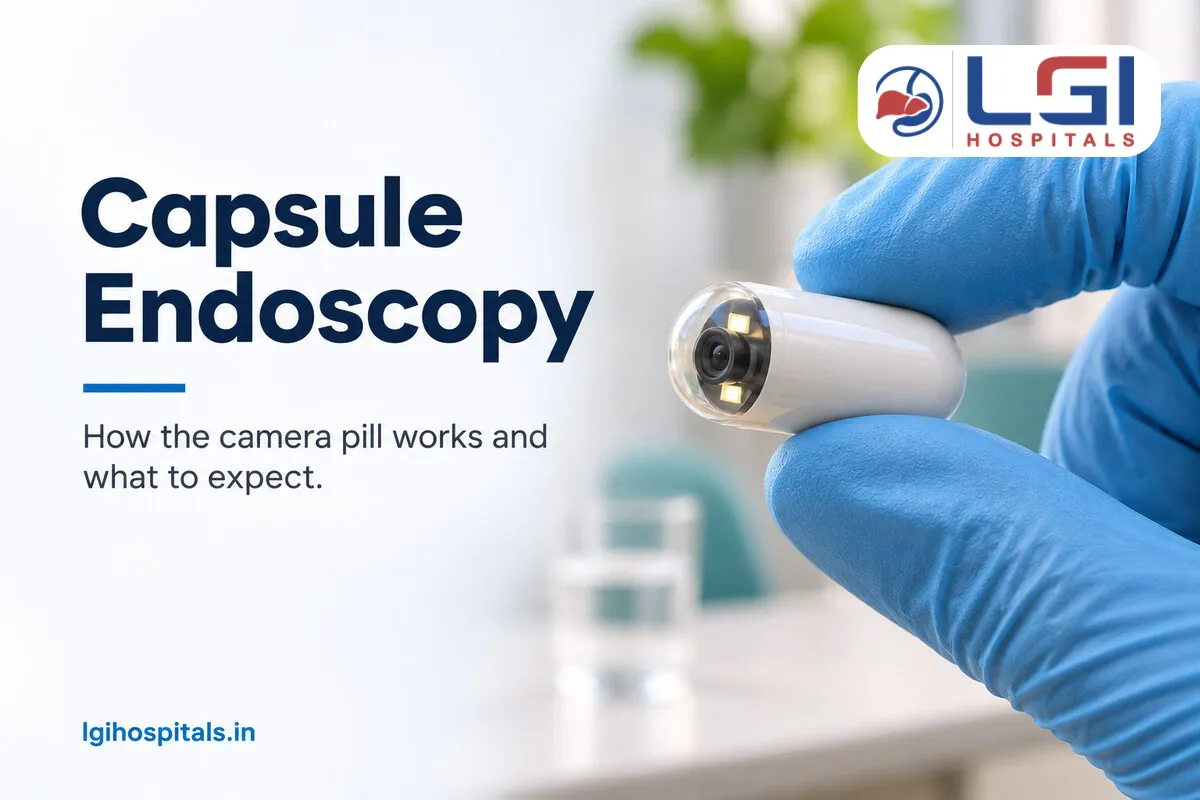
Capsule endoscopy is a diagnostic test that uses a small, swallowable camera to examine the inside of the small intestine. It helps doctors identify abnormalities such as unexplained bleeding, inflammation and certain intestinal lesions.
Unlike conventional endoscopy, this procedure does not require a flexible camera tube to be inserted through the mouth or rectum. Instead, the patient swallows a capsule that captures images as it moves naturally through the digestive tract.
Capsule endoscopy is listed among the diagnostic services under Gastroenterology at LGI Hospitals, Nagpur.
In this guide, understand how capsule endoscopy works, why it is recommended, how to prepare and what patients should expect.
What Is Capsule Endoscopy?
Capsule endoscopy is a diagnostic procedure that uses a small capsule containing a miniature camera, light source, battery and image-transmission technology.
After swallowing the capsule with water, it travels through the digestive tract and captures images of the intestinal lining. These images are transmitted to a recording device worn by the patient.
A gastroenterologist reviews the recorded images to identify possible abnormalities.
The procedure is particularly useful for examining the small intestine, which is not completely accessible through conventional upper GI endoscopy or colonoscopy.
Why Is Capsule Endoscopy Recommended?
A doctor may recommend capsule endoscopy when there is a need to examine the small intestine more closely.
Some common reasons include:
1. Unexplained gastrointestinal bleeding
When initial investigations do not identify the source of bleeding, capsule endoscopy may help examine the small intestine for possible bleeding sites.
2. Unexplained iron deficiency anaemia
In selected patients, the test may help investigate possible intestinal blood loss associated with unexplained iron deficiency anaemia.
3. Suspected Crohn’s disease
Capsule endoscopy may help identify inflammation or ulcers in the small intestine in patients being evaluated for Crohn’s disease. However, intestinal narrowing must be considered before the procedure.
4. Suspected small intestinal lesions
The examination may help identify certain polyps, growths or other abnormalities that require further investigation.
The decision to perform the test depends on the patient’s symptoms, medical history and previous investigation results.
How Does Capsule Endoscopy Work?
The capsule endoscopy procedure generally involves five steps.
- Preparation: The patient follows the fasting and bowel preparation instructions provided by the healthcare team.
- Swallowing the capsule: The small camera capsule is swallowed with water.
- Image capture: The capsule travels naturally through the digestive tract while capturing images.
- Image transmission: The images are sent to a recording device worn by the patient.
- Image review: A gastroenterologist reviews the recorded images to identify abnormalities.
The recording period varies according to the capsule system and intestinal movement.
Unlike conventional endoscopy procedures, capsule endoscopy does not allow doctors to take biopsies, remove polyps or treat bleeding during the same examination.
Which Parts of the Digestive System Can It Examine?
Capsule endoscopy is primarily used to examine the small intestine, which has three main sections:
- Duodenum: The first section, connected to the stomach.
- Jejunum: The middle section, where most of the nutrient absorption takes place.
- Ileum: The final section, which connects to the large intestine.
These areas can be difficult to examine completely using conventional upper GI endoscopy and colonoscopy.
The amount of the intestine visualised depends on intestinal movement, image quality and the completeness of the recording.
How to Prepare for Capsule Endoscopy
Preparation is important to obtain clear images during the examination.
Your doctor may recommend:
- Fasting for a specified period before swallowing the capsule.
- Bowel preparation, if required.
- Reviewing current medicines and supplements.
- Informing the doctor about previous abdominal surgery.
- Discussing any history of intestinal obstruction or narrowing.
- Reporting difficulty swallowing capsules or tablets.
- Telling the doctor about any MRI scan already planned in the coming days.
Patients should not stop prescribed medicines without medical advice.
The exact preparation instructions depend on the capsule system and the patient’s medical condition.
What Happens During and After the Procedure?
After swallowing the capsule, patients wear a recording device that receives images transmitted by the camera.
The capsule moves through the digestive tract through natural intestinal contractions. Patients may be allowed to continue certain routine activities while following the instructions given by the healthcare team.
After the recording period, the equipment is returned for image processing and review.
The capsule is disposable and generally passes naturally in a bowel movement, often without the patient noticing. Patients should follow the medical team’s instructions about confirming its passage and the precautions below until it has left the body.
A gastroenterologist reviews the images and explains the findings. If an abnormality is identified, additional tests or treatment may be recommended.
Important Precautions Until the Capsule Has Passed
The capsule stays in the digestive tract until it is passed in a bowel movement. Until its passage is confirmed, patients should follow these precautions:
- Do not have an MRI scan. Avoid MRI scans and do not go near an MRI machine until the capsule has passed. The capsule contains metal and electronic parts, and the strong magnetic field of an MRI scanner can cause serious injury to the intestine.
- Tell other doctors about the capsule. If an MRI is planned and you are not sure the capsule has passed, inform your gastroenterologist and the radiology team. An abdominal X-ray may be done first to check that the capsule is no longer in the body.
- Keep the recording equipment in place. Do not remove the sensor belt or recorder during the recording period unless the healthcare team tells you to.
- Stay away from strong electromagnetic fields. Equipment such as MRI machines and radio transmitters can interfere with the recording. Routine household electronics and mobile phones are generally acceptable unless advised otherwise.
- Follow eating, drinking and activity instructions. The team will tell you when you can drink clear liquids and eat again, and whether to avoid strenuous activity during the recording.
- Watch for the capsule passing. The capsule usually passes within a few days. Tell your doctor if you have not seen it pass within the time advised by your healthcare team.
Warning Symptoms: When to Contact Your Doctor
Capsule retention is uncommon, but a capsule that is stuck can partly or fully block the intestine. Contact your doctor promptly if any of the following occur after swallowing the capsule:
- Abdominal pain, especially pain that is severe or getting worse.
- Unusual bloating or a swollen abdomen.
- Nausea or vomiting.
- Inability to pass stool or gas.
- Chest pain, pain on swallowing or a feeling that the capsule is stuck in the throat or chest.
- Uncertainty about whether the capsule has passed when an MRI scan is needed.
Seek emergency medical care for severe abdominal pain, repeated vomiting or a swollen, hard abdomen, as these may be signs of intestinal obstruction.
If the capsule has not passed, an abdominal X-ray can show whether it is still in the body. A retained capsule can often be removed endoscopically, and surgery is needed only in some cases.
Benefits and Limitations of Capsule Endoscopy
Potential benefits
- Helps examine much of the small intestine.
- Does not require conventional endoscope insertion.
- May help investigate unexplained gastrointestinal bleeding.
- Can identify certain inflammatory changes and intestinal lesions.
- Provides images that may guide further medical evaluation.
Limitations
- It cannot collect tissue samples.
- It cannot remove polyps or treat bleeding.
- The examination may be incomplete.
- Image quality can be affected by intestinal contents.
- Capsule retention is possible in patients with intestinal narrowing.
Capsule endoscopy is therefore a diagnostic tool, not a replacement for every other endoscopic procedure.
What Are the Possible Risks?
Capsule endoscopy is generally well tolerated, but certain risks need to be considered.
Capsule retention: The capsule may become stuck in an area of intestinal narrowing or obstruction. See the warning symptoms above for signs that need prompt medical attention.
Difficulty swallowing: Some patients may have difficulty swallowing the capsule.
Incomplete examination: The capsule may not capture images of the entire intended area during the recording period.
Image quality limitations: Poor visibility may affect the interpretation of the examination.
Patients with suspected intestinal obstruction, strictures or certain forms of Crohn’s disease may require additional assessment before the test.
A patency capsule or imaging assessment may be considered in selected patients to evaluate whether the capsule is likely to pass safely.
Capsule Endoscopy vs Traditional Endoscopy
Both procedures examine the digestive system, but their methods and purposes are different.
| Feature | Capsule Endoscopy | Traditional Upper GI Endoscopy |
| Method | Swallowable camera | Flexible endoscope |
| Main examination area | Small intestine | Oesophagus, stomach and duodenum |
| Image capture | Camera travels naturally | Direct visual examination |
| Biopsy | Not possible | Possible |
| Treatment | Not possible | Certain treatments possible |
The appropriate procedure depends on the symptoms and the area that needs examination.
Frequently Asked Questions
1. Is capsule endoscopy painful?
The procedure involves swallowing a small camera capsule and generally does not require conventional endoscope insertion. Individual experiences may vary.
2. How long does capsule endoscopy take?
The recording period depends on the capsule system and intestinal movement. It generally takes several hours, and the healthcare team will explain the expected schedule.
3. Does capsule endoscopy require anaesthesia?
Routine capsule endoscopy generally does not require sedation or general anaesthesia.
4. Can capsule endoscopy detect Crohn’s disease?
It may help identify inflammation and ulcers in the small intestine associated with Crohn’s disease. However, it may not be suitable for patients with suspected intestinal narrowing.
5. Can capsule endoscopy detect cancer?
It may identify suspicious lesions or growths in the small intestine. Further investigations and tissue sampling may be needed to confirm a diagnosis.
6. What happens if the capsule does not pass naturally?
Contact your doctor if the capsule has not passed within the time advised, or if you develop abdominal pain, bloating, nausea or vomiting. An abdominal X-ray may be used to check its position, and an endoscopic procedure may be needed to remove it. Avoid MRI scans until its passage has been confirmed.
7. Is capsule endoscopy suitable for everyone?
No. Suitability depends on medical history, swallowing ability and the possibility of intestinal narrowing or obstruction.
8. Can I have an MRI after capsule endoscopy?
Not until the capsule has passed out of the body. The strong magnetic field of an MRI scanner can cause serious injury if the capsule is still inside. If you need an MRI and are unsure whether the capsule has passed, tell your doctor; an abdominal X-ray may be done first.
9. When should I call my doctor after capsule endoscopy?
Call your doctor if you have abdominal pain, bloating, nausea, vomiting or difficulty passing stool or gas, or if you have not seen the capsule pass within the time advised. Seek emergency care for severe pain or repeated vomiting.
Capsule Endoscopy at LGI Hospitals, Nagpur
Capsule Endoscopy is included in the gastroenterology services listed by LGI Hospitals, Nagpur.
Patients who have been advised to undergo this examination can discuss their symptoms, previous investigation reports and possible diagnostic options with a qualified gastroenterologist.
Explore Gastroenterology services at LGI Hospitals for further information.
References
1. Pennazio M, Rondonotti E, Despott EJ, et al. Small-bowel capsule endoscopy and device-assisted enteroscopy for diagnosis and treatment of small-bowel disorders: European Society of Gastrointestinal Endoscopy (ESGE) Guideline – Update 2022. Endoscopy. 2023;55(1):58–95. doi:10.1055/a-1973-3796
2. Robertson KD, Singh R. Capsule Endoscopy. StatPearls [Internet]. Treasure Island (FL): StatPearls Publishing. NCBI Bookshelf
3. American Society for Gastrointestinal Endoscopy (ASGE). Understanding Capsule Endoscopy. asge.org
4. American Cancer Society. Capsule Endoscopy. cancer.org
5. Mayo Clinic. Capsule endoscopy. mayoclinic.org
Medical Disclaimer: This article is intended for general educational and informational purposes only. It does not replace professional medical advice, diagnosis or treatment. The suitability of capsule endoscopy depends on individual clinical assessment. Consult a qualified medical practitioner for advice regarding your health concerns.