
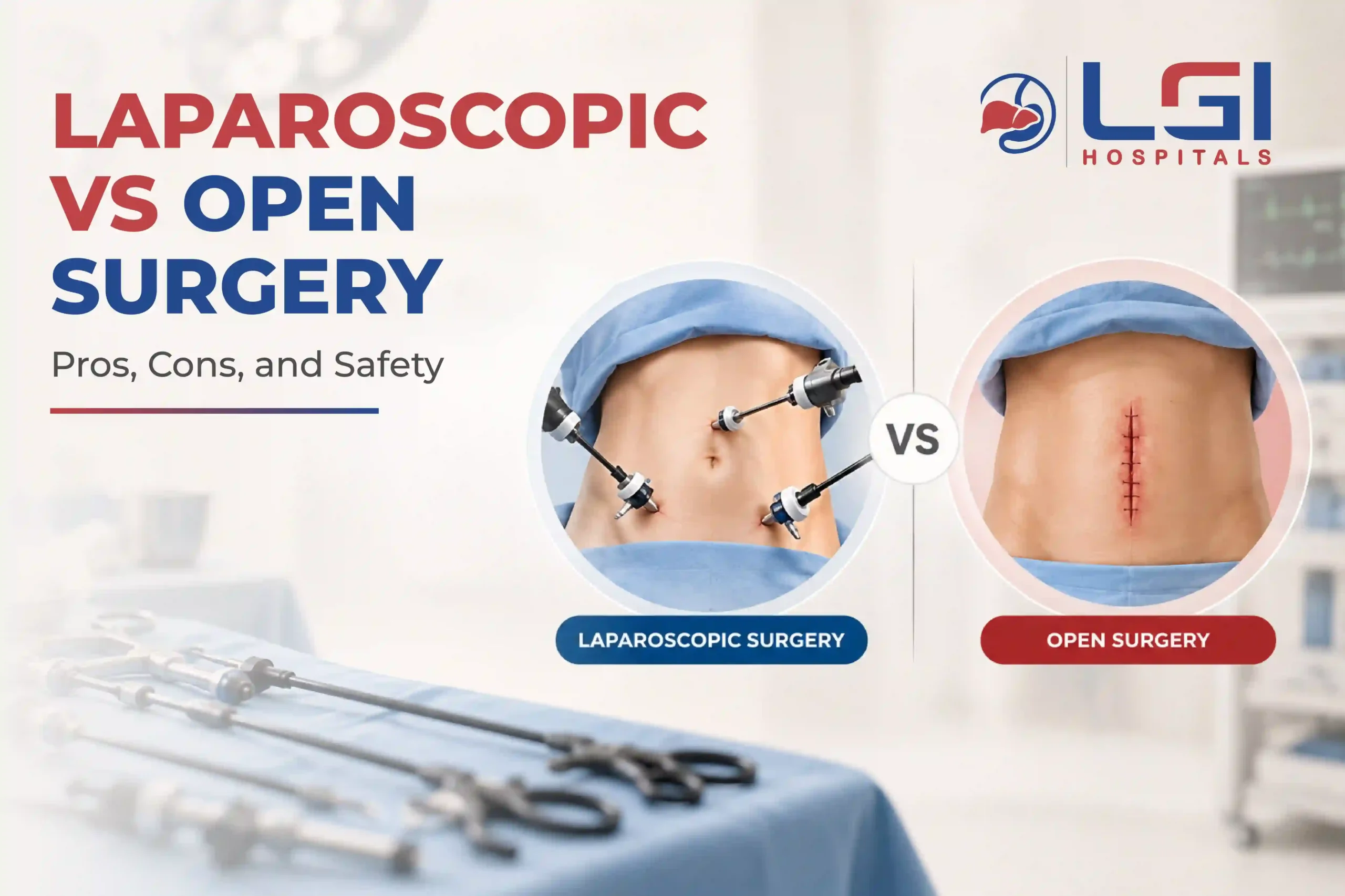
Quick Answer: Laparoscopic (minimally invasive) surgery uses small incisions and camera guidance, generally offering faster recovery and less pain than open surgery’s single larger incision. However, the right choice depends on the specific condition’s complexity and the surgeon’s assessment, since not every case is suitable for a laparoscopic approach.
What is Laparoscopic Surgery?
Laparoscopic surgery is performed through a few small incisions, typically 0.5 to 1.5 cm each, using a thin camera called a laparoscope and specialized long-handled instruments. The surgeon views the procedure on a monitor in real time rather than looking directly into an open incision. Carbon dioxide gas is used to gently inflate the abdomen, creating working space for the instruments.
At LGI Hospitals, our surgical gastroenterology team performs a wide range of laparoscopic procedures, from routine gallbladder removal to complex colorectal and pancreatic surgeries. For a detailed overview of what laparoscopic surgery involves, read our guide about laparoscopic surgery.
What is Open Surgery?
Open surgery involves a single larger incision, typically 10 to 20 cm or more, that allows the surgeon direct access to the surgical site. The surgeon can see and feel the tissues directly, which can be advantageous in complex cases or when unexpected findings require a broader view.
While laparoscopic techniques have advanced significantly, open surgery remains an important and sometimes necessary approach for certain conditions. The choice between the two depends on multiple factors that your surgeon evaluates during consultation.
Pros of Laparoscopic Surgery
| Benefit | How It Helps Patients |
| Smaller incisions | Significantly less visible scarring compared to open surgery |
| Less post-operative pain | Smaller wounds mean less tissue trauma and disruption |
| Faster recovery | Many patients return to normal daily activity sooner |
| Shorter hospital stay | Often a day or two less than a comparable open procedure |
| Lower infection risk | Smaller wounds generally reduce exposure and healing complications |
| Reduced blood loss | More precise, magnified visualization in many procedures |
| Better cosmetic results | Minimal scarring that fades over time |
Doctor’s Tip: The benefits of laparoscopic surgery are most pronounced when performed by a surgeon with dedicated minimally invasive training and consistent case volume. At LGI Hospitals, our surgeons specialize in advanced laparoscopic techniques and perform these procedures regularly, ensuring optimal outcomes.
Cons and Limitations of Laparoscopic Surgery
| Limitation | What It Means |
| Not suitable for every case | Complex, high-risk, or extensively spread conditions may require open surgery for safety |
| Requires specialized surgical skill | Outcomes depend heavily on the surgeon’s specific laparoscopic training and experience |
| Longer procedure time in some cases | Technical precision required can extend operative time |
| Conversion risk | Occasionally needs to convert to open surgery mid-procedure if unexpected complications arise |
| Limited tactile feedback | Surgeon cannot directly feel tissues as in open surgery |
| Equipment dependent | Requires specialized instruments and imaging systems |
Did You Know? Conversion from laparoscopic to open surgery during a procedure is a safety decision, not a failure. Experienced surgeons recognize when open access will provide better outcomes and make this decision proactively to ensure patient safety.
Is Laparoscopic Surgery Safe?
Yes. Laparoscopic surgery is a well-established, widely used approach across many types of GI and general surgery, with decades of clinical evidence supporting its safety profile. Safety in any individual case depends heavily on the specific condition’s complexity and the surgeon’s experience with the technique.
This is why choosing a surgeon with dedicated minimally invasive training and consistent case volume matters more than general safety statistics alone. The surgical team at LGI Hospitals has extensive experience in both laparoscopic and open approaches, allowing us to select the safest technique for each patient’s specific situation.
You can view our portfolio of surgical capabilities and case examples to understand the range of procedures we perform using minimally invasive techniques.
Recovery Comparison: Laparoscopic vs Open Surgery
| Aspect | Laparoscopic Surgery | Open Surgery |
| Incision size | Small (a few cm total) | Larger, single incision (10 to 20 cm) |
| Hospital stay | Typically 1 to 3 days | Typically 3 to 7 days |
| Return to normal activity | 1 to 2 weeks | 4 to 6 weeks |
| Post-op pain | Generally less, managed with oral medications | Generally more, may require stronger pain control |
| Scarring | Minimal, fades over time | More visible, permanent scar |
| Infection risk | Lower | Higher due to larger wound |
| Hernia risk at incision | Lower | Higher due to larger incision |
Who is a Candidate for Laparoscopic Surgery?
Suitability depends on multiple factors:
- The specific condition: Some conditions are better managed with open surgery
- Severity and complexity: Advanced disease may require open access
- Previous abdominal surgeries: Scar tissue from prior operations can make laparoscopic access difficult
- Overall health: Certain medical conditions may favor one approach over the other
- Body habitus: Severe obesity can sometimes make laparoscopic surgery more challenging
- Surgeon’s assessment: Based on imaging studies and clinical evaluation
This is why an in-person surgical consultation matters far more than deciding based on general information. What works well for one patient’s gallbladder removal may not apply to another patient’s more complex or previously operated case.
If you are considering surgery for a GI condition, book a consultation with our surgical team to discuss which approach is best for your specific situation.
Common Laparoscopic Procedures at LGI Hospitals
Our surgical gastroenterology team performs a wide range of laparoscopic procedures:
| Procedure | What It Treats |
| Laparoscopic cholecystectomy | Gallbladder removal for gallstones or inflammation |
| Laparoscopic appendectomy | Appendix removal for appendicitis |
| Laparoscopic hernia repair | Inguinal, umbilical, and incisional hernias |
| Laparoscopic colorectal surgery | Colon cancer, diverticulitis, inflammatory bowel disease |
| Laparoscopic anti-reflux surgery | GERD and hiatal hernia |
| Laparoscopic pancreatic surgery | Selected pancreatic conditions |
| Laparoscopic liver surgery | Selected liver tumors and conditions |
For comprehensive information about our laparoscopic surgery services and the conditions we treat, visit our service page.
Meet the Specialist at LGI Hospitals
Dr. Yogesh A. Bang (MS General Surgery, DNB Surgical Gastroenterology, FMAS) is a Consultant GI Surgeon at LGI Hospitals, Nagpur, trained at the Asian Institute of Gastroenterology, Hyderabad. His areas of expertise include:
- Advanced laparoscopic surgery
- Pancreato-Biliary Surgery
- Hepatic Surgery
- Upper GI and Colorectal Surgery
Dr. Bang regularly performs minimally invasive procedures across a wide range of GI conditions and has performed over 60 pancreatic resections. His training at one of India’s premier gastroenterology institutes, combined with extensive surgical experience, ensures that patients receive the highest standard of minimally invasive surgical care.
FAQs
In addition, it leaves small scars at the small cut points, which generally become less visible over time than a single larger open-surgery scar. Most patients find the scars barely noticeable after healing.
No. Complex or advanced cases are sometimes safer managed with open surgery, based on your surgeon’s assessment of your specific situation. The goal is always to choose the approach that provides the best outcome for your condition.
This is a safety decision made if the surgeon encounters something unexpected that is safer to address through an open approach. It is a recognized part of surgical practice, not a sign anything went wrong. Your surgeon will discuss this possibility during pre-operative counseling.
Costs can vary. While the procedure itself may have different costs due to specialized equipment, the shorter hospital stay and faster recovery associated with laparoscopic surgery can offset some of the difference. It is worth discussing directly with your hospital during consultation.
Laparoscopic surgery ek minimally invasive technique hai jisme chhote incisions (0.5 to 1.5 cm) ke through camera aur specialized instruments use karke surgery ki jati hai. Yeh open surgery ke mukable kam dard, chhota hospital stay, aur jaldi recovery deti hai. Yeh technique safe hai jab experienced surgeon dwara ki jaye. Har case ke liye suitable nahi hoti, isliye surgeon se consultation zaroori hai. (लैप्रोस्कोपिक सर्जरी एक मिनिमली इनवेसिव तकनीक है जिसमें छोटे चीरों के माध्यम से कैमरा और विशेष उपकरणों का उपयोग करके सर्जरी की जाती है।)
Key Takeaways
- Laparoscopic surgery uses small incisions and camera guidance for minimally invasive procedures.
- Benefits include less pain, faster recovery, shorter hospital stay, and minimal scarring.
- Not all cases are suitable for laparoscopic approach. Complex conditions may require open surgery.
- Safety depends heavily on surgeon experience and training in minimally invasive techniques.
- Conversion to open surgery during a procedure is a safety decision, not a failure.
- Recovery from laparoscopic surgery typically takes 1 to 2 weeks versus 4 to 6 weeks for open surgery.
- LGI Hospitals in Nagpur offers comprehensive laparoscopic surgery services with experienced GI surgeons.
Conclusion
The choice between laparoscopic and open surgery is not simply about which technique is better in general. It is about which approach is safest and most effective for your specific condition, your anatomy, and your overall health. Both techniques have their place in modern surgical practice, and the best outcomes come from surgeons who are skilled in both approaches and can select the right one for each patient.
If you are facing surgery for a gastrointestinal condition, the surgical gastroenterology team at LGI Hospitals, Nagpur can evaluate your case and recommend the approach that will give you the best possible outcome. With extensive experience in both laparoscopic and open techniques, we ensure that every patient receives the most appropriate and safest surgical care.
Book Your Surgical Consultation at LGI Hospitals →
Medical Disclaimer: This article is intended for educational purposes only and does not constitute medical advice, diagnosis, or treatment. Always consult a qualified surgical gastroenterologist for personalized evaluation and treatment recommendations specific to your condition.