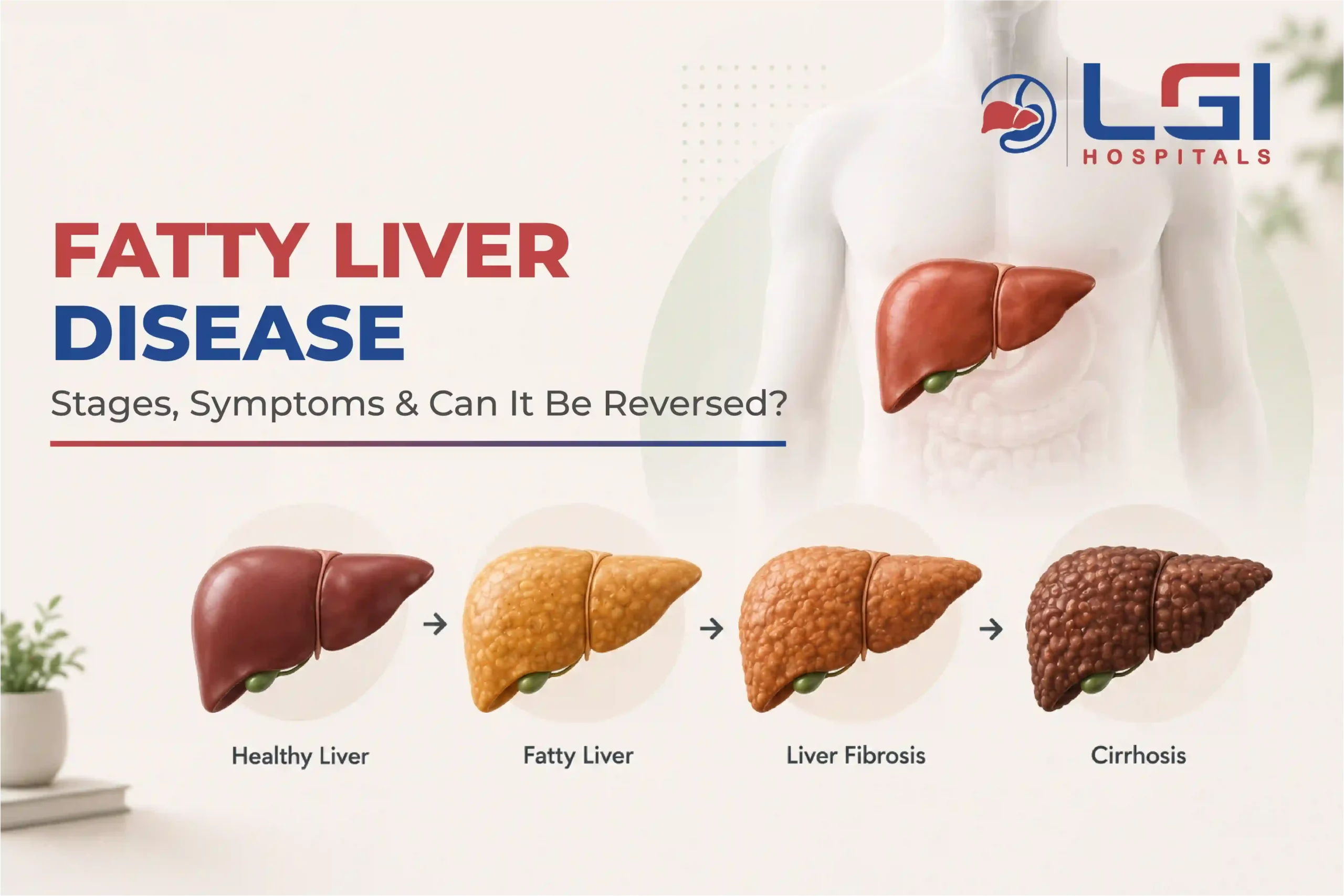
Quick Answer: Fatty liver disease progresses through four stages: simple fatty liver, steatohepatitis (NASH), fibrosis, and cirrhosis. It is often reversible in the early stages through weight loss, dietary changes, and managing underlying conditions like diabetes. Once fibrosis or cirrhosis develops, damage is largely permanent, though further progression can often be slowed with proper medical management.
What Is Fatty Liver Disease?
Fatty liver disease occurs when excess fat accumulates in liver cells, beyond what is considered normal (roughly 5 to 10 percent of the liver’s weight). It is broadly classified into two types:
- Non-Alcoholic Fatty Liver Disease (NAFLD): Linked to obesity, type 2 diabetes, and metabolic syndrome, unrelated to alcohol use. It is now one of the most common liver conditions in India.
- Alcoholic Fatty Liver Disease (AFLD): Caused by excessive, sustained alcohol consumption.
Did You Know?
India has one of the highest rates of fatty liver disease in the world, affecting an estimated 30 to 40 percent of the urban adult population. The combination of sedentary lifestyles, processed diets, and rising diabetes rates makes early screening critical.
The 4 Stages of Fatty Liver Disease
| Stage | What Happens | Reversible? | Key Symptoms |
| Stage 1: Simple Fatty Liver (Steatosis) | Fat accumulates with little to no inflammation | Yes, with diet and lifestyle changes | Usually no symptoms |
| Stage 2: Non-Alcoholic Steatohepatitis (NASH) | Fat buildup triggers inflammation and active liver cell damage | Partially, with medical management | Fatigue, mild upper right abdominal discomfort |
| Stage 3: Fibrosis | Persistent inflammation leads to scarring of liver tissue | Limited, focus shifts to slowing progression | Worsening fatigue, weakness |
| Stage 4: Cirrhosis | Severe scarring replaces healthy liver tissue | Largely irreversible | Jaundice, swelling, confusion, easy bruising |
Stage 1: Simple Fatty Liver (Steatosis)
Fat accumulates with little to no inflammation. This stage is usually reversible with diet and lifestyle changes. It often produces no symptoms at all, which is why it is frequently discovered incidentally during routine testing or an LFT blood test.
Stage 2: Non-Alcoholic Steatohepatitis (NASH)
Fat buildup triggers inflammation and active liver cell damage. This stage needs medical management, not just lifestyle changes, since inflammation left unaddressed drives progression to the next stage.
Stage 3: Fibrosis
Persistent inflammation leads to scarring of liver tissue. The liver can still function reasonably well at this stage, but the damage is now structural rather than purely functional.
Stage 4: Cirrhosis
Severe, long-term scarring replaces healthy liver tissue. At this stage, damage is largely irreversible, and the risk of liver failure, portal hypertension, or liver cancer increases significantly.
Common Symptoms by Stage
Early-stage fatty liver often causes no symptoms, so doctors describe it as “silent” until the disease progresses. When symptoms do appear, they include:
- Fatigue or persistent tiredness
- Mild discomfort or a dull ache in the upper right abdomen
- Weakness
- In advanced stages: jaundice, swelling in the legs or abdomen, easy bruising, and confusion (a sign of significant liver dysfunction)
Doctor’s Tip: If you experience persistent fatigue along with a dull ache in the upper right side of your abdomen, do not dismiss it as general tiredness. These can be early signs of fatty liver progression. A simple blood test and ultrasound at LGI Hospitals can confirm the diagnosis early, when treatment is most effective.
What Causes Fatty Liver Disease?
- Obesity or being overweight, particularly with excess abdominal fat
- Type 2 diabetes or insulin resistance
- High cholesterol or triglycerides
- A sedentary lifestyle
- Rapid weight loss (paradoxically, this can also trigger fat mobilization to the liver)
- Certain medications
- Excessive alcohol consumption (specifically for AFLD)
Can Fatty Liver Be Reversed Naturally?
In the early stages (simple fatty liver and early NASH), yes. Clinical evidence consistently shows that even a 7 to 10 percent reduction in body weight, combined with reduced intake of refined sugar and processed food, and regular physical activity, can meaningfully reduce liver fat content. This improvement is sometimes measurable within 3 to 6 months of consistent changes.
Once fibrosis or cirrhosis sets in, the scarring itself is largely permanent. However, a hepatologist can often slow further progression significantly through proper long-term management.
How Fatty Liver Is Diagnosed
| Diagnostic Method | What It Checks |
| Liver Function Tests (LFTs) | Blood tests checking liver enzyme levels like ALT and AST, though these can be normal even in confirmed fatty liver |
| Ultrasound | The most common first-line imaging test to detect fat in the liver |
| FibroScan | A specialized non-invasive test that estimates both fat content and the degree of scarring (fibrosis) |
| Liver Biopsy | Used in select, more complex cases to confirm the exact stage |
Doctors at LGI Hospitals typically recommend starting with an LFT blood test and an ultrasound. If the results suggest progression, a hepatologist may recommend a FibroScan to assess the degree of fibrosis without requiring an invasive biopsy.
Treatment Options by Stage
For Early-Stage Fatty Liver (Stage 1 and early Stage 2):
- Structured, gradual weight loss (aim for 7 to 10 percent of body weight)
- Dietary changes: reducing refined sugar, processed food, and saturated fats while increasing fiber and vegetables
- Regular physical activity (at least 150 minutes of moderate exercise per week)
- Managing underlying diabetes and cholesterol
- Complete avoidance of alcohol, regardless of the original cause
For Advanced Stages (NASH, Fibrosis):
Treatment moves beyond lifestyle changes alone and requires ongoing monitoring and medical management. The goal shifts to slowing or halting further scarring rather than full reversal. This may include targeted medications, regular follow-up with a hepatologist, and periodic imaging to monitor progression.
Doctor’s Tip: Do not attempt rapid weight loss or extreme detox diets to reverse fatty liver. Crash diets can actually worsen liver inflammation. Gradual, sustainable weight loss of 0.5 to 1 kg per week is the safest and most effective approach.
Meet the Specialists at LGI Hospitals
Fatty liver management benefits from dedicated hepatology expertise. Dr. Manoj A. Vyawahare specializes in Hepatology alongside Luminal Gastroenterology, and Dr. Prashant Bhandarkar brings over 30 years of Hepatology-focused clinical experience. Together, they offer comprehensive fatty liver specialist care from diagnosis through long-term management at LGI Hospitals, Nagpur.
FAQs
Measurable improvement is often seen within 3 to 6 months of consistent weight loss and dietary changes, though this varies by individual, starting stage, and how consistently changes are maintained.
For many early-stage patients, yes. Lifestyle changes alone can be effective. Your doctor will determine whether you also need medication based on your specific stage and risk factors.
Yes. While obesity is the most common risk factor, fatty liver can also develop in people with normal body weight, particularly those with insulin resistance or specific metabolic factors. Doctors sometimes call this condition “lean fatty liver.”
No. Many people with simple fatty liver never progress further, especially with early lifestyle intervention. Progression risk is higher with ongoing untreated inflammation (NASH).
Yes, strongly. Insulin resistance and type 2 diabetes are among the leading risk factors, and the two conditions often need to be managed together for the best outcomes.
Fatty liver ek condition hai jisme liver cells mein excess fat jama ho jata hai. Shuruaati stages mein ise weight loss, sahi diet, aur exercise se reverse kiya ja sakta hai. Agar fibrosis ya cirrhosis ho gaya hai, to damage permanent ho sakta hai, lekin progression ko slow kiya ja sakta hai. (फैटी लीवर एक ऐसी स्थिति है जिसमें लीवर कोशिकाओं में अतिरिक्त वसा जमा हो जाती है। शुरुआती चरणों में इसे वजन घटाने, सही आहार और व्यायाम से उलटा किया जा सकता है।)
Key Takeaways
- Fatty liver disease progresses through four stages: simple fatty liver, NASH, fibrosis, and cirrhosis.
- Early-stage fatty liver is often silent and detected incidentally through routine testing.
- It is reversible in early stages through 7 to 10 percent weight loss, dietary changes, and regular exercise.
- Advanced stages (fibrosis and cirrhosis) involve permanent scarring, but progression can be slowed.
- Diagnosis typically involves LFT blood tests, ultrasound, and sometimes FibroScan.
- LGI Hospitals in Nagpur offers comprehensive fatty liver care from diagnosis through long-term management.
To Wrap it Up
Fatty liver disease is one of the most common and most underestimated liver conditions in India today. The good news is that in its early stages, it is entirely reversible with the right combination of lifestyle changes and medical guidance. The key is early detection and consistent management before irreversible scarring develops. If you have been diagnosed with fatty liver or are experiencing persistent fatigue and abdominal discomfort, the hepatology team at LGI Hospitals, Nagpur is here to help you understand your condition and create a personalized reversal plan.
Book Your Consultation at LGI Hospitals →
Medical Disclaimer: This article is intended for educational purposes only and does not constitute medical advice, diagnosis, or treatment. Always consult a qualified gastroenterologist or hepatologist for accurate diagnosis and appropriate care.