
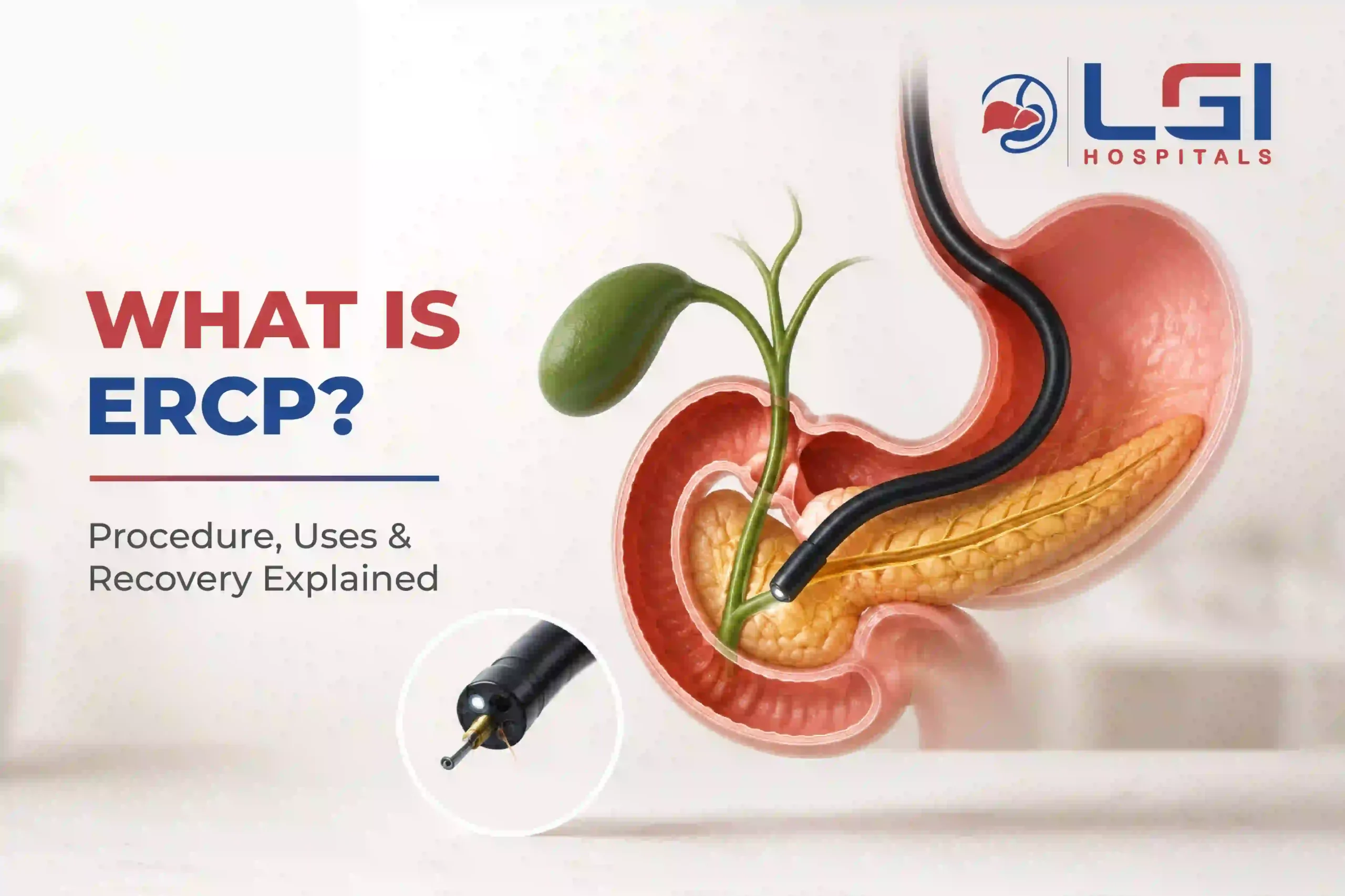
Quick Answer: ERCP (Endoscopic Retrograde Cholangiopancreatography) is a minimally invasive procedure that combines endoscopy with X-ray imaging to diagnose and treat problems in the bile ducts and pancreas. It can remove gallstones, open narrowed ducts with stents, and relieve blockages, often treating the problem in the same session it is diagnosed. It is not a major surgery.
Hearing a doctor recommend a medical procedure with a long, complex acronym can be an intimidating experience. If you or a loved one has recently been referred to a gastroenterologist for unexplained abdominal pain or jaundice, you have likely encountered the term ERCP. This guide from LGI Hospitals breaks down exactly what the ERCP meaning is, how the procedure works, and what recovery looks like, so you can face your appointment with confidence.
Breaking Down the ERCP Meaning
ERCP stands for Endoscopic Retrograde Cholangiopancreatography. While it sounds like a mouthful, breaking the word into its four parts makes it much easier to understand:
- Endoscopic: The doctor uses an endoscope, which is a flexible, lighted tube with a high-definition camera on the tip.
- Retrograde: The physician injects a special contrast dye backward, or upward, into your ducts to make them visible on an X-ray.
- Cholangio: This refers to the bile ducts, the tubes that carry bile from the liver and gallbladder.
- Pancreatography: This refers to the pancreatic ducts.
In simple terms, the ERCP meaning boils down to this: it is a highly advanced, minimally invasive technique that allows specialists to diagnose and treat problems in the plumbing of your liver, gallbladder, and pancreas without making a single surgical incision.
ERCP at a Glance
| Feature | Details |
| Full Form | Endoscopic Retrograde Cholangiopancreatography |
| Procedure Type | Minimally invasive endoscopy, not open surgery |
| Area Treated | Bile ducts and pancreatic ducts |
| Typical Duration | 30 to 90 minutes |
| Anesthesia | IV sedation or general anesthesia |
| Hospital Stay | Same-day discharge or one night of observation |
| Recovery Time | 1 to 2 days for normal activity |
How ERCP Works
A thin, flexible endoscope is passed through the mouth, down through the stomach, and into the first part of the small intestine, where the bile duct and pancreatic duct open. A small catheter is then passed through the endoscope into these ducts, and contrast dye is injected while X-ray images are taken. This combination allows the doctor to see blockages, narrowing, or stones that would not be visible with a standard endoscope alone.
If a problem is identified, the doctor can often treat it immediately using specialized tools passed through the same endoscope.
Did You Know?
Unlike a standard endoscopy that only looks at the stomach, ERCP is largely therapeutic. Doctors use it to fix problems in real time, making it a cornerstone of modern digestive healthcare.
What ERCP Can Diagnose and Treat
- Gallstones in the bile duct: Doctors can capture and remove these stones using a small basket or balloon device.
- Bile duct strictures (narrowing): Often relieved by placing a small tube called a stent to hold the duct open.
- Chronic pancreatitis complications: Including blocked pancreatic ducts.
- Bile or pancreatic duct leaks: Commonly seen after gallbladder surgery.
- Bile duct or pancreatic tumors: For both diagnostic tissue sampling and palliative stent placement to relieve blockage-related jaundice.
Who Typically Needs ERCP
Doctors usually recommend ERCP after imaging, such as an ultrasound or MRI, suggests a problem with the bile duct or pancreatic duct. It is rarely a first-line test because it is more invasive than standard imaging. Common triggers for an ERCP referral include:
- Unexplained jaundice with duct dilation on imaging.
- Gallstone pancreatitis.
- Persistent abnormal liver function tests pointing toward a duct obstruction.
What Happens During the Procedure
Doctors perform the procedure under sedation, so patients usually remain relaxed and do not feel it. The procedure typically takes 30 to 90 minutes, depending on the treatment needed. Afterward, medical staff monitor patients before they go home the same day or stay overnight for observation, depending on the case complexity.
ERCP Recovery: What to Expect
- First few hours: Grogginess from sedation, mild throat discomfort from the endoscope, and a bloated feeling from air introduced during the procedure. These typically resolve within a day.
- First 24 hours: A light diet is usually recommended initially, progressing to normal food as tolerated. Strenuous activity is generally avoided for the rest of the day.
- If a stent was placed: Your doctor will explain whether it is temporary and needs removal in a follow-up procedure, or long-term, and what symptoms would indicate it needs attention.
- Watch for: Severe abdominal pain, fever, or vomiting in the days following the procedure. These symptoms may rarely indicate complications such as pancreatitis. Report them immediately rather than waiting.
Most patients resume normal activities within 1 to 2 days, although recovery time varies based on the procedure and individual healing.
Doctor’s Tip: Mild throat soreness and bloating after ERCP are completely normal. However, if you develop severe abdominal pain, fever, or vomiting at home, do not wait for your follow-up. Contact the hospital immediately.
Meet the Specialist
Dr. Prashant Bhandarkar (MD, DNB Medicine, DM, DNB Gastroenterology) brings over 30 years of experience in critical care gastroenterology and advanced therapeutic endoscopy, with a specific focus on ERCP and Hepatology. He trained in GI endoscopy at centres across Europe and the USA. He pioneered third-space endoscopy in Central India and performs complex procedures such as POEM, EMR, and ESD.
Why Specialized Care Matters for ERCP
Because ERCP requires a high degree of precision and specialized equipment, it is not a procedure that just any doctor can perform. It requires an advanced gastroenterologist who specializes in therapeutic endoscopy. When dealing with complex liver, bile duct, or pancreatic issues, it is vital to seek care from a dedicated center like LGI Hospitals in Nagpur. Our facility provides advanced imaging suites, in-house diagnostics, and emergency backup to help doctors perform your procedure safely and effectively.
1
FAQs
No. ERCP is a non-surgical endoscopic procedure. Because the doctor accesses the ducts naturally through the mouth and digestive tract, there are no incisions, no stitches, and no scarring. However, it can achieve outcomes, like removing a bile duct stone, that would otherwise require open surgery.
You will not feel pain during the procedure. Doctors perform it under IV sedation or general anesthesia, which keeps you deeply relaxed or completely asleep.You may experience a mild sore throat or slight bloating for a day or two afterward, but you can easily manage these symptoms.
Yes, this is one of its most common uses. If a gallstone has slipped out of the gallbladder and become stuck in the common bile duct, the specialist can use tiny tools, such as a small balloon or a wire basket, to capture the stone and gently pull it out.
Most patients can resume a light diet within a few hours, progressing to normal food as advised. Your doctor will decide this based on what they did during your procedure.
Like any procedure, ERCP carries some risk, including a small chance of pancreatitis, bleeding, or infection. The specialists at LGI Hospitals take extensive preventative measures, including administering medications during the procedure, to minimize these risks.
Sometimes. For example, if doctors placed a temporary stent, they may need a follow-up procedure to remove or replace it or confirm the problem has resolved.
Yes. In the hands of an expert endoscopist, the success rate for locating the ducts, removing stones, and placing stents is well over 90 percent, effectively sparing most patients from invasive open abdominal surgery.
ERCP ka matlab hai ek advanced endoscopic procedure jo bile ducts aur pancreas ki samasyaon, jaise gallstones ya blockages, ko diagnose aur treat karti hai. Yeh bina kisi surgical cut ke ki jati hai. (ईआरसीपी एक उन्नत एंडोस्कोपिक प्रक्रिया है जो पित्त वाहिका और अग्नाशय की समस्याओं का निदान और उपचार करती है।)
Key Takeaways
- ERCP is a minimally invasive procedure, not a major surgery.
- It combines endoscopy and X-ray imaging to treat bile duct and pancreatic problems in real time.
- Common uses include removing bile duct stones, placing stents, and treating strictures.
- Most patients go home the same day and return to normal activity within 1 to 2 days.
- ERCP requires a highly trained therapeutic endoscopist, which is why choosing a specialized center like LGI Hospitals matters.
Conclusion
Understanding the ERCP meaning removes the fear of the unknown. It is not a major surgery, but rather a brilliant, minimally invasive solution to some of the digestive system’s most painful and dangerous blockages. If you are experiencing symptoms like persistent abdominal pain, unexplained jaundice, or abnormal liver function tests, do not ignore them. Early intervention is the key to preventing severe infections or liver damage. The gastroenterology team at LGI Hospitals, Nagpur is here to guide you through every step, from diagnosis to a swift recovery.
Book Your Consultation at LGI Hospitals →
Medical Disclaimer: This article is intended for educational purposes only and does not constitute medical advice, diagnosis, or treatment. Always consult a qualified gastroenterologist for any medical concerns. Seek immediate medical attention in case of a medical emergency.