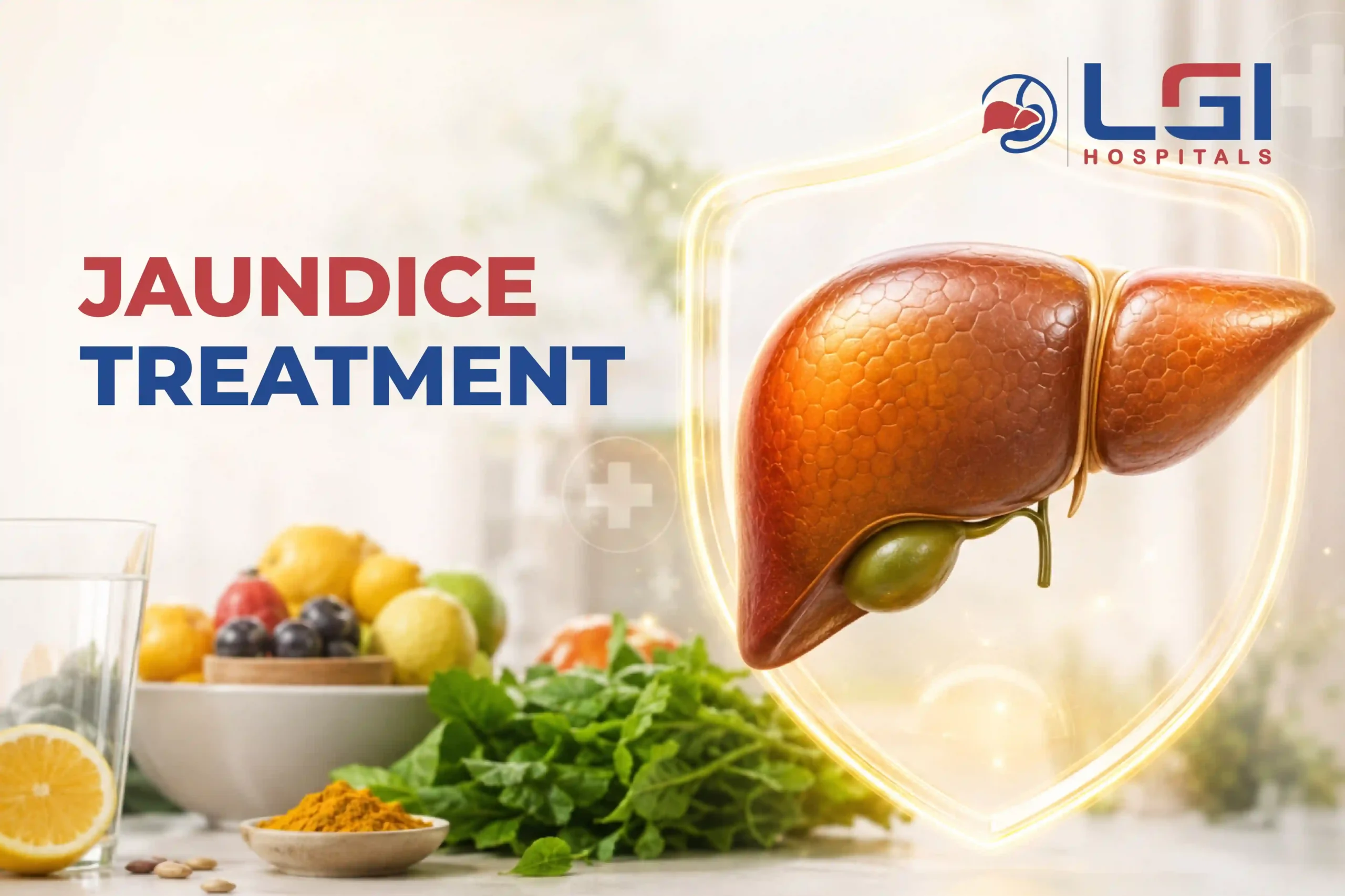
Waking up to a yellowish tint on your skin or in the whites of your eyes can be alarming. It’s natural to want a quick fix, but jaundice isn’t something to self-manage with home remedies alone.
This article, prepared with the gastroenterology team at LGI Hospitals in Nagpur, explains what jaundice actually is, the different causes behind it, how the treatment of jaundice in adults typically works, the right diet for jaundice treatment, and when yellowing skin needs urgent medical attention rather than a wait-and-watch approach.
What Is Jaundice?
Jaundice is a medical condition marked by a yellowish tinge in the skin, the whites of the eyes, and sometimes the inside of the mouth. It happens when there’s too much bilirubin, a yellow-orange pigment created when the body breaks down old red blood cells, circulating in the blood.
Under normal conditions, the liver processes bilirubin and sends it out of the body through bile. When something disrupts this process, whether that’s red blood cells breaking down faster than usual, liver cells that can’t filter bilirubin properly, or a blocked path for bile to drain – bilirubin builds up in the blood, and jaundice appears.
It’s worth understanding this clearly: jaundice is not a disease in itself. It’s a visible warning sign that something further upstream, in the blood, the liver, or the bile ducts, needs medical attention.
What Are the Main Causes of Jaundice?
Doctors categorize the causes of jaundice into three broad types, based on where in the process things go wrong:
| Type | What Happens | Common Triggers |
| Pre-Hepatic (Hemolytic) | Red blood cells break down faster than the liver can process the bilirubin they release | Malaria, thalassemia, sickle cell anaemia |
| Hepatic (Hepatocellular) | The liver itself is damaged and cannot filter bilirubin properly | Viral hepatitis (A, B, C, E), chronic alcohol use, cirrhosis |
| Post-Hepatic (Obstructive) | Bilirubin is processed normally, but a blocked bile duct prevents it from draining | Gallstones, cysts, tumours |
Identifying which of these three categories a patient falls into is the first and most important step, because it directly determines which treatment of jaundice in adults will actually work.
What Are the Symptoms of Jaundice?
Beyond the visible yellowing of the skin and eyes, jaundice often comes with other signs that point toward how significant the underlying problem is:
| Symptom | What It May Suggest |
| Dark-coloured urine | Excess bilirubin being filtered out through the kidneys |
| Pale or clay-coloured stools | Reduced bile reaching the intestines, often from a blockage |
| Persistent itching | Bile salts building up under the skin |
| Fatigue and weakness | General liver stress or an underlying infection |
| Abdominal pain, especially upper right side | Liver inflammation or gallbladder involvement |
| Nausea, vomiting, or loss of appetite | Common with both hepatic and obstructive causes |
Not every case shows all of these signs, and severity varies widely from person to person, which is exactly why a proper diagnosis matters more than self-assessment.
Treatment of Jaundice in Adults
Because jaundice is a symptom rather than a standalone disease, there’s no single medicine that treats it directly. The treatment of jaundice in adults is built around identifying and managing the root cause:
When a viral infection or hepatitis is responsible, care focuses on supporting the liver while it heals, with medical management guided by a specialist based on which virus is involved.
The cause lies in the immune system affecting red blood cells, doctors evaluate and manage this under close specialist supervision.
When a gallstone, cyst, or tumour is blocking the bile duct, the blockage itself needs to be addressed, often through an endoscopic or minimally invasive procedure.
Accurate diagnosis is what makes this possible. At LGI Hospitals, Nagpur, patients have access to in-house Liver Function Tests (LFTs), ultrasounds, and CT scans, so the gastroenterology team can pinpoint the cause without delay. For obstructive cases, our specialists also perform ERCP, a minimally invasive endoscopic technique used to clear blocked bile ducts, which can often avoid the need for major open surgery. You can read more about our approach on our jaundice treatment page.
Diet for Jaundice Treatment: What to Eat and Avoid
When the liver is under strain, digestion takes a hit too, since the liver produces the bile needed to break down fat. This is why the right jaundice treatment food matters almost as much as medical care itself.
A sensible diet for jaundice treatment focuses on reducing the liver’s workload while still providing enough energy for it to heal.
| Foods to Include | Foods to Avoid |
| Easily digestible carbs – oats, brown rice, whole wheat | Alcohol, in any amount |
| Fresh fruits – papaya, watermelon, oranges | Fried, oily, or heavy foods |
| Leafy greens and vegetables | Processed foods and refined sugar |
| Light plant-based proteins – moong dal | Over-the-counter painkillers (e.g., high-dose paracetamol) without medical supervision |
| Plenty of fluids – water, coconut water | Unverified herbal supplements |
These dietary changes support recovery, but they work alongside medical treatment, not instead of it.
Recovery Timeline and How LGI Hospitals Supports Healing
The liver has a genuine ability to regenerate, and in many cases of viral hepatitis, especially Hepatitis A or E, jaundice resolves within about 1 to 4 weeks of proper care. However, this timeline doesn’t apply to everyone. Hepatitis B and C can become chronic infections that need longer-term management rather than a quick recovery, and jaundice occurring during pregnancy needs prompt specialist evaluation, since it can carry added risk for both mother and baby.
This is why recovery should never be left to guesswork. At LGI Hospitals, Nagpur, care continues well beyond the initial diagnosis:
● Continuous monitoring of bilirubin and liver enzyme levels through follow-up LFTs
● A personalised care plan based on your specific diagnosis, whether that’s viral hepatitis, a bile duct blockage, or another cause
● In-house endoscopy and surgical support for advanced procedures like ERCP, without treatment delays
● Guidance on diet, hydration, and rest to follow at home after discharge
● Protection against self-medication, since some unverified herbal or traditional remedies are hepatotoxic and can turn a manageable case into a medical emergency
When Should You Seek Emergency Care?
Most cases of jaundice are manageable with timely treatment, but certain signs point to a medical emergency and need immediate attention rather than a scheduled appointment:
- High fever with chills alongside yellowing skin (a possible sign of bile duct infection)
- Severe or worsening abdominal pain
- Confusion, drowsiness, or difficulty staying alert
- Vomiting blood or passing black, tarry stools
- Jaundice appearing during pregnancy or in a newborn
If you notice any of these, don’t wait for a routine appointment, head to an emergency department. For other cases, booking a consultation with a gastroenterologist at LGI Hospitals is the right step toward an accurate diagnosis.
FAQs
There isn’t one “best” treatment, because jaundice is a symptom, not a disease — the right approach depends entirely on its root cause. Viral causes require supportive medical care under a specialist, while doctors may monitor and manage immune-related causes more closely. Doctors treat blockages caused by gallstones or tumours by clearing the obstruction, often through an endoscopic procedure such as ERCP. An accurate diagnosis is what determines the right path, which is why self-treating based on guesswork isn’t advisable.
Doctors may recommend rest, hydration, and a bland, low-fat diet alongside medical supervision. Home care can support recovery once a doctor has identified the cause, but it cannot treat the underlying condition on its own. Avoid unverified herbal remedies or supplements, since some are toxic to the liver.
Foods that are easy to digest and low in fat tend to work best, including fresh fruits like papaya and citrus, vegetables, whole grains, and light plant-based proteins such as moong dal. Staying well-hydrated with water or coconut water also helps. Fried, processed, and sugary foods, along with alcohol, should be avoided, since they add strain to a liver that’s already working hard to recover.
The causes fall into three broad categories: pre-hepatic, where red blood cells break down faster than the liver can process them (as in malaria or thalassemia); hepatic, where the liver itself is damaged, often by hepatitis, alcohol, or cirrhosis; and post-hepatic, where a blocked bile duct, usually from gallstones or a tumour, prevents bilirubin from draining properly.
Jaundice itself is a warning sign rather than harm in itself, but how serious it becomes depends entirely on its cause. Mild viral hepatitis, for instance, often resolves within a few weeks with proper care. Left untreated, however, causes like a blocked bile duct or certain infections can progress to serious complications, including acute liver failure, which is why prompt evaluation matters.
Yes. The liver is one of the few organs capable of regenerating its own tissue. Once the underlying cause is treated and the patient follows medical advice on diet and rest, bilirubin levels typically normalise and the yellowing of the skin and eyes fades gradually. Recovery time varies depending on the cause, from a few weeks for some viral infections to longer for chronic liver conditions.
Key Takeaways
Jaundice is a symptom of an underlying issue in the blood, liver, or bile ducts, not a disease itself.
Causes fall into three categories – pre-hepatic, hepatic, and post-hepatic – each needing a different treatment approach.
Treatment of jaundice in adults always targets the root cause, not just the yellow colour.
A low-fat, easily digestible diet supports recovery but cannot replace medical treatment.
Many cases of viral hepatitis resolve in 1- 4 weeks, but Hepatitis B and C can become chronic and need longer-term care.
Avoid unverified herbal remedies – some are toxic to the liver and can worsen the condition.
Seek emergency care for high fever, severe pain, confusion, or jaundice during pregnancy or in a newborn.
Conclusion
Jaundice deserves prompt medical attention rather than panic or guesswork. With accurate diagnosis, the right category of treatment, and a properly monitored recovery plan, the vast majority of cases are fully treatable, and the liver’s natural ability to heal does the rest.
If you or a loved one are noticing yellowing skin or eyes, don’t wait it out. The gastroenterology team at LGI Hospitals, Nagpur offers in-house diagnostics, personalised treatment, and advanced endoscopic care to guide you through a safe recovery. Book your appointment at LGI Hospitals today for an accurate diagnosis and the right treatment plan for your specific condition.
Medical Disclaimer :This article is for educational purposes only and is not a substitute for professional medical advice, diagnosis, or treatment. Always consult a qualified physician for any medical concerns. LGI Hospitals assumes no liability for actions taken based on this content. Seek immediate medical attention in case of a medical emergency.
Tags: Jaundice, Bilirubin, Liver Health, Hepatitis, LGI Hospitals
Book Your Appointment at LGI Hospitals Now →
If you’d prefer to read about early warning signs in Hindi, you can also see our liver disease symptoms guide in Hindi.