
“Is this a fissure or piles?” This is one of the most common questions people type into Google at midnight, hoping for a clear answer. And while the internet can give you a long list of possibilities, it cannot examine you, take your history or tell you what is actually happening inside your body. Only a trained specialist can do that.
At LGI Hospitals in Nagpur, a dedicated gastroenterology and liver hospital located in Dhantoli near Yashwant Stadium, our team of senior medical gastroenterologists and a GI surgeon see fissure and piles cases every single day. They know exactly what questions to ask, what to look for and how to tell the two conditions apart safely and accurately.
This blog will explain the fissure vs piles difference in plain language, walk you through how doctors actually make this distinction, and guide you clearly on which doctor to consult for piles or a fissure—and why getting that choice right matters more than you might think.
What Are Piles?
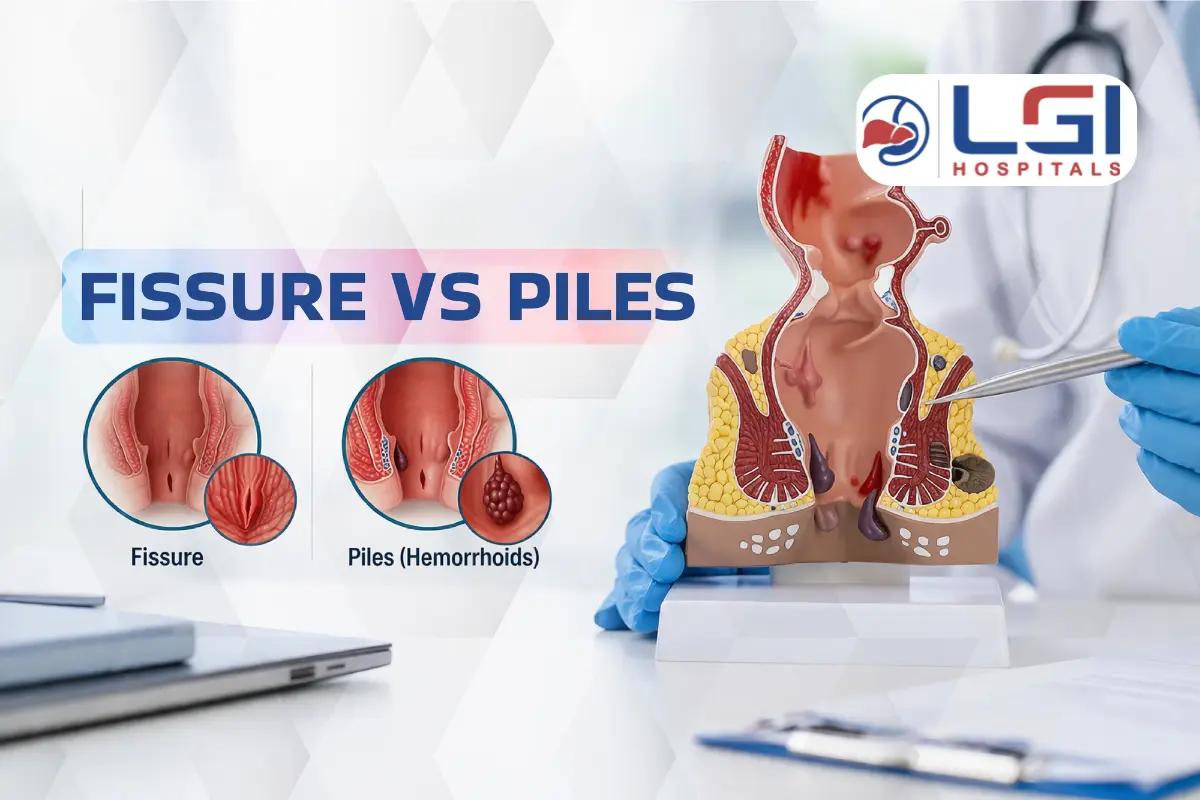
Piles, medically called haemorrhoids, are swollen, inflamed veins inside or around the anal canal. They can be internal (inside the rectum), external (under the skin around the anus), prolapsed (internal piles that push out) or thrombosed (when a blood clot forms inside). They are very common and are often triggered by chronic constipation, straining, prolonged sitting and a low‑fibre diet.
For a complete explanation of causes, types, symptoms, grades and all available treatment options, read Piles Problem: Causes, Types, Symptoms and Treatment Options Explained on the LGI Hospitals website.
What Is an Anal Fissure?
An anal fissure is a small but painful tear in the thin lining of the anal canal. Unlike piles, which involve swollen veins, a fissure is a wound, and it behaves like one: it hurts sharply, it may bleed a little, and it often feels worse after passing stool, sometimes for hours afterward.
Common causes include passing hard, dry stool, chronic constipation, straining during bowel movements, diarrhoea and in some cases, childbirth. Fissures can be acute (fresh, usually healing within a few weeks with proper care) or chronic (lasting more than six to eight weeks, often with a small skin tag forming near the tear that patients frequently mistake for an external pile).
This is exactly where the confusion begins, and why self‑diagnosis can send you in the wrong direction entirely.
Fissure vs Piles Symptoms: What Doctors Look For
When you walk into a gastroenterologist’s clinic with rectal pain or bleeding, the doctor does not simply look at you and guess. They ask a very specific set of questions and conduct a careful examination.
Questions a gastroenterologist typically asks:
- When did the pain or bleeding start?
- Does the pain happen during the bowel movement, after it, or both?
- How long does the pain last after passing stool?
- Is there visible blood? Is it on the tissue paper, in the toilet bowl or mixed with stool?
- Is there a lump? Does it go back in on its own, or do you have to push it in?
- Have your bowel habits changed recently?
- Do you strain when passing stool?
What they look for on examination:
- A visible tear or skin tag near the anal opening (suggests fissure)
- A soft, bluish or swollen lump (suggests external pile or thrombosed haemorrhoid)
- Internal swelling felt on digital rectal examination or seen on proctoscopy (suggests internal piles)
- Spasm of the anal sphincter muscle (strongly suggests chronic fissure)
Many people who search terms like “fisher piles” are actually dealing with one or the other, but the symptoms overlap enough that a clinical examination is the only reliable way to know.
Fissure vs Piles at a Glance
| Feature | Anal Fissure | Piles (Haemorrhoids) |
| What it is | A tear in the anal canal lining | Swollen veins in or around the rectum |
| Pain pattern | Sharp, burning pain during and after stool; lasts hours | Discomfort or pressure; often mild unless thrombosed |
| Bleeding | Small, bright red streak on tissue/stool, painful | Bright red blood, may drip; often painless (internal) |
| Lump | Usually none; chronic fissure may have small skin tag | Visible or palpable lump, internal or external |
| Main cause | Hard stool, straining, constipation, diarrhoea | Chronic constipation, straining, prolonged sitting, low fibre |
| Sphincter spasm | Common and significant | Rare |
| Confusion factor | Skin tag can look like a pile | Internal piles not visible without proctoscopy |
| First‑line treatment | Diet, sitz baths, ointments, stool softeners | Lifestyle changes, office procedures, surgery if advanced |
| LGI specialist | Medical gastroenterologist → GI surgeon if surgery | Medical gastroenterologist → GI surgeon for Grade 3 or 4 |
The colloquial term “fisher piles” usually reflects this confusion between fissure and piles rather than a separate disease.
How LGI Specialists Diagnose Fissure vs Piles
At LGI Hospitals, diagnosis always begins with a detailed history taken by a medical gastroenterologist. Nothing is rushed. The doctor listens carefully to your symptoms, their timeline, your bowel habits and any associated signs before proceeding to examination.
The physical examination includes visual inspection of the anal area and, where appropriate, a digital rectal examination. Proctoscopy, a quick and minimally uncomfortable in‑clinic procedure, allows the doctor to directly visualise the interior of the anal canal and lower rectum, making it possible to confirm internal piles, assess their grade and rule out other causes of bleeding.
When red‑flag signs are present, including bleeding in older patients, unexplained weight loss, change in stool calibre or a family history of colorectal disease, the gastroenterologist will recommend a colonoscopy to ensure nothing more serious is being missed.
The key advantage at LGI is that all of this happens under one roof. Medical gastroenterologists and the GI surgeon work as a team, share records and discuss complex cases together, so you do not need to visit multiple hospitals or carry files from one specialist to another.
Throughout this process, patient comfort, privacy and dignity are prioritised. Anorectal examinations are conducted with full sensitivity, and you will always be told what is happening and why.
Anal Fissure Treatment vs Piles Treatment: Who Handles What
For anal fissures, the first approach is conservative: a high‑fibre diet, adequate water intake, warm sitz baths two to three times daily, stool softeners and topical ointments to reduce pain and promote healing. At LGI, the medical gastroenterologist manages this phase completely. If the fissure does not heal and becomes chronic, treatment may escalate to topical calcium channel blockers or nitrates, and in some cases, Botox injection into the sphincter to relieve the spasm that prevents healing. When none of these work, the GI surgeon steps in for a minor surgical procedure called lateral internal sphincterotomy, which has a very high success rate.
For piles, treatment depends on the grade and type. Medical gastroenterologists at LGI handle lifestyle guidance, dietary changes and office‑based procedures such as rubber band ligation (banding), sclerotherapy and infrared coagulation for Grade 1 and Grade 2 piles. For Grade 3 and Grade 4 piles, or cases that have not responded to minimally invasive procedures, the GI surgeon leads the surgical management. For a detailed guide on piles grades and all treatment options, read Piles Problem: Causes, Types, Symptoms and Treatment Options Explained.
The key message is this: if your symptoms have not improved after two weeks of home management, it is time to see a specialist.
Which Doctor to Consult for Piles and Fissure?
Which doctor to consult for piles or a fissure as your first step? A medical gastroenterologist. This is the specialist trained to evaluate all symptoms related to the digestive tract, including rectal bleeding, anal pain, changes in bowel habits and suspected anorectal conditions. They will take a complete history, perform the appropriate examination and either manage your condition medically or coordinate with a surgeon when needed.
At LGI Hospitals, Nagpur, this role is led by senior specialists like Dr Prashant Bhandarkar and Dr Manoj A Vyawahare, who bring decades of experience in medical gastroenterology, advanced endoscopy and complex digestive disorders. They routinely evaluate anorectal symptoms such as fissure, piles, fistulas and unexplained rectal bleeding, and are trained to distinguish benign conditions from more serious diseases using endoscopy, colonoscopy and targeted medical management.
When conservative or minimally invasive treatments are not enough, your care seamlessly extends to GI and colorectal surgery under Dr Yogesh A Bang, an accomplished surgical gastroenterologist with specialised training in hepatobiliary, pancreatic and colorectal surgery and a strong track record in minimally invasive procedures. This team‑based model means you are first seen by a medical gastroenterologist, investigated under one roof, and, if needed, handed over directly to a GI surgeon who already knows your case—no running between hospitals, no repeated explanations, and no break in continuity of care.
For a full breakdown of specialist roles and how to choose between a gastroenterologist, proctologist and general surgeon, read Which Doctor to Consult for Piles? Proctologist vs General Surgeon Explained on the LGI Hospitals website.
When to Stop Guessing and Visit LGI Hospitals, Nagpur
Do not wait if you experience any of the following:
- Rectal bleeding that continues for more than two to three days, even if small in amount
- Severe or worsening pain during or after bowel movements
- A lump near the anus that does not go back in on its own
- Symptoms that keep recurring every few weeks despite diet changes
- Unexplained weight loss combined with any bowel symptom
- A significant change in stool colour (dark or tarry stools), consistency or frequency that persists beyond two to three weeks
- A family history of colorectal cancer or inflammatory bowel disease
At LGI Hospitals, the path from symptom to solution is straightforward. You book a consultation, you are seen by a medical gastroenterologist, the appropriate investigations are done under the same roof, and if surgery or an advanced procedure is needed, the GI surgeon is part of the same team.
FAQs
Q1. Which doctor should I see first for “fisher piles” type symptoms, meaning rectal pain and bleeding?
See a medical gastroenterologist first. They are trained to evaluate all anorectal symptoms, distinguish between fissure and piles accurately, and manage both conditions medically; if surgery is necessary, they coordinate directly with a GI surgeon.
Q2. Can a gastroenterologist treat both fissure and piles, or do I always need a surgeon?
Yes, a medical gastroenterologist manages the majority of fissure and piles cases, including conservative treatment, office‑based procedures and medical escalation; surgery is reserved for chronic, severe or advanced cases.
Q3. When do I need a GI or colorectal surgeon instead of a physician?
You need a GI surgeon when a fissure has not healed with medication and Botox, when piles are Grade 3 or 4, when there is recurrent prolapse, or when office procedures have not given lasting relief.
Q4. Is it okay to see a general surgeon for piles if there is no gastroenterologist nearby?
A general surgeon can manage straightforward cases, but at a super‑specialty centre like LGI Hospitals in Nagpur, GI and colorectal surgery is handled by a specialist with dedicated training in this field and access to advanced minimally invasive options.
Q5. Can I self‑diagnose using online symptom checkers?
You can use them to get a rough idea, but they cannot examine you, assess sphincter spasm, perform proctoscopy or rule out conditions that mimic piles and fissures, including polyps or early colorectal disease; a clinical evaluation by a trained gastroenterologist is always safer.
Wrapping Up
Understanding the fissure vs piles difference is genuinely useful, but the most important step is seeing the right doctor. The right specialist will give you a correct diagnosis, appropriate treatment and peace of mind, things a search engine simply cannot provide.
The team at LGI Hospitals in Nagpur brings together deep expertise in medical gastroenterology, endoscopy and GI surgery to ensure every patient with anorectal symptoms gets the right answer and the right care plan. To know more about our specialists, visit the LGI Hospitals doctor profiles page, and to book your consultation for piles, fissure or any other digestive concern.
Disclaimer:
This blog is intended for informational and educational purposes only and should not be considered medical advice. While it explains the differences between fissure and piles based on clinical understanding, it cannot replace a proper medical evaluation. As diagnosis requires physical examination and sometimes procedures like proctoscopy or colonoscopy, always consult a qualified medical gastroenterologist or specialist for accurate diagnosis and treatment