
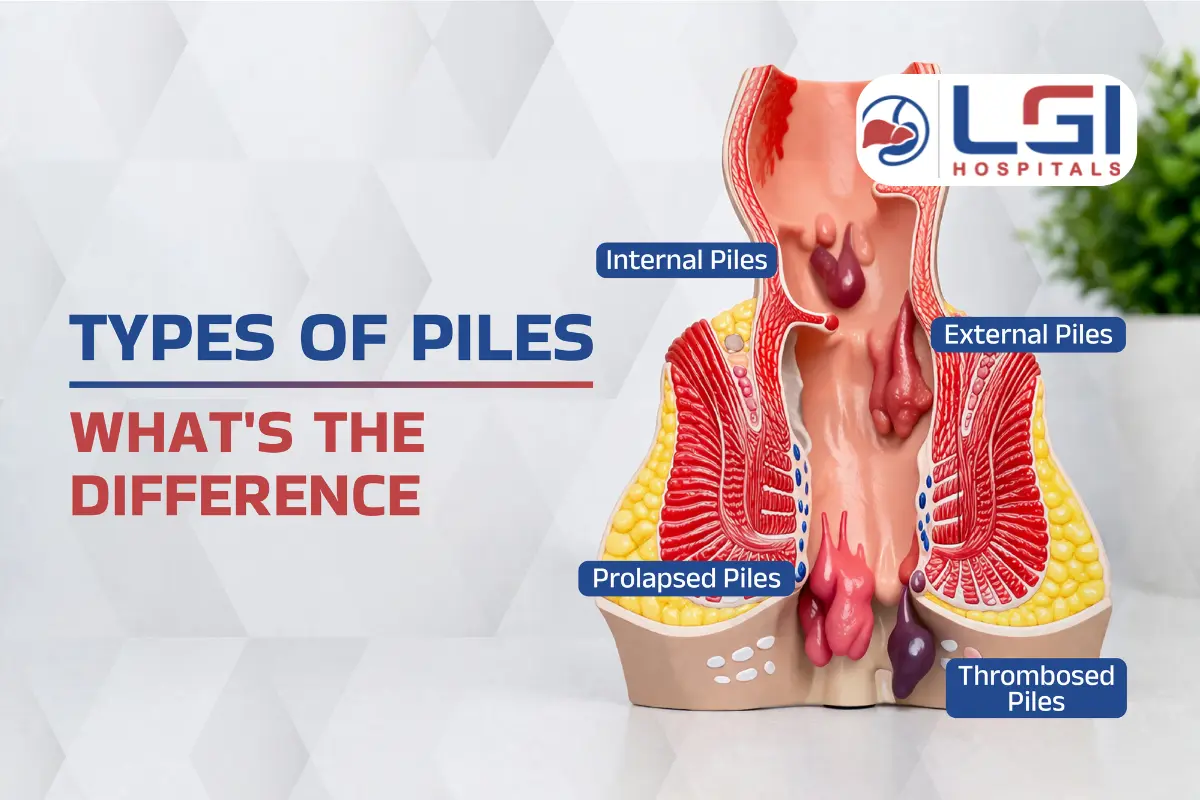
If you have been searching about your symptoms and come across terms like “internal piles”, “external hemorrhoids”, “Grade 3”, or “thrombosed piles” it is completely normal to feel confused or even a little scared. Medical terms can make a common condition sound far more alarming than it is.
Here is the simple truth: piles are swollen veins in and around the rectum and anus. They are extremely common, affect people of all ages, and are very much treatable. The different “types” you keep reading about simply describe where the piles are located, how far they have progressed, or what is happening inside them.
This blog breaks down every type of pile in plain, simple language – what each one means, how it feels, and when it is time to stop Googling and see a specialist. If you are in or around Nagpur, the team at LGI Hospitals is here to help you get the right diagnosis and care.
What Is a Piles Problem?
Piles (also called hemorrhoids) are swollen, enlarged veins in the lower part of the rectum or around the anus similar to varicose veins on the legs. They develop when the walls of these veins come under repeated pressure and begin to bulge.
They can cause bleeding, pain, itching, lumps, or no symptoms at all depending on their type and grade. For a complete understanding of causes, symptoms, and all treatment options, refer to our detailed piles problem guide.
Internal vs External Hemorrhoids: The Basic Difference
This is where most of the confusion begins. Are your piles internal or external? Here is how to think about it:
Internal Piles
Internal piles develop inside the rectum, above a boundary called the anorectal junction. Because there are very few pain-sensing nerves in this area, internal piles are often painless which is why many people do not realise they have them until they notice blood.
Typical symptoms include:
- Bright red blood on the tissue or in the toilet bowl after passing stool
- A feeling of fullness or incomplete evacuation
- Mucus discharge
- A sensation of something coming down (in more advanced stages, the pile may actually come out)
External Piles
External piles develop under the skin around the anus, where pain-sensing nerves are abundant. These tend to be far more uncomfortable.
Typical symptoms include:
- A visible or palpable lump near the anal opening
- Pain, soreness, or throbbing especially when sitting
- Itching and irritation around the anus
- Swelling that may worsen after a bowel movement
Internal vs External: Side by Side
| Feature | Internal Piles | External Piles |
| Location | Inside the rectum | Under skin around the anus |
| Visible from outside | No (unless prolapsed) | Yes felt or seen as a lump |
| Pain level | Usually low to none | Moderate to high |
| Main symptom | Painless bleeding | Pain, lump, itching |
| Treatment direction | Lifestyle, procedures, surgery depending on grade | Creams, sitz baths, possible surgery |
Grades of Internal Piles (I to IV) Explained
Internal piles are classified into four grades based on how far they have progressed. This grading helps doctors choose the right treatment.
Grade I Early Stage : The pile is small and sits entirely inside the rectum. You cannot see or feel it from outside. The only symptom may be a little bright red bleeding during bowel movements. At this stage, dietary changes, increased water intake, and simple medicines are usually enough.
Grade II Prolapse with Spontaneous Return : The pile is larger and may push out (prolapse) during a bowel movement but it goes back inside on its own without any help. You might notice some bleeding and mild discomfort. Non-surgical procedures like rubber band ligation are often effective at this stage.
Grade III Prolapse Requiring Manual Reduction : The pile comes out during straining and does not return on its own. You have to gently push it back inside with your finger. There may be mucus discharge, itching, and noticeable discomfort. Grade III piles commonly need minimally invasive procedures or surgery.
Grade IV Permanently Prolapsed : The pile stays outside the anus permanently and cannot be pushed back in. It may become very painful, especially if a blood clot forms. Surgical treatment is usually required at this stage.
Quick guide to grades:
| Grade | What Happens | Treatment Direction |
| I | Bleeding, no prolapse | Lifestyle changes + medicines |
| II | Prolapse, returns on its own | Non-surgical procedures |
| III | Prolapse, needs manual push-back | Procedures or surgery |
| IV | Permanently outside, cannot be reduced | Surgery |
Prolapsed Piles: What It Means and When to Worry
“Prolapsed piles” simply means that an internal pile has slipped out through the anal opening. It does not always indicate a crisis but it does mean the condition has advanced beyond the early stage.
Here is how to understand the levels of prolapse:
- Prolapse that returns on its own : This is Grade II. Uncomfortable, but the pile goes back inside without you doing anything.
- Prolapse that needs to be pushed back : This is Grade III. The pile comes out and stays out until you gently push it back in.
- Prolapse that cannot be pushed back : This is Grade IV. The pile remains permanently outside and often requires surgery.
Symptoms of prolapsed piles include:
- Feeling a soft lump or tissue hanging outside the anus
- Mucus or discharge that soils your underwear
- Itching and irritation around the anal area
- Discomfort while sitting, walking, or during any activity that puts pressure on the area
When does prolapsed piles become an emergency?
If a prolapsed pile becomes trapped outside the anus and cannot be pushed back, the blood supply to it may be cut off this is called strangulation. It causes sudden, severe pain and requires urgent medical attention. Do not wait in this situation. Go to a hospital immediately.
Thrombosed Piles: The Painful Clot
Thrombosed hemorrhoids are a specific and particularly painful situation. They occur when a blood clot (thrombus) forms inside an external hemorrhoid, causing it to swell suddenly and become very tender.
What does it feel like?
- Sudden onset of severe pain often described as the worst anal pain a person has experienced
- A firm, tender lump near the anal opening that feels hard to the touch
- Visible swelling, sometimes with a bluish or purple discolouration of the skin over it
- The pain is usually constant, not just during bowel movements
Is it dangerous?
Thrombosed piles are not life-threatening, but the pain can be severe enough to significantly affect daily life. In many cases, a small procedure to drain the clot provides almost instant relief and is best done within 48–72 hours of the pain starting.
If you develop sudden, severe anal pain with a hard, swollen lump do not ignore it. Get it evaluated at a hospital as soon as possible.
Which Type of Piles Do I Have?
Only a doctor can give you a proper diagnosis please do not rely solely on self-assessment. That said, your symptoms can give you a rough idea of what you may be dealing with:
- If you notice bright red blood but feel no lump or pain you may have early-stage internal piles (Grade I or II). See a doctor to confirm and rule out other causes of rectal bleeding.
- If you feel something coming out during a bowel movement but it goes back in on its own this sounds like Grade II internal piles with prolapse.
- If you have to push something back inside after passing stool this is likely Grade III prolapsed piles. Medical evaluation and treatment are needed.
- If there is a lump outside that will not go back this could be Grade IV prolapsed piles or a thrombosed external pile. See a doctor promptly.
- If you have sudden, severe pain with a hard, tender lump near the anus this sounds like a thrombosed external hemorrhoid. This needs urgent evaluation.
- If you have pain and bleeding but no visible lump it may not even be piles. It could be a fissure or another anorectal condition.
Not all anal pain and bleeding is caused by piles. Getting properly examined at a gastroenterology hospital in Nagpur like LGI Hospitals ensures you receive the right diagnosis not just a guess.
Visual-Friendly Summary: Types of Piles at a Glance
| Type | Location | Main Symptoms | Pain Level | Usual Treatment Direction |
| Internal (Grade I–II) | Inside rectum | Painless bleeding, fullness | Low | Lifestyle changes, medicines, non-surgical procedures |
| Internal (Grade III–IV) | Inside rectum / prolapsed | Prolapse, bleeding, mucus | Low to moderate | Minimally invasive procedures or surgery |
| External | Around anal opening | Lump, itching, pain | Moderate to high | Creams, sitz baths, procedures or surgery if severe |
| Prolapsed | Hangs outside anus | Visible lump, mucus, discomfort | Moderate to high | Procedures or surgery depending on grade |
| Thrombosed | External, with blood clot | Sudden severe pain, hard lump, swelling | Very high | Urgent evaluation; possible clot drainage or surger |
When Should You See a Doctor at LGI Hospitals?
Please do not wait too long. Book a consultation if you experience any of the following:
- Rectal bleeding that continues for more than two to three days
- Severe or worsening pain around the anus
- A lump outside the anus that will not go back in
- Difficulty sitting, walking, or going about daily activities due to pain
- Mucus discharge or soiling that is affecting your comfort and confidence
- Sudden onset of very severe anal pain (possible thrombosed pile)
- Any red flag symptoms: unexplained weight loss, dark or tarry stools, significant change in bowel habits, or a family history of colorectal cancer
LGI Hospitals, located in Dhantoli, near Yashwant Stadium, Nagpur, is a dedicated gastroenterology and liver hospital with experienced gastroenterologists and colorectal surgeons. We offer advanced endoscopy and colonoscopy facilities, minimally invasive procedures, and surgical options for all types and grades of piles in a comfortable, private setting where your dignity is always respected.
For readers who want to understand how diet affects piles, our guide on high fibre foods for constipation and piles is a practical starting point. And if you are a woman experiencing these symptoms, our guide on female piles and piles symptoms in women covers factors specific to your situation.
FAQs
Q: What are the four types of piles?
The four main types of piles (hemorrhoids) are internal, external, prolapsed and thrombosed piles. Internal piles form inside the rectum, external around the anus, prolapsed piles are internal ones that slip out, and thrombosed piles contain a painful blood clot.
Q: Is grade 3 piles serious?
Yes, grade 3 piles are considered serious because they prolapse outside the anus and have to be pushed back in by hand, often causing significant pain and bleeding. They carry a higher risk of complications and frequently need active medical or surgical treatment.
Q: How can I confirm piles?
You can’t reliably confirm piles on your own; a doctor needs to examine you. Diagnosis usually involves a visual inspection of the anal area, a digital rectal exam, and sometimes a proctoscopy or colonoscopy to check for internal piles and rule out other conditions.
Q: What do stage 1 piles look like?
Stage 1 (grade 1) piles are small, internal swellings inside the anal canal that do not come out and usually cannot be seen or felt from outside. They may look like tiny bulges on endoscopy/colonoscopy and are the mildest stage, though they can worsen if ignored.
Know Your Type, Get the Right Care
Understanding the different types of piles internal, external, prolapsed, thrombosed helps you make sense of your symptoms and have a more informed conversation with your doctor. But remember: knowing the terms does not replace a proper diagnosis.
Whether you are dealing with occasional bleeding, a painful lump, or something that just does not feel right, please do not put it off. Piles respond very well to treatment when caught at the right stage. Waiting often means more discomfort and more complex treatment later.
Book an appointment with the gastroenterology and colorectal team at LGI Hospitals, Nagpur today. Our specialists will evaluate your condition thoroughly, explain your options clearly, and help you recover with confidence in a private, supportive environment.
Disclaimer:
This blog is intended for informational and educational purposes only and should not be considered medical advice. While it explains different types of piles, symptoms, and treatment approaches, a proper diagnosis requires clinical evaluation by a qualified specialist. Always consult a medical gastroenterologist or healthcare professional for accurate diagnosis and personalised treatment, especially if symptoms persist, worsen, or include bleeding or severe pain.