
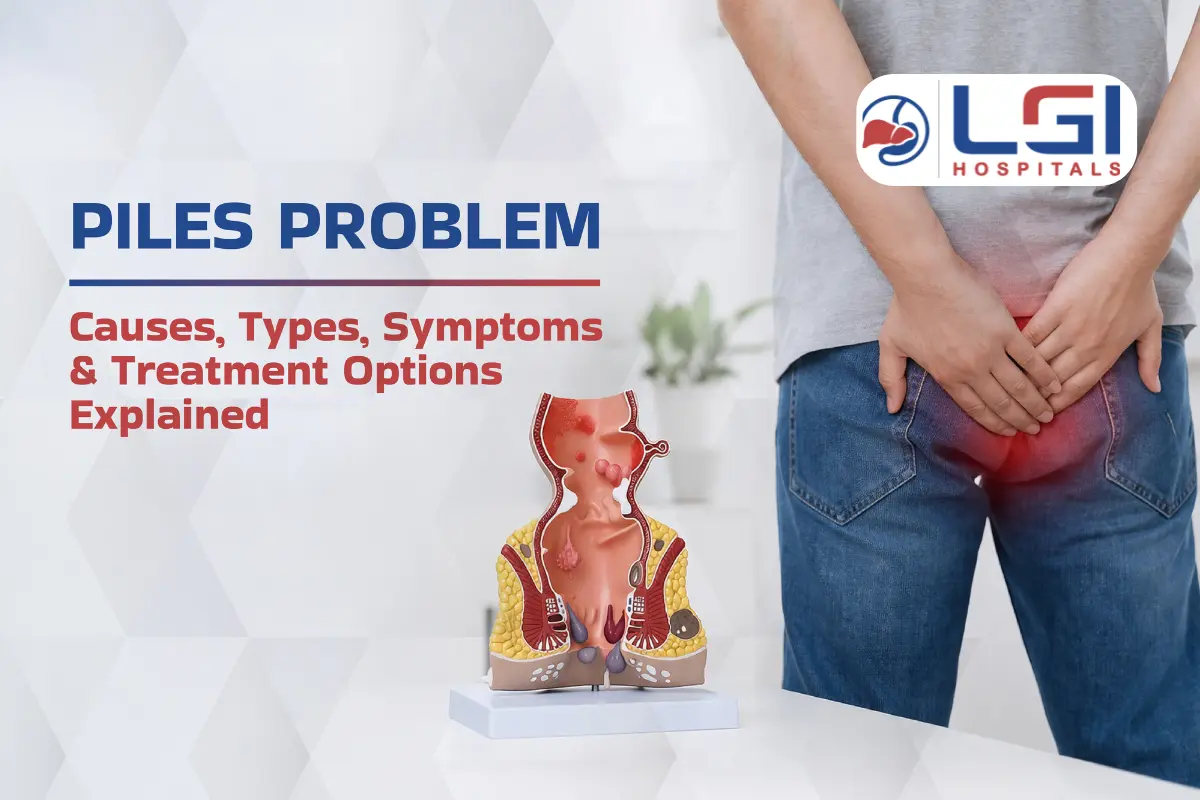
Have you been noticing blood on the tissue after a bowel movement? Feeling a painful lump near your bottom, or dealing with a burning, itching sensation that just will not go away? If yes, you are not alone and you do not need to feel embarrassed.
A piles problem is one of the most common colorectal conditions in India. Millions of people experience it at some point in their lives, yet most suffer in silence for months before seeking help. The delay often makes the condition worse.
Piles, medically known as hemorrhoids, are swollen veins in and around the rectum and anus. They can range from mildly uncomfortable to severely painful, but the good news is that they are very much treatable, especially when caught early.
At LGI Hospitals, a dedicated gastroenterology and liver hospital located in Dhantoli, near Yashwant Stadium, Nagpur, our team of expert gastroenterologists and colorectal surgeons provides comprehensive care for piles, from diagnosis and lifestyle guidance to advanced minimally invasive procedures and surgery. This guide covers everything you need to know.
What Is a Piles Problem?
Piles (hemorrhoids) are swollen, inflamed veins in the lower rectum or around the anus, similar to varicose veins you might see on the legs. When the walls of these blood vessels are placed under repeated pressure, they stretch, thin out, and bulge. This is what causes the pain, bleeding, and discomfort associated with a piles problem.
There are two main types based on location:
Internal piles develop inside the rectum, above the anorectal junction. Because there are fewer pain-sensing nerves inside the rectum, internal piles are usually painless, but they can bleed during bowel movements and may protrude (prolapse) outward in later stages.
External piles form under the skin around the anus, where pain-sensing nerves are plentiful. These can cause significant pain, swelling, itching, and discomfort, especially when sitting or during bowel movements.
Here is something important to remember: piles are extremely common. Research suggests that up to 50–75% of people will experience some form of hemorrhoid at some point in their life. They are not a sign of poor hygiene or something to be ashamed of and they are very treatable.
Hemorrhoids Causes: Why Do Piles Happen?
Piles develop when increased pressure is placed on the veins in the lower rectum and anal region, causing them to swell. Several everyday factors can lead to this:
- Chronic constipation: Straining hard to pass dry, hard stools is one of the leading causes of piles. The intense pressure this puts on rectal veins, repeated over time, causes them to swell and become inflamed.
- Low-fibre diet: A diet lacking in fruits, vegetables, and whole grains leads to hard stools and sluggish digestion, making constipation and therefore piles, much more likely.
- Prolonged sitting: Sitting on the toilet for extended periods, or spending most of the day in a chair (especially a desk job), increases pressure on the blood vessels in the anal and rectal area.
- Pregnancy: The growing uterus places significant pressure on the pelvic veins, while pregnancy hormones relax vein walls. This is why many women develop piles during or after pregnancy. Women dealing with female piles face unique challenges that deserve specialised attention.
- Obesity: Excess body weight puts consistent pressure on the lower abdomen and pelvic blood vessels, increasing the risk of piles.
- Ageing: As we age, the connective tissue that supports the veins in the rectum and anus weakens naturally, making piles more common after the age of 45.
- Heavy lifting: Repeated heavy lifting at work or in the gym raises abdominal pressure if you hold your breath while lifting, straining rectal veins.
- Heredity: If your parents or close relatives have had piles, you may have a genetic predisposition to developing them.
- Chronic diarrhoea: Frequent loose stools can irritate and inflame the anal area just as much as constipation.
In simple terms: anything that causes repeated straining, or that puts sustained pressure on the rectal blood vessels, can trigger or worsen a piles problem.
Types of Piles and Grades
Understanding the type and grade of your piles helps your doctor choose the most effective treatment.
Internal vs External Piles
Internal piles are located inside the rectum. They cannot be seen or felt from outside. They typically cause painless bright red bleeding during or after a bowel movement. In more advanced stages, they may prolapse (come out of the anus) during straining.
External piles form under the skin around the anus. They can be seen or felt as soft lumps. They are often painful, particularly when a blood clot forms inside. This is called a thrombosed external pile and can cause sudden, severe pain and swelling.
Grades of Internal Piles (I to IV)
Grade I: Small swellings just inside the lining of the anus. Not visible from outside, cannot be felt. The main symptom may be a little bleeding. Usually managed with dietary changes and medication alone.
Grade II: Larger swellings that may come out (prolapse) during a bowel movement but return inside on their own afterwards. Bleeding and mild discomfort are common. Often treatable with non-surgical procedures.
Grade III: Piles prolapse during bowel movements and do not return on their own they have to be gently pushed back in by hand. Discomfort is more significant. Usually require minimally invasive procedures or surgery.
Grade IV: Piles are permanently prolapsed outside the anus and cannot be pushed back. They can become very painful, especially if thrombosed. Surgical treatment is typically necessary.
As a general rule: Grade I and II piles respond well to lifestyle changes and non-surgical treatments. Grade III and IV, as well as thrombosed external piles, are more likely to need medical procedures or surgery.
Piles Symptoms You Should Not Ignore
Piles can present with a range of symptoms depending on the type and grade. The most common ones include:
- Bright red blood during or after a bowel movement on the stool, on the tissue, or in the toilet bowl
- Pain, soreness, or a burning sensation around the anus
- Persistent itching or irritation in the anal area
- A lump or swelling felt around or just inside the anus
- Mucus or slimy discharge after passing stool
- Discomfort or difficulty when sitting down
- A feeling that the bowels have not fully emptied even after passing stool
Red Flag Symptoms: When to Act Urgently
While most piles are benign and manageable, certain symptoms should prompt immediate evaluation, as they could indicate something more serious than a simple piles problem:
- Heavy or persistent rectal bleeding, not just a few drops
- Very dark or tarry stools (which may indicate bleeding higher up in the digestive tract)
- Significant and unexplained weight loss
- A noticeable change in bowel habits lasting more than two to three weeks
- Abdominal pain occurring along with rectal bleeding
- Family history of colorectal cancer
These symptoms require urgent evaluation at a specialised gastroenterology hospital in Nagpur like LGI Hospitals, where doctors can perform the necessary investigations to rule out colorectal polyps, inflammatory bowel disease, or cancer.
How Piles Are Diagnosed at the Hospital
Many people feel nervous or embarrassed about seeing a doctor for a piles problem. At LGI Hospitals, our team creates a respectful, comfortable environment where your privacy and dignity are protected at every step.
A typical evaluation may involve:
- Medical history: Your doctor will ask about your symptoms when they started, how often they occur, your bowel habits, diet, family history, and any relevant medical conditions.
- Physical examination: A gentle visual inspection of the anal area to check for external piles, skin changes, or other anorectal conditions. It is worth noting that many patients wonder about the difference between piles and fissures — small tears in the anal lining that can look and feel similar. A doctor can distinguish between these conditions easily.
- Digital rectal examination (DRE): Using a gloved, lubricated finger, the doctor gently feels inside the rectum to check for internal piles, masses, or other abnormalities. It is quick and generally not painful.
- Proctoscopy: A short, thin instrument with a light is inserted gently into the rectum to directly visualise internal piles and assess their grade. Most patients find this well-tolerated and it takes just a few minutes.
- Colonoscopy: If red flag symptoms are present, if you are above 45–50 years of age, or if there is a family history of colorectal cancer, a colonoscopy may be advised to thoroughly examine the entire colon and rule out other conditions.
Our gastroenterologists and colorectal surgeons at LGI Hospitals have extensive experience in making this process as smooth and reassuring as possible.
Piles Treatment Options Explained
Piles treatment depends on the type, grade, and severity of your condition. There is no single approach that works for everyone. Treatment ranges from simple home care for early cases to advanced procedures for severe ones.
Piles Treatment at Home and Lifestyle Changes
For Grade I or mild Grade II piles, lifestyle changes and home care can provide significant relief and prevent the condition from worsening:
- High-fibre diet: Eating more fruits, vegetables, whole grains, and dal softens stools and reduces straining. See the diet section below for specific Indian food recommendations.
- Increase water intake: Aim for at least 8-10 glasses (2-2.5 litres) of water per day. Hydration is just as important as fibre in keeping stools soft.
- Sitz baths: Soaking the anal area in warm (not hot) water for 10-15 minutes, two to three times a day, relieves pain, itching, and swelling effectively.
- Avoid straining: Do not push hard during bowel movements. Never hold your breath while on the toilet.
- Regular bowel habits: Go to the toilet as soon as you feel the urge-do not delay. Spend no more than 5 minutes at a time on the toilet.
- Over-the-counter relief: Some topical creams, suppositories, and medicated wipes can reduce itching and discomfort temporarily. Always use these under a pharmacist’s or doctor’s guidance.
Important: While piles treatment at home is effective for mild cases, it is often not sufficient on its own for Grade III or IV piles, thrombosed external piles, or any case involving significant or recurring bleeding. If symptoms persist beyond one to two weeks, please see a doctor.
Medical Management by Doctors
Your doctor may prescribe one or more of the following:
- Stool softeners and bulk-forming laxatives – to ease constipation and reduce straining
- Pain relief medication – oral or topical analgesics for discomfort
- Prescription-strength topical creams – stronger formulations to reduce inflammation, itching, and swelling
- Fibre supplements – such as psyllium husk (Isabgol) to regulate bowel movements
Non-Surgical / Minimally Invasive Procedures
For Grade II and some Grade III piles that do not adequately respond to lifestyle changes and medicine, minimally invasive procedures are highly effective:
- Rubber band ligation: A small rubber band is placed at the base of the internal pile, cutting off its blood supply. The pile shrinks and falls off within a few days. This is one of the most commonly used outpatient procedures for piles and has a high success rate.
- Sclerotherapy: A chemical solution is injected into the pile tissue to shrink it. Relatively painless and performed in a clinic setting.
- Infrared coagulation (IRC): Infrared light cuts off the blood supply to smaller internal piles, causing them to shrink. Quick, with minimal discomfort.
Surgical and Advanced Treatment Options
For Grade III or IV piles, large external piles, or cases where other treatments have not worked, surgery offers a long-term solution:
- Conventional haemorrhoidectomy: Surgical removal of pile tissue. Very effective with a low long-term recurrence rate. Recovery typically takes 2-4 weeks.
- Stapled haemorrhoidopexy (PPH): A surgical stapler repositions prolapsed piles back inside the anal canal and cuts off their blood supply. Results in less post-operative pain and faster recovery compared to conventional surgery.
- Laser piles surgery: A precise laser beam targets and removes or coagulates pile tissue with minimal damage to surrounding healthy tissue. Key benefits include significantly less post-operative pain, reduced bleeding, faster recovery, and it is often performed as a day-care procedure.
LGI Hospitals offers advanced diagnostic and surgical options for piles, with expert gastroenterologists and colorectal surgeons in Nagpur who personalise your treatment plan based on your grade, medical history, and individual needs.
Diet and Lifestyle: Best Piles Food to Eat
What you eat plays a significant role in both preventing and managing a piles problem. A high-fibre diet is the single most important dietary change you can make – fibre adds bulk to stools, makes them softer and easier to pass, and reduces the need to strain.
Best piles food to eat:
- Whole grains: Brown rice, whole wheat chapati, oats, daliya, and barley — all rich in fibre that aids smooth digestion.
- Fruits: Bananas, papaya, guava, pears, figs, and apples (with skin) help regulate bowel movements and soften stools.
- Vegetables: Bottle gourd (lauki), ridge gourd (turai), spinach, carrots, and other leafy greens are excellent, easy-to-digest options.
- Salads: Fresh cucumber, tomato, and lettuce salads add bulk and moisture to your meals.
- Dal and legumes: Moong dal, masoor dal, rajma, and chana are high in both fibre and protein — a healthy gut staple in the Indian diet.
- Sprouts: Moong or chana sprouts are light on the stomach and rich in fibre.
- Water: At least 8–10 glasses per day. Adequate hydration is non-negotiable for soft stools and healthy digestion.
For a more comprehensive plan, refer to a high fibre foods chart for constipation and piles, which maps out daily meal options, food swaps, and portion guidance tailored for people managing piles.
Foods to avoid:
- Spicy and heavily oily food – can irritate the digestive tract and worsen anal burning and itching
- Processed and junk food – maida-based products (white bread, biscuits, fast food) are low in fibre and contribute to constipation
- Excess tea and coffee – caffeine dehydrates the body and can harden stools
- Alcohol – dehydrates the body and can worsen constipation and rectal irritation
- Excessive red meat – low in fibre and harder to digest; limit intake
Daily Routine Tips
Small, consistent habits make a significant difference in preventing constipation and piles flare-ups:
- Morning: Start the day with a large glass of warm water. Have a fibre-rich breakfast – oats, daliya, or whole wheat upma.
- After meals: Take a short walk (even 10-15 minutes) after lunch or dinner to stimulate digestion.
- Toilet habits: Go when you feel the urge, never delay. Spend no more than 5 minutes on the toilet. Avoid using your phone or reading while sitting there.
- Throughout the day: Keep a water bottle with you and sip regularly.
- Evening: Include a serving of fruit or salad with your meal. Light exercise yoga, cycling, or walking reduces pressure on pelvic veins.
- Night: Avoid heavy or spicy dinners late at night. Eat dinner at least 2 hours before sleeping.
When Should You See a Doctor at LGI Hospitals?
Many people try home remedies for weeks sometimes months before visiting a doctor. While mild cases may improve with home care, certain situations require professional evaluation without delay:
- Rectal bleeding that lasts more than two to three days, or bleeding that is heavy
- Severe pain that does not settle with sitz baths or over-the-counter treatments
- A pile that has prolapsed and cannot be pushed back
- Recurring piles that keep coming back despite home management
- Any of the red flag symptoms mentioned earlier in this article
- Significant impact on quality of life pain at work, difficulty sitting, sleep disruption
Seeking early medical advice not only brings faster relief it also prevents the condition from worsening into a higher grade that may need more complex treatment.
LGI Hospitals, located in Dhantoli, near Yashwant Stadium, Nagpur, is a specialised gastroenterology and liver hospital with dedicated expertise in colorectal care. Our team of experienced gastroenterologists and colorectal surgeons will evaluate you with complete privacy, walk you through your treatment options, and build a personalised plan that works for you, whether that involves simple lifestyle changes, a quick minimally invasive procedure, or advanced surgery.
Understanding Related Anorectal Conditions
Piles are just one of several common anorectal conditions. Knowing how they relate helps you get the right care:
- Many patients are unsure about the difference between piles and fissures small tears in the anal lining that cause sharp pain and bleeding during bowel movements. Though they share some symptoms, they are distinct conditions with different treatments.
- Women are at a higher risk of piles due to pregnancy and hormonal changes. If you are a woman experiencing symptoms during or after pregnancy or around your menstrual cycle, our blog female piles covers specific symptoms, treatment options, and recovery tailored to women.
- Piles are often linked to broader digestive health issues. LGI Hospitals, as a dedicated gastroenterology hospital in Nagpur, provides comprehensive care beyond piles including colonoscopy, liver disorders, irritable bowel syndrome, and more.
FAQs
Q: How to get rid of a pile?
Mild piles can improve with a high-fibre diet, plenty of water, and avoiding straining. Doctors may prescribe medicines for relief. Advanced cases may need procedures like laser treatment or surgery for long-term results.
Q: Is it normal to live with piles?
Yes, many people have piles, especially in early stages, but it should not be ignored. Without treatment, it can worsen over time. Early care helps prevent pain, bleeding, and complications.
Q: What are the main causes of piles?
Piles are mainly caused by pressure on rectal veins due to constipation and straining. Other causes include low-fibre diet, long sitting hours, pregnancy, obesity, and heavy lifting.
Q: What foods are good for piles?
High-fibre foods like fruits, vegetables, whole grains, and dal help soften stools and reduce strain. Drinking enough water is equally important. These habits help relieve and prevent piles.
Conclusion: You Do Not Have to Suffer in Silence
A piles problem is one of the most common conditions people experience and one of the most undertreated, simply because of embarrassment or fear. But here is the truth: piles are very manageable, and the sooner you seek help, the simpler your treatment is likely to be.
Whether you are dealing with early-stage discomfort or have been suffering for months, there is a clear path to relief. Start with dietary changes and home care, but if your symptoms persist, worsen, or you notice any red flag signs, please do not wait.
At LGI Hospitals, our gastroenterology and colorectal team in Nagpur is here to help you recover fully. We offer a confidential, respectful, and expert environment from simple procedures to advanced laser surgery. You deserve to live without pain, discomfort, or worry.
Disclaimer:
This blog is intended for informational and educational purposes only and should not be considered medical advice. While it provides an overview of piles, including causes, symptoms, and treatment options, an accurate diagnosis requires clinical evaluation by a qualified specialist. Always consult a medical gastroenterologist or healthcare professional for personalised diagnosis and treatment, especially if you experience persistent symptoms, bleeding, or severe pain.