
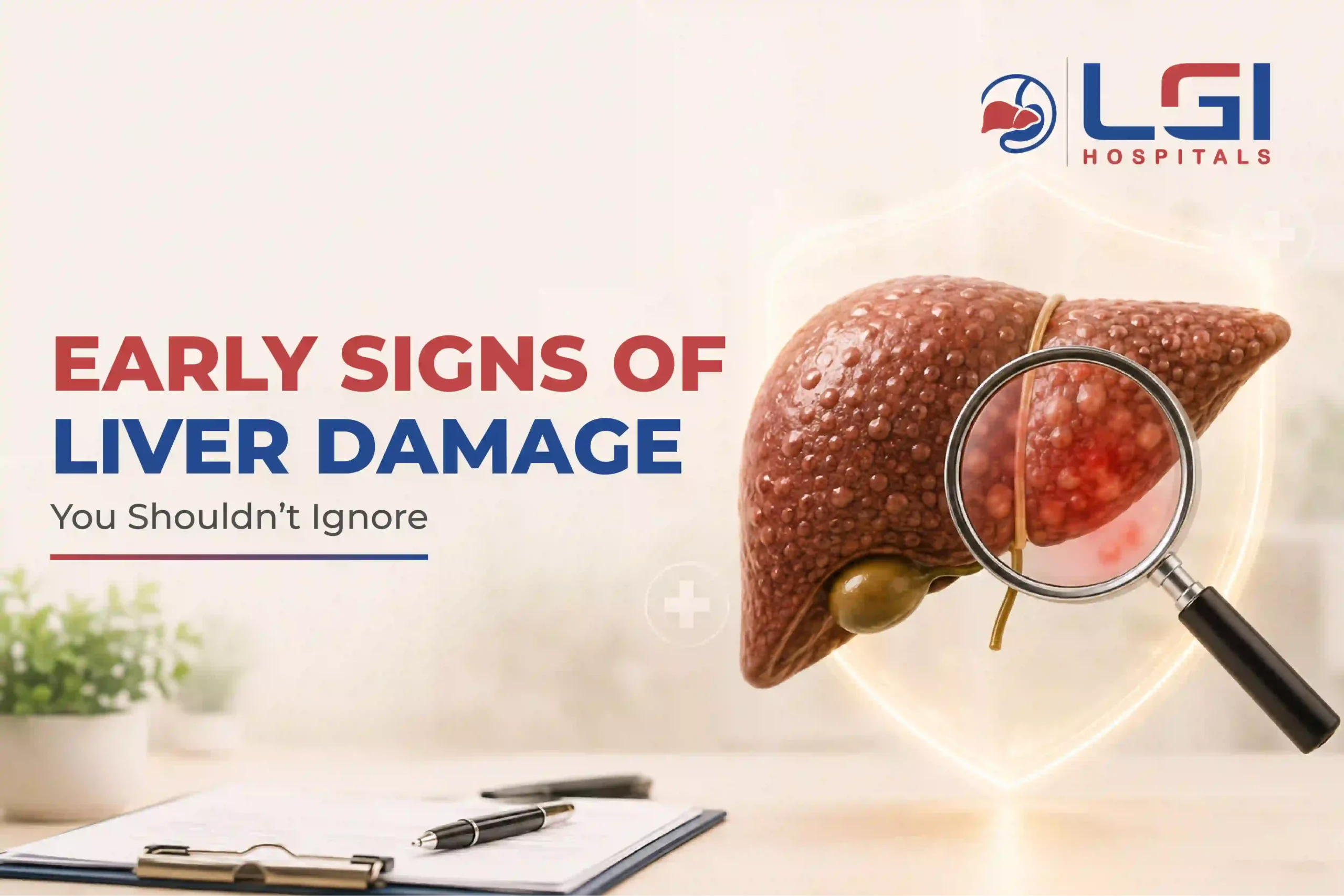
Quick Answer: Early liver damage often causes no noticeable symptoms, so doctors frequently discover it through routine blood tests rather than through a patient’s symptoms.
When symptoms do appear, they include persistent fatigue, digestive changes, and eventually skin and eye changes. These warrant prompt evaluation by a liver specialist rather than being dismissed as general tiredness.
Why Liver Damage Is Often Silent
The liver has remarkable reserve capacity and regenerative ability, and can continue functioning reasonably well even with significant damage. This is precisely why doctors sometimes call liver disease a “silent condition”. By the time symptoms become obvious, damage has often already progressed considerably. This is also why routine screening matters more for liver health than waiting for symptoms.
At LGI Hospitals, our hepatologists see many patients who had no idea they had liver damage until a routine blood test picked it up. This makes proactive screening essential, especially for those in higher-risk categories.
Early Warning Signs to Watch For
The following symptoms are often subtle and easy to dismiss as everyday tiredness or minor digestive issues. However, when they persist for more than a few weeks, they deserve medical attention.
| Symptom | What It May Indicate |
| Persistent fatigue or weakness that does not improve with rest | The liver is struggling to process nutrients and clear toxins |
| Loss of appetite | Often accompanies liver inflammation |
| Mild, dull discomfort in the upper right abdomen | Where the liver sits, may indicate swelling or inflammation |
| Nausea, especially after fatty meals | The liver is having trouble processing fats |
| Unexplained weight changes | Can reflect metabolic disruption from liver dysfunction |
| Itchy skin without an obvious cause | Bile salt buildup in the skin due to impaired liver function |
| Mild, unexplained swelling in the ankles | Early sign of fluid retention from reduced liver protein production |
Doctor’s Tip: If you have been feeling unusually tired for weeks and cannot pinpoint a reason, do not just assume it is stress or lack of sleep. A simple liver function test can reveal early damage that is still completely reversible with the right intervention.
Signs of More Advanced Liver Damage
When people miss or ignore early signs, liver damage can progress to more visible and serious symptoms. At this stage, patients need urgent medical attention.
| Symptom | What It May Indicate |
| Yellowing of the skin or eyes (jaundice) | Bilirubin buildup because the liver cannot process it |
| Swelling in the abdomen (ascites) or legs | Fluid retention from reduced albumin production |
| Easy bruising or unusual bleeding | The liver is not producing enough clotting factors |
| Dark-colored urine and pale, clay-colored stools | Bilirubin processing is impaired |
| Confusion or difficulty concentrating | Hepatic encephalopathy, where toxins affect the brain |
| Spider-like blood vessels visible on the skin | Hormonal imbalance from impaired liver function |
If you notice any of these advanced signs, it is important to seek evaluation from a liver specialist in Nagpur as soon as possible. In some cases, advanced liver damage may require surgical intervention, and early referral to a specialized center significantly improves outcomes.
Who Is at Higher Risk for Liver Damage
Certain groups of people are more likely to develop liver damage, often without realizing it until significant harm has occurred.
| Risk Factor | Why It Matters |
| Type 2 diabetes or obesity | Insulin resistance drives fat buildup in liver cells |
| High alcohol consumption | Directly toxic to liver cells over time |
| Viral hepatitis (B or C) | Chronic infection causes ongoing inflammation |
| Family history of liver disease | Genetic predisposition increases vulnerability |
| Long-term medications | Certain drugs are known to affect liver function |
| High cholesterol or metabolic syndrome | Part of the same metabolic cluster as fatty liver |
Individuals in these higher-risk categories should consider periodic liver screening even in the complete absence of symptoms. Early detection is what makes intervention most effective. If you want to understand what fatty liver actually is and how it develops, our detailed guide explains the condition in depth.
The Role of Routine Blood Work
Many cases of early liver damage are first identified through a routine liver function test, sometimes performed as part of an unrelated general health checkup. This is a strong argument for periodic screening in higher-risk individuals, rather than waiting for symptoms that may not appear until later stages.
At LGI Hospitals, we recommend that patients with diabetes, obesity, or a family history of liver disease get a liver function test at least once a year, even if they feel perfectly fine.
When to See a Doctor Immediately
The following symptoms indicate advanced or acute liver dysfunction requiring urgent evaluation. Do not wait for them to pass on their own.
- Yellowing of the skin or eyes appearing over a few days
- Confusion or unusual drowsiness
- Severe abdominal pain or swelling
- Vomiting blood or passing black, tarry stools
If you experience any of these, book an appointment at LGI Hospitals immediately or visit the nearest emergency department. Time is critical in acute liver dysfunction.
FAQs
Yes, in many cases. Especially fatty liver-related damage, early intervention through lifestyle changes and treating underlying causes can prevent or significantly slow further progression. The liver has a remarkable ability to regenerate when the source of damage is removed.
This depends on your individual risk factors. Your doctor can recommend an appropriate screening schedule based on your health history, weight, and any existing conditions like diabetes. For most higher-risk individuals, an annual liver function test is a good baseline.
Not universally, but the risk increases significantly with the amount and duration of consumption. There is no single safe threshold that applies to everyone given individual variation in liver sensitivity.
Yes. Non-alcoholic fatty liver disease, viral hepatitis, autoimmune conditions, and certain medications can all cause liver damage entirely independent of alcohol consumption. In fact, fatty liver is now one of the leading causes of liver damage in India.
The core symptoms are similar, but women may notice hormonal changes like irregular periods alongside liver dysfunction, while men may be more likely to experience itchy skin and fatigue. Both genders should take persistent digestive symptoms seriously.
Liver damage ke early signs mein thakan, bhookh na lagna, pet ke upper right side mein halka dard, aur unexplained weight changes shamil hain. Yeh symptoms aksar ignore ho jate hain kyunki yeh general tiredness lagte hain. Agar yeh kuch hafton se zyada rahein, to liver function test karwana chahiye. (लीवर डैमेज के शुरुआती लक्षणों में थकान, भूख न लगना, पेट के ऊपरी दाएं हिस्से में हल्का दर्द और अनexplained वजन परिवर्तन शामिल हैं।)
Key Takeaways
- Early liver damage is often silent and detected only through routine blood tests.
- Persistent fatigue, loss of appetite, and upper right abdominal discomfort are early warning signs.
- Jaundice, swelling, confusion, and easy bruising indicate advanced damage requiring urgent care.
- People with diabetes, obesity, hepatitis, or high alcohol use are at higher risk and should screen periodically.
- Most early-stage liver damage is reversible with the right lifestyle and medical intervention.
- LGI Hospitals in Nagpur offers comprehensive liver screening, diagnosis, and treatment from early detection through advanced care.
Final thoughts
Liver damage does not announce itself with obvious symptoms until it has already progressed significantly. The early warning signs are subtle, easy to dismiss, and often overlap with everyday tiredness or minor digestive issues. This is exactly why proactive screening and taking persistent symptoms seriously are so important. If you are in a higher-risk category or have been experiencing any of the signs described in this guide, the hepatology team at LGI Hospitals, Nagpur can help you get a clear picture of your liver health and take action before damage becomes irreversible.
Book Your Liver Health Consultation at LGI Hospitals →
Medical Disclaimer: This article is intended for educational purposes only and does not constitute medical advice, diagnosis, or treatment. Always consult a qualified gastroenterologist or hepatologist for accurate diagnosis and appropriate care.