
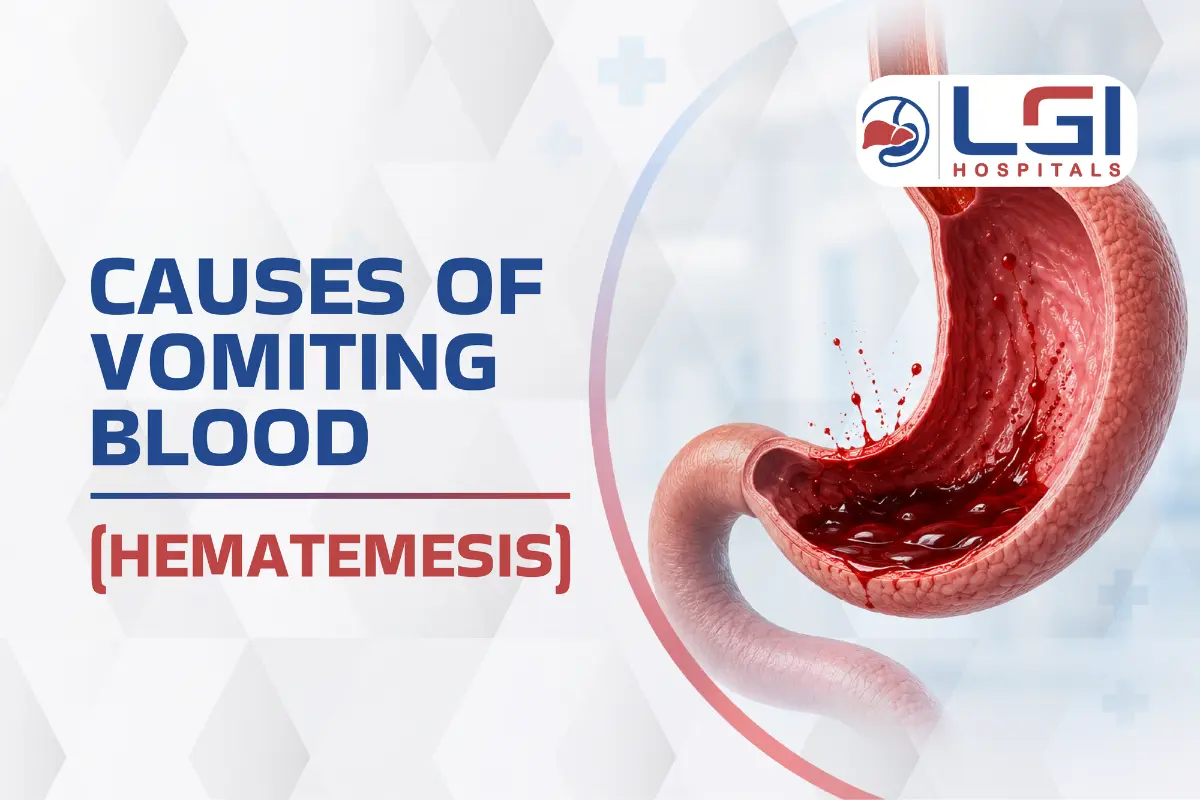
Key Overview
- Vomiting blood (hematemesis) means bringing up blood through the mouth, which comes from somewhere in the upper gastrointestinal (GI) tract — the oesophagus (food pipe), stomach, or upper small intestine. It is always a serious symptom and must never be ignored.
- Common causes include peptic ulcers, oesophageal varices (swollen veins in the food pipe due to liver disease), stomach lining tears, medications like NSAIDs and aspirin, and in serious cases, cancers.
- Emergency signs that require immediate hospital visit include large amounts of blood, blood that looks bright red or resembles coffee grounds, dizziness, fainting, rapid heartbeat, or low blood pressure.
- Key tests include endoscopy (the most important investigation), blood tests, and imaging — endoscopy can both diagnose the source of bleeding and treat it at the same time.
- Home treatment is unsafe. Vomiting blood requires urgent professional evaluation; no home remedy can stop internal bleeding.
What Is Vomiting Blood (Hematemesis)?
Vomiting blood — medically called hematemesis (pronounced: hem-ah-TEM-eh-sis) — refers to vomiting that contains blood. It should not be confused with coughing up blood (haemoptysis), which comes from the lungs or airways.
The blood in vomit can appear:
- Bright red — indicating fresh, active bleeding, usually from the oesophagus or stomach.
- Dark red or maroon — partially digested blood from the stomach.
- “Coffee ground” appearance — dark, grainy material that looks like used coffee grounds; this is blood that has been in the stomach for some time and has been digested by stomach acid.
Any amount of blood in vomit is abnormal and warrants urgent medical attention. It is one of the important GI bleeding symptoms and emergency signs that should never be dismissed.
| What you see | Likely source | Urgency |
|---|---|---|
| Bright red blood in vomit | Active bleeding in oesophagus or stomach | Emergency |
| Dark red or coffee ground vomit | Partially digested blood from stomach | Emergency |
| Blood mixed with food | Upper GI tract | Emergency |
| Frothy bright red blood when coughing | Lungs (not GI) | Emergency |
| Blood only after severe retching | Mallory-Weiss tear likely | Urgent |
How Is Vomiting Blood Different from Upper GI Bleeding?
Vomiting blood is one of the hallmark signs of upper gastrointestinal (GI) bleeding — that is, bleeding that originates from above the small intestine (Treitz ligament). Upper GI bleeding can also present as:
- Melena — black, tarry, foul-smelling stools, caused by blood that has passed through the digestive system. Learn more about black or tarry stool (melena) meaning and why it happens.
- A combination of vomiting blood and passing black stools — often indicating significant bleeding.
It is important to understand that even if you are not actively vomiting blood, the presence of black stools after a previous episode may mean that internal bleeding is still occurring.
Main Causes of Vomiting Blood
1. Peptic Ulcers (Stomach and Duodenal Ulcers)
Peptic ulcers are the most common cause of vomiting blood, accounting for approximately 50% of cases. These are open sores that form on the inner lining of the stomach (gastric ulcers) or the first part of the small intestine (duodenal ulcers).
Ulcers bleed when they erode into a blood vessel. Causes include:
- H. pylori bacterial infection (extremely common in India)
- NSAIDs such as ibuprofen, diclofenac, aspirin — regularly taken without stomach protection
- Excessive alcohol consumption
- Stress in critically ill patients (stress ulcers)
It is important to understand the stomach ulcer and cancer-related causes of bleeding, since some ulcers that appear benign may have a malignant component. If you are unsure about the nature of your ulcer, your doctor may investigate to understand the difference between simple and cancerous ulcer — a distinction that has major implications for treatment.
2. Oesophageal Varices
Oesophageal varices are enlarged, fragile veins in the lower oesophagus (food pipe) that develop as a complication of liver cirrhosis and portal hypertension (high blood pressure in the liver’s portal vein system). When these veins rupture, they cause massive, life-threatening bleeding — bright red blood in large quantities.
This is one of the most dangerous causes of vomiting blood. Patients with known liver cirrhosis, heavy alcohol use, or a history of jaundice are at particularly high risk.
3. Mallory-Weiss Tear
A Mallory-Weiss tear is a tear in the mucous membrane at the junction of the oesophagus and stomach, typically caused by severe, forceful, or prolonged vomiting — often after excessive alcohol intake or during severe morning sickness in pregnancy. It usually causes streaks of bright red blood in vomit.
4. Erosive Gastritis and Oesophagitis
Erosive gastritis (severe inflammation and erosion of the stomach lining) and oesophagitis (inflammation of the food pipe) can both cause bleeding. Common triggers include alcohol, NSAIDs, bile reflux, and H. pylori infection.
5. Causes of Vomiting Blood During Pregnancy
Pregnant women may vomit blood due to:
- Mallory-Weiss tears from severe vomiting (hyperemesis gravidarum)
- Oesophagitis and gastritis worsened by pregnancy hormones and reflux
- Peptic ulcers — less common in pregnancy but possible
Vomiting blood during pregnancy (causes of blood vomiting during pregnancy / causes of blood in vomit during pregnancy) must be evaluated by a doctor immediately. It is never safe to assume it is “just pregnancy vomiting.” Both the mother’s and baby’s safety depends on prompt investigation.
6. Stomach Cancer (Gastric Cancer)
Stomach cancer can cause bleeding from a tumour in the stomach wall. Vomiting blood in this context is often associated with weight loss, loss of appetite, and persistent stomach pain. This is more common in older adults and those with a strong family history.
7. Oesophageal Cancer
A tumour in the food pipe can bleed and present as vomiting blood, often combined with difficulty swallowing.
8. Blood-Thinning Medications and Bleeding Disorders
Medications like warfarin, heparin, clopidogrel, and high-dose aspirin reduce the blood’s ability to clot. In patients already vulnerable to GI mucosal injury, these can lead to significant bleeding.
Conditions like haemophilia or severe liver disease (which impairs production of clotting factors) also increase the risk.
9. Aortoenteric Fistula (Rare but Serious)
In patients who have had aortic graft surgery, an abnormal connection can sometimes form between the aorta and the GI tract, causing massive bleeding. This is rare but immediately life-threatening.
Emergency Warning Signs — Go to Hospital Immediately
Vomiting blood is almost always a medical emergency. Go to hospital without delay if:
- You are vomiting large amounts of blood (more than a few tablespoons)
- The blood is bright red
- You feel dizzy, lightheaded, or faint
- Your heart is racing (palpitations)
- You feel cold, sweaty, and weak
- You have low blood pressure or feel like you may collapse
- You are on blood thinners and vomit even a small amount of blood
- You have known liver disease or cirrhosis and vomit any blood at all
- You are pregnant and vomit blood
Do not drive yourself to the hospital. Call for emergency assistance or have someone take you immediately.
Experiencing any of these symptoms right now?
Do not wait. LGI Hospitals Nagpur has a dedicated gastroenterology team available around the clock. Call us immediately at +91 9168274488 or visit our emergency unit.
Diagnosis: How Do Doctors Find the Source of Bleeding?
Endoscopy — The Most Important Test
An upper GI endoscopy (also called OGD — oesophago-gastro-duodenoscopy) is the single most important investigation for vomiting blood. A thin, flexible tube with a camera is passed through the mouth into the oesophagus, stomach, and duodenum. It allows the doctor to:
- See the exact source of bleeding
- Treat the bleeding at the same time — by injecting medication into the ulcer, applying a clip, or banding oesophageal varices
- Take biopsies if cancer is suspected
At LGI Hospitals, we offer endoscopy test in Nagpur to find the source of bleeding with advanced equipment and experienced gastroenterologists.
Endoscopy should ideally be performed within 24 hours of a significant upper GI bleed, and within 12 hours in high-risk cases.
Blood Tests
- Complete Blood Count (CBC) — to assess the degree of anaemia (blood loss)
- Liver function tests, kidney function tests
- Coagulation profile (PT/INR) — especially in liver disease patients
- Blood group and cross-match — in case transfusion is needed
Imaging (CT Angiography)
If endoscopy cannot locate the bleeding source, a CT scan with contrast (CT angiography) may be used to identify abnormal blood vessels.
Treatment of Vomiting Blood
Treatment depends on the cause and severity of bleeding. At the hospital, the immediate priorities are:
Stabilisation:
- Intravenous (IV) fluid resuscitation
- Blood transfusion if necessary
- Medications to reduce stomach acid (proton pump inhibitors — PPIs) given intravenously
Endoscopic treatment:
- Injection therapy (adrenaline injection into the ulcer base)
- Mechanical clips to close bleeding vessels
- Variceal band ligation (for oesophageal varices)
- Argon plasma coagulation
At LGI Hospitals, Nagpur, upper GI endoscopy for active bleeding is performed by experienced gastroenterologists using advanced endoscopic equipment, allowing both diagnosis and treatment to be completed in a single procedure. Whether the cause is a bleeding peptic ulcer, oesophageal varices, or a Mallory-Weiss tear, our team is equipped to manage the full range of upper GI bleeding emergencies without the need for referral elsewhere. Patients in Nagpur and surrounding areas including Wardha, Amravati, and Chandrapur regularly visit LGI Hospitals for specialist gastroenterology care that would otherwise require travel to larger cities.
Medications:
- PPIs (omeprazole, pantoprazole) — to heal ulcers and reduce acid
- Somatostatin analogues (octreotide, terlipressin) — to reduce blood flow to varices
- Antibiotics in cirrhosis patients to prevent infection
- H. pylori eradication if infection is present
Surgery or interventional radiology:
- In rare cases where endoscopy fails to stop bleeding, emergency surgery or angiographic embolisation may be needed.
What NOT to Do at Home
- Do not take NSAIDs (ibuprofen, diclofenac, aspirin) if you have stomach ulcers or a history of GI bleeding.
- Do not ignore “coffee ground” vomit, assuming it is not serious.
- Do not take antacids and wait it out at home — this wastes critical time.
- Do not give the patient food or water if they may need endoscopy or surgery.
Frequently Asked Questions (FAQs)
Q1. Is vomiting blood always a sign of cancer?
No. While stomach or oesophageal cancer can cause vomiting blood, the most common causes are peptic ulcers and oesophageal varices (in liver disease patients). However, any episode of vomiting blood must be thoroughly investigated by a doctor.
Q2. I only vomited a little blood. Does it still need emergency attention?
Yes. Even a small amount of blood in vomit should prompt an urgent medical evaluation. Minor bleeding can quickly become major. The only safe approach is to be assessed at a hospital.
Q3. Can acidity or acid reflux cause vomiting blood?
Severe acid reflux can cause oesophagitis, which can occasionally cause minor bleeding (streaks of blood). However, significant vomiting of blood due to acid reflux alone is uncommon and warrants investigation to rule out more serious causes.
Q4. What is the connection between vomiting blood and liver disease?
Liver cirrhosis leads to portal hypertension, which causes oesophageal varices — fragile swollen veins in the food pipe. When these rupture, they cause profuse, life-threatening vomiting of bright red blood. This is one of the most serious complications of liver disease.
Q5. Can vomiting blood be confused with coughing up blood?
Yes, it can sometimes be difficult to tell. Blood from the lungs (haemoptysis) tends to be frothy and bright red, and is coughed up (not vomited). Blood from the GI tract may look darker, often mixed with food particles, and comes with nausea. If you are unsure, seek emergency care immediately — both are serious.
What to Do Now
Vomiting blood is not something to observe and wait on. At LGI Hospitals, Nagpur, our gastroenterology team is available 24 hours a day, 7 days a week to evaluate, diagnose, and treat all causes of upper GI bleeding. The earlier you come in, the better the outcome. Book your consultation today or call us directly at +91 9168274488.
Medical Disclaimer: This article is written for general educational purposes only. It does not constitute medical advice, diagnosis, or treatment. Vomiting blood (उल्टी में खून आना) is a medical emergency in most cases. If you or someone near you is vomiting blood, call for emergency help or go to the nearest hospital immediately. Do not attempt to self-diagnose or self-treat. Always consult a qualified doctor for any medical concern.