
Why a Pathology Test Matters for Your Health
When your doctor says “let’s run a pathology test,” many patients feel anxious or confused. But a pathology test is simply a scientific examination of body samples – blood, urine, stool, or tissue – to understand what is happening inside your body. A pathology test list helps doctors detect diseases early, monitor ongoing conditions, and guide the right treatment.
At LGI Hospitals, Nagpur, our dedicated pathology and radiology unit offers a comprehensive pathology test list covering everything from routine blood work to specialised liver and gut panels. In this blog, we walk you through what pathology tests are, why they are important, and which tests are most relevant for digestive and liver health.
What Is a Pathology Test?
A pathology test is a medical investigation performed on a biological sample to identify disease, infection, or abnormality. Pathology covers multiple disciplines, including:
Clinical Pathology – analysis of blood, urine, and other body fluids
Histopathology – examination of tissue samples under a microscope
Microbiology – identification of bacteria, viruses, fungi, and parasites
Biochemistry – measurement of chemicals and enzymes in the blood
Haematology – study of blood cells and clotting disorders
Modern pathology tests are highly accurate, minimally invasive, and provide results within hours or days. They form the backbone of clinical diagnosis across all medical specialties.
Comprehensive Pathology Test List at LGI Hospitals
Below is the pathology test list offered at our centre, organised by category. This list is especially relevant for patients with digestive disorders, liver diseases, and gastrointestinal complaints.
1. Routine Blood Tests
These are the most commonly ordered pathology tests, suitable for all patients as a baseline health check:
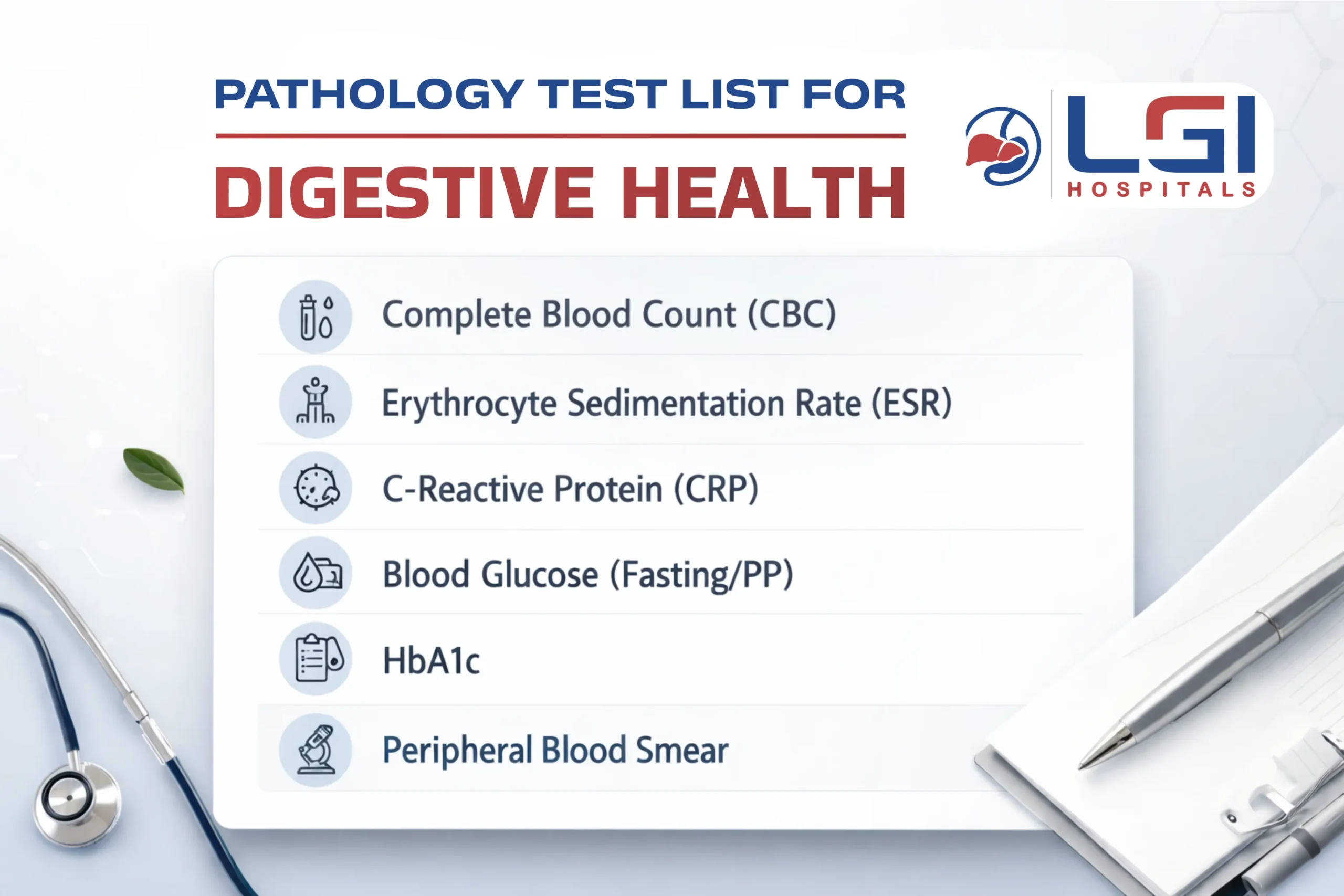
| Test Name | What It Checks | Why It Matters |
| Complete Blood Count (CBC) | Red cells, white cells, platelets | Detects anaemia, infection, immune disorders |
| Erythrocyte Sedimentation Rate (ESR) | Inflammation marker | Screens for chronic infections, IBD, autoimmune conditions |
| C-Reactive Protein (CRP) | Acute inflammation | Monitors active flare-ups of colitis, Crohn’s disease |
| Blood Glucose (Fasting/PP) | Blood sugar levels | Diagnoses diabetes, which affects liver health |
| HbA1c | 3-month blood sugar average | Monitors diabetes management |
| Peripheral Blood Smear | Blood cell morphology | Identifies sickle cell, malaria, leukaemia |
2. Liver Function Tests (LFT) – Key Pathology Tests for Liver Health
Liver Function Tests form one of the most critical parts of the pathology test list at LGI Hospitals. Since we specialise in gastroenterology and hepatology, LFTs are frequently ordered:
| Test | Normal Range (Approx.) | Elevated Levels May Indicate |
| ALT (Alanine Aminotransferase) | 7-56 U/L | Hepatitis, fatty liver, liver injury |
| AST (Aspartate Aminotransferase) | 10-40 U/L | Liver damage, heart issues, muscle disorders |
| ALP (Alkaline Phosphatase) | 44-147 U/L | Bile duct blockage, liver disease, bone disorders |
| GGT (Gamma-Glutamyl Transferase) | 8-61 U/L | Alcohol-related liver disease, bile duct problems |
| Total Bilirubin | 0.1-1.2 mg/dL | Jaundice, haemolysis, liver dysfunction |
| Direct & Indirect Bilirubin | See report | Differentiates types of jaundice |
| Total Protein & Albumin | 6.0-8.3 g/dL | Liver’s protein synthesis capacity |
| PT/INR (Prothrombin Time) | 11-13.5 sec / INR <1.1 | Liver’s clotting factor production |
Tip: If you have symptoms like yellowing of eyes, dark urine, or persistent fatigue, get a full Liver Function Test done at the earliest. At LGI Hospitals, we provide same-day LFT results.
3. Kidney Function Tests (KFT/RFT)
Kidney and liver health are closely linked. Liver disease can impair kidney function, a condition known as hepatorenal syndrome. Our pathology test list includes:
Serum Creatinine – measures kidney filtration efficiency
Blood Urea Nitrogen (BUN) – detects kidney or digestive tract bleeding
Serum Electrolytes (Sodium, Potassium, Bicarbonate) – critical in cirrhosis management
Uric Acid — elevated in gout, which often accompanies metabolic liver disease
4. Urine Tests
Urine tests are non-invasive pathology tests that reveal a great deal about both kidney and systemic health:
Routine & Microscopy (R/M) – screens for infection, blood, protein, glucose
Culture & Sensitivity – identifies bacterial UTIs and appropriate antibiotics
24-Hour Urine Protein – monitors protein loss in kidney disease
Urine Bile Salts & Pigments – helps diagnose obstructive jaundice
5. Stool (Faecal) Tests
Stool tests are vital pathology tests for diagnosing conditions of the gastrointestinal tract – the core focus of LGI Hospitals:
| Stool Test | Purpose |
| Faecal Occult Blood Test (FOBT) | Screens for hidden bleeding in the gut – early colon cancer detection |
| Stool Culture | Identifies bacteria causing gastroenteritis, typhoid, cholera |
| Ova & Parasite Examination | Detects intestinal worms, Giardia, Entamoeba histolytica |
| Stool Calprotectin | Differentiates IBS from inflammatory bowel disease (Crohn’s/Colitis) |
| H. pylori Stool Antigen Test | Non-invasive detection of Helicobacter pylori infection |
| Stool Routine Examination | Checks colour, consistency, pH, reducing substances |
6. Viral Hepatitis Panel – Essential Liver Pathology Tests
Hepatitis remains a major public health concern in India. LGI Hospitals offers a complete Viral Hepatitis Panel as part of our pathology test list:
HBsAg (Hepatitis B Surface Antigen) – screens for active Hepatitis B infection
Anti-HCV (Hepatitis C Antibody) – detects exposure to Hepatitis C virus
HBeAg & Anti-HBe – assesses Hepatitis B viral activity
HBV DNA Quantitative (PCR) – measures Hepatitis B viral load in the blood
HCV RNA Quantitative (PCR) – measures Hepatitis C viral load
Anti-HAV IgM – diagnoses acute Hepatitis A infection
Anti-HEV IgM – diagnoses Hepatitis E, common during outbreaks
Important: A positive HBsAg does not always mean active disease. Get a comprehensive panel at LGI Hospitals for accurate staging and treatment planning.
7. Tumour Markers
Tumour marker tests help in diagnosing and monitoring gastrointestinal cancers:
| Tumour Marker | Associated Cancer |
| AFP (Alpha-Fetoprotein) | Hepatocellular Carcinoma (Liver Cancer) |
| CEA (Carcinoembryonic Antigen) | Colorectal Cancer, Stomach Cancer |
| CA 19-9 | Pancreatic Cancer, Bile Duct Cancer, Gallbladder Cancer |
| CA 125 | Liver, Ovarian Cancer (used with imaging) |
8. Thyroid Function Tests (TFT)
Thyroid imbalance often manifests as digestive issues like constipation, diarrhoea, and weight changes. Our pathology test list includes:
TSH (Thyroid Stimulating Hormone)
Free T3 & Free T4
Anti-TPO Antibodies – for autoimmune thyroid disease
9. Lipid Profile
A lipid profile is a crucial pathology test for patients with fatty liver (NAFLD/NASH), one of the most common liver conditions seen at LGI Hospitals:
Total Cholesterol
LDL (Low-Density Lipoprotein) – ‘bad’ cholesterol
HDL (High-Density Lipoprotein) – ‘good’ cholesterol
VLDL
Triglycerides – particularly elevated in metabolic-associated steatotic liver disease
10. Iron Studies & Haematinics
Iron deficiency and overload (haemochromatosis) both affect the liver and gut:
Serum Iron, TIBC, Transferrin Saturation
Serum Ferritin – stored iron; often elevated in NAFLD
Vitamin B12 & Folate – deficiency causes GI symptoms and anaemia
Vitamin D – deficiency is common in liver disease patients
11. Autoimmune Liver Disease Panel
When liver enzymes are elevated without a clear viral or alcoholic cause, autoimmune liver disease must be excluded. This is a specialised portion of our pathology test list:
ANA (Anti-Nuclear Antibody) – Autoimmune Hepatitis
Anti-SMA (Anti-Smooth Muscle Antibody) – Type 1 Autoimmune Hepatitis
Anti-LKM1 – Type 2 Autoimmune Hepatitis
AMA (Anti-Mitochondrial Antibody) – Primary Biliary Cholangitis (PBC)
ANCA – Primary Sclerosing Cholangitis (PSC)
12. Coagulation & Clotting Studies
Liver disease frequently impairs clotting. These pathology tests are essential in advanced liver disease:
Prothrombin Time (PT) with INR
Activated Partial Thromboplastin Time (APTT)
D-Dimer – screens for clot formation (DVT, PE)
Fibrinogen Level
13. Microbiology & Infection Tests
Blood Culture & Sensitivity – for sepsis, spontaneous bacterial peritonitis (SBP)
Widal Test – for typhoid fever causing abdominal pain and diarrhoea
Dengue NS1 Antigen, IgM, IgG – liver involvement is common in dengue
Malaria Antigen (RDT) & Peripheral Smear – liver enlargement in malaria
14. Histopathology & Biopsy
When imaging or blood tests are inconclusive, a tissue biopsy provides a definitive answer:
Liver Biopsy – grades and stages fibrosis, cirrhosis, NASH, and autoimmune hepatitis
Colonoscopic Biopsy – diagnoses IBD, polyps, dysplasia, colorectal cancer
Endoscopic Biopsy – investigates Barrett’s oesophagus, gastric cancer, coeliac disease
FNAC (Fine Needle Aspiration Cytology) – evaluates liver or abdominal masses
How to Prepare for a Pathology Test
Preparation depends on the specific pathology test ordered. Here are general guidelines:
| Test Type | Preparation Required |
| Fasting Blood Tests (Glucose, Lipid Profile) | 8–12 hours fasting; water is allowed |
| Liver Function Test (LFT) | Ideally fasting; avoid alcohol 48 hours prior |
| CBC, CRP, ESR | No special preparation needed |
| Stool Tests | Collect fresh sample in a sterile container; avoid laxatives before the test |
| Urine Tests | Use mid-stream, early morning urine sample in a sterile container |
| Liver Biopsy | Stop blood-thinning medications; fasting for 6 hours before procedure |
Warning Signs: When You Should Get a Pathology Test Done
Do not delay getting a pathology test if you experience any of the following symptoms:
Jaundice – yellowing of the skin or whites of the eyes
Dark yellow or brown urine
Pale or clay-coloured stools
Persistent abdominal pain or bloating
Unexplained weight loss
Chronic fatigue and weakness
Blood in stool or black tarry stools
Nausea, vomiting, or loss of appetite
Swelling in the abdomen (ascites)
Easy bruising or prolonged bleeding
At LGI Hospitals, our gastroenterologists review your pathology test results in context with your clinical symptoms to give you an accurate diagnosis – not just a lab report.
Why Choose LGI Hospitals for Your Pathology Test in Nagpur?
LGI Hospitals is a dedicated gastroenterology and liver hospital located in Dhantoli, Nagpur. Our pathology and radiology department is fully integrated with our clinical team, meaning:
| Feature | LGI Hospitals Advantage |
| Specialisation | GI and liver-focused pathology — not a general lab |
| Speed | Same-day reports for most routine pathology tests |
| Accuracy | Quality-controlled equipment and trained pathologists |
| Integration | Results directly reviewed by your treating gastroenterologist |
| Convenience | Pathology, radiology, endoscopy under one roof |
| Accessibility | Located centrally in Dhantoli, Nagpur; appointment-based and walk-in |
| Emergency Support | 24×7 emergency pathology for critically ill patients |
FAQs
Q1: How long does a pathology test take to get results?
Most routine pathology tests like CBC, LFT, and urine tests are available within 4–6 hours. Specialised tests like HCV PCR or autoimmune panels may take 24 – 72 hours.
Q2: Do I need a doctor’s prescription for a pathology test?
For most standard tests, a doctor’s prescription is recommended so that the results are interpreted correctly in the context of your clinical condition. At LGI Hospitals, our doctors guide you on which tests are necessary.
Q3: Is a pathology test painful?
A blood test involves a small needle prick and is generally well-tolerated. Stool and urine tests are completely painless. Biopsies are performed under local anaesthesia with minimal discomfort.
Q4: Can I eat before a pathology test?
It depends on the test. Fasting (8 -12 hours) is required for blood glucose, lipid profile, and some LFTs. For CBC, CRP, and viral tests, fasting is usually not necessary. Always follow your doctor’s specific instructions.
Q5: Is a liver biopsy safe?
Liver biopsy performed by experienced gastroenterologists at LGI Hospitals is a safe and well-established procedure. It is done under ultrasound guidance to ensure precision and minimise complications.
Understanding the pathology test list and knowing which tests to get can make a significant difference in the early detection and effective management of digestive and liver diseases. Whether it is a routine blood test, a specialised liver panel, or a tissue biopsy, LGI Hospitals in Nagpur provides the full spectrum of pathology services under one roof, interpreted by specialists who understand your GI health completely.
If you are experiencing digestive symptoms or simply want a comprehensive health check, do not wait
Disclaimer
The information provided in this blog is intended for general informational and educational purposes only. It is not a substitute for professional medical advice, diagnosis, or treatment. Always seek the guidance of a qualified and registered medical practitioner or specialist, such as a gastroenterologist or hepatologist, before making any healthcare decisions or undertaking any diagnostic tests.